Getting Started with Claude Code: A Guide to Terminal AI Coding Tools

A practical guide to Claude Code — terminal AI coding agent selection, enterprise use cases, and Claude Code + DeepSeek setup.
Claude Code is Anthropic's command-line AI coding tool built around a project-scoped, safe Agent model. This guide explains the core difference between Terminal Agents and Device Agents, why Claude Code is the top enterprise choice, and how developers in China can pair it with DeepSeek for a cost-effective, accessible AI coding environment.
In an era overflowing with AI coding tools, many developers are already familiar with conversational AIs like DeepSeek and Doubao — but tools like Claude Code, which live in the command line, remain a mystery to most. What exactly is it? Why is it worth learning? And how can developers in China set it up effectively? This guide will walk you through what is currently the most mainstream enterprise-grade AI coding solution.
What Is Claude Code
Claude Code is a command-line coding tool developed by Anthropic. Its defining feature is that it runs directly in the terminal. Compared to consumer-facing chat tools like DeepSeek or Doubao, Claude Code is more professional in nature and has seen widespread adoption in software development.
The reason it deserves attention stems largely from Anthropic's deep roots in the AI field. Founded in 2021 by former core members of OpenAI, Anthropic is driven by a core mission of "AI safety." The company introduced "Constitutional AI" — a training methodology that lets models self-improve according to a defined set of value principles, rather than relying solely on human feedback. The Claude model family has consistently ranked among the world's top performers in coding ability, leading on SWE-bench — the industry-recognized benchmark for real-world AI software engineering. This test requires AI to locate and fix bugs in real GitHub open-source projects, covering the full engineering workflow: code comprehension, cross-file tracing, and test validation. It's far more representative of real development than simple algorithmic puzzles.
Influential technical concepts now widely discussed — including MCP (Model Context Protocol) and Skills — were first proposed and promoted by Anthropic. MCP was officially open-sourced in late 2024. At its core, it defines a unified "plugin interface" standard between AI models and external tools or data sources — analogous to how the USB standard unified hardware ecosystems. Any tool that follows the protocol can plug in and immediately provide contextual capabilities to an AI. Today, mainstream development tools including VS Code, Cursor, and Claude Code all support MCP, which reflects Anthropic's significant influence in setting standards for the AI coding industry.
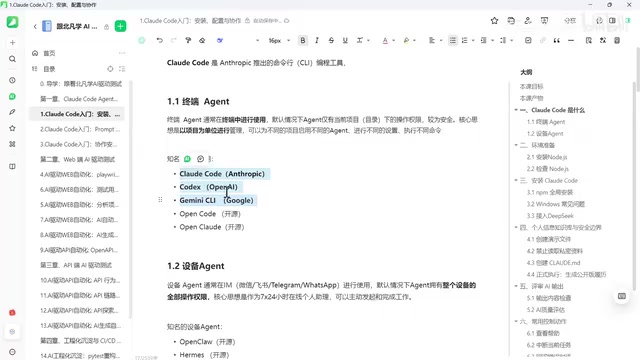
It's worth emphasizing that Claude Code is an Agent tool. Unlike traditional "one question, one answer" chat interfaces, Agents operate on a "perceive–reason–act" loop: the AI first perceives the current environment (e.g., code files, error messages), then performs multi-step reasoning and planning, and finally autonomously invokes tools (runs commands, modifies files, calls APIs) while observing the results — repeating this cycle until the task is fully complete. This architecture enables AI to truly "think independently and keep moving forward," rather than passively waiting for each user instruction. Choosing the right type of Agent is the critical first step to effectively using AI-driven coding.
Terminal Agent vs. Device Agent: The Core Difference
AI Agent tools on the market today broadly fall into two categories: Terminal Agents and Device Agents. Understanding the fundamental difference between them is a prerequisite for making the right technology choice.
Terminal Agent: Project-Scoped, Safe, and Controllable
Terminal Agents run in the command line — the preferred working style of experienced developers and power users. They have two defining characteristics:
First, they operate in the terminal via command-line interactions. Second, they are managed at the project or directory level — the AI can only operate within the currently specified directory or project, rather than taking over the entire machine.
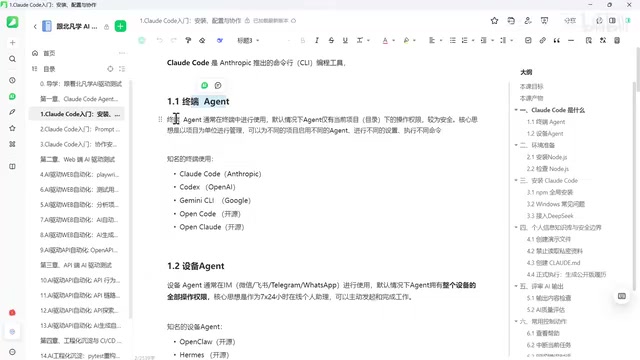
The biggest advantage of this design is safety and control. From a technical standpoint, directory-level permission isolation is essentially an engineering constraint on Agent autonomy — Agents have powerful self-execution capabilities, and confining them to a specific sandbox directory is the engineering tradeoff between capability and safety. The user always retains supreme decision-making authority over the entire device, delegating only a portion — a specific directory or project — to the AI. This aligns well with real enterprise needs: company assets simply cannot be handed over wholesale to an unpredictable AI. For this reason, Terminal Agents are the most mainstream and trusted approach in enterprise environments today.
Another benefit is flexibility: different projects on the same machine can have their own independent configurations and execution commands. The AI handles concrete execution while the human maintains overall control.
Well-known Terminal Agents include:
- Claude Code (Anthropic, uses Claude models by default)
- Codex (uses GPT models by default)
- Gemini CLI (uses Gemini models by default)
These are all tools from commercial companies, typically bundled with their own models. Open-source alternatives also exist, such as OpenCode and OpenClaude — whose names make their inspiration and positioning abundantly clear. This means you're not locked into any single commercial tool; the choice is genuinely wide open.
Device Agent: Low Barrier to Entry, But Risks Shouldn't Be Ignored
Device Agents work very differently. They typically receive instructions through IM apps (like WeChat, Feishu, or DingTalk) — you simply send a chat message, no need to open a terminal or know any command-line operations.
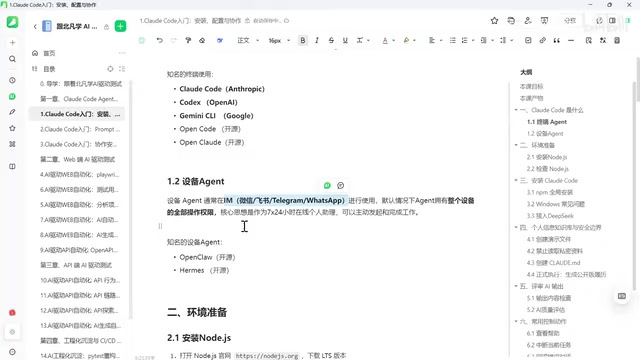
This lowers the barrier to entry significantly, but comes with notable risks. Because you may not be directly operating the machine, the AI needs to take over full permissions on the entire computer through a backend gateway to complete complex tasks. There have been cases of AI accidentally deleting system files and causing crashes, as well as risks of confidential information leakage. When OpenClaude ("Xiaolongxia") went viral, China's national security authorities issued a public warning about exactly these kinds of risks.
The core positioning of Device Agents is "personal assistant" — better suited for individual enthusiasts experimenting on their own machines, not enterprise applications. A number of companies have already formally notified employees that such tools are prohibited for use on company projects, precisely because the uncertainty of handing enterprise assets and confidential data to an AI is too high.
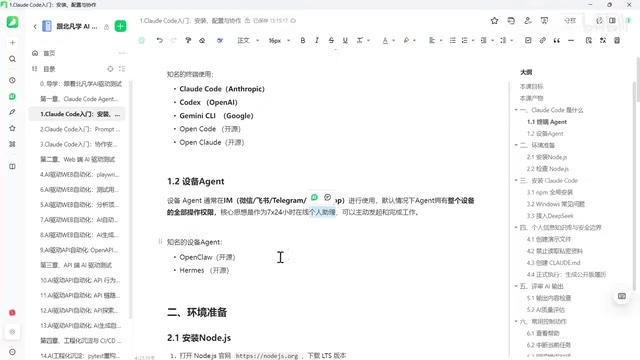
Notable Device Agents include OpenClaude ("Xiaolongxia") and the newer Elmas. The latter supports self-evolution, consuming more tokens but offering greater potential. However, continuous self-modification means high unpredictability — fine for personal experimentation, but exercise extreme caution in enterprise settings.
Why Choose the Claude Code + DeepSeek Combination
Based on the analysis above, enterprise development or serious projects should prioritize Terminal Agents with stronger controllability — preserving excellent capabilities while avoiding the risk of "waking up to a crashed system."
Choosing Claude Code among Terminal Agents comes down to the fact that it is simply excellent — as evidenced by the sheer number of open-source projects that reference and pay homage to it, and backed by strong data from the Claude model's consistent lead on SWE-bench and other coding benchmarks.
It's worth noting that while Claude Code defaults to the Claude model, in practice within China, it can be fully driven by DeepSeek as the underlying LLM. DeepSeek is a large language model series from DeepSeek AI. Its DeepSeek-V3 and DeepSeek-R1 models are on par with flagship models like GPT-4o and Claude 3.5 Sonnet across multiple coding benchmarks, yet API pricing is roughly 1/30 to 1/10 of the latter. More importantly, DeepSeek is accessible in China without a VPN, and billing is in RMB — dramatically lowering the barrier for domestic developers. Claude Code supports connecting to custom model endpoints via OpenAI-compatible format, making it possible to seamlessly integrate the DeepSeek API. This "Claude Code + DeepSeek" combination balances capability with cost, and forms the technical foundation for the hands-on examples in this tutorial.
Environment Setup: Starting with Node.js
With the technical direction settled, the next step is setting up the runtime environment. Claude Code depends on Node.js to run, so the first step is installing Node.js. Node.js is a JavaScript runtime built on the Chrome V8 engine. It was chosen as Claude Code's runtime for two key reasons: the npm/npx ecosystem is the most mainstream way to distribute command-line tools (users can complete a global install with a single command), and its asynchronous non-blocking I/O model is well-suited for handling the frequent streaming output in AI tools. It's recommended to install the LTS (Long-Term Support) version — typically an even-numbered release (e.g., v20, v22) — for better stability. If Node.js is already installed on your machine, you can skip this step.
For beginners, understanding the tool taxonomy and selection logic above matters more than rushing to type commands. Choosing the right Agent type and thinking clearly about security boundaries will make all subsequent installation, configuration, and coding work far more effective.
Summary
Claude Code, as a leading Terminal Agent, has become the mainstream choice for enterprise-grade AI coding thanks to its design philosophy of "project-scoped, safe, and controllable." The fundamental difference between it and Device Agents in terms of permission models — one keeps control with the human, the other delegates it to the AI — is the core tradeoff that must be weighed during technical selection. Anthropic's continued investment in Claude's coding capabilities and the establishment of the MCP protocol standard form the core technical moat of this tool. For developers in China, pairing it with DeepSeek is a practical path that balances capability and cost.
Key Takeaways
Related articles
Alibaba Launches Happy Shrimp: AI-Powered One-Click Complete Song Generation
Alibaba launches Happy Shrimp, an AI music generation tool that creates complete songs with lyrics, melody, arrangement, and vocals from natural language descriptions. In-depth analysis of its core features, differentiation from competitors like Suno, and industry impact.
GPT Sol Ultra vs Grok 4.6: Real-World Task Completion Benchmark in Reasoning Mode
Developer benchmark reveals GPT Sol Ultra completes draw.io scientific diagrams in one iteration while Grok 4.6 fails to converge despite maximum reasoning mode, exposing that reasoning depth ≠ task delivery capability.
OpenAI Authorship Dispute: The Battle Over Academic Boundaries in the AI Era
OpenAI disputes authorship with mathematician Tristan Buckmaster over Navier-Stokes research, raising ethical questions about AI involvement in science.