Getting Started with LLM Development: Alibaba Cloud Model Studio Setup and API Key Configuration
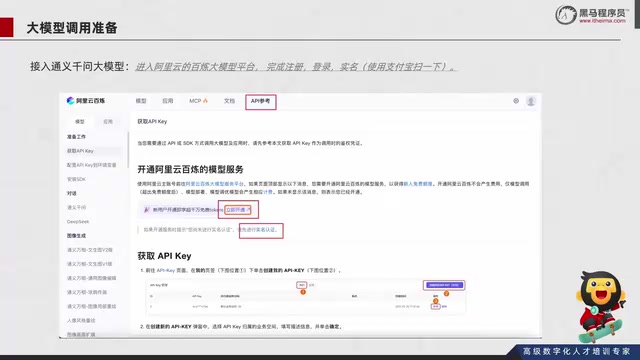
A beginner's guide to connecting LLMs via Alibaba Cloud Bailian and obtaining an API Key for RAG and Agent development.
This beginner's guide focuses on the foundational first step of LLM development: getting a model connected. It compares local deployment (running distilled models via Ollama) with cloud-based access (full-parameter models on Alibaba Cloud Bailian), recommending the cloud platform for newcomers. Using Bailian as the example, it walks through registration, real-name verification, free quota activation, and API Key creation, and explains how to leverage each model's ~1M free token quota while using the "stop on quota exhaustion" feature to avoid unexpected charges.
The First Step in LLM Development: Connecting a Model to Your Environment
When learning LLM development, the first challenge isn't mastering complex algorithms — it's getting a working model connected to your development environment. This step may seem basic, but it determines whether your subsequent RAG and Agent development can move forward smoothly.
There are two mainstream approaches: local deployment and cloud platform calls. Local deployment typically uses the Ollama framework to run distilled models like Qwen or DeepSeek directly on your own machine. The advantage is that it's free and self-contained, but personal hardware limitations mean you're usually limited to small models with 1.5B, 7B, or 8B parameters — a noticeable step down in quality compared to the full-size versions.
The second approach is to use a cloud platform, such as Alibaba Cloud Model Studio (Bailian). Cloud-hosted models are essentially always full-parameter versions, delivering a significantly better experience than local small models. While cloud calls typically involve costs, the Bailian platform provides generous free quotas that are more than sufficient for learning purposes. Weighing performance against cost, cloud platforms are the more practical choice for LLM development beginners.
Token is the basic unit for LLM billing and usage measurement. Simply put, a token is the smallest text fragment a model processes — in Chinese, 1 token corresponds to roughly 0.6–0.7 characters; in English, a single word is typically split into 1–2 tokens. One million tokens is roughly equivalent to processing 600,000–700,000 Chinese characters of input or output. For everyday learning, this quota is quite generous — a complete conversational request usually consumes only a few hundred to a few thousand tokens.
RAG (Retrieval-Augmented Generation) and Agent are the two core directions in LLM application development today. RAG combines external knowledge bases with a model, enabling it to answer questions beyond its training data. Agents give models the ability to call tools and execute multi-step tasks — such as automatically searching the web, writing code, and running it. Both directions depend on a stable, reliable model connection as their foundation, which is why the integration setup described in this article is a prerequisite for all subsequent development work.
Ollama is an open-source local LLM runtime framework that supports one-click downloading and running of open-source models on macOS, Linux, and Windows. It bundles model downloading, quantization compression, and the inference engine together, dramatically lowering the barrier to local deployment. Distilled models are lightweight versions produced by "knowledge distillation" — a technique that compresses and transfers the capabilities of a large-parameter model into a smaller one. For example, the 1.5B and 7B distilled versions of DeepSeek-R1 have far fewer parameters than the original 671B full model, yet still perform reasonably well on common tasks and can run on consumer-grade GPUs or even CPUs.
Registering on Alibaba Cloud Model Studio (Bailian)
The onboarding process for Alibaba Cloud's Bailian platform is straightforward. Open the official website at bailian.console.aliyun.com, complete registration, log in, and finish real-name verification — then a few more clicks will activate your free quota.
If you're a new account, the system will first display a service agreement; simply click to accept. You may then see an "Account Status Abnormal" prompt, which appears because new accounts require real-name verification. Click the "Go to Verify" button in the top-right corner, select personal verification, and scan the QR code with Alipay for a facial recognition check. The entire process takes just a minute or two.
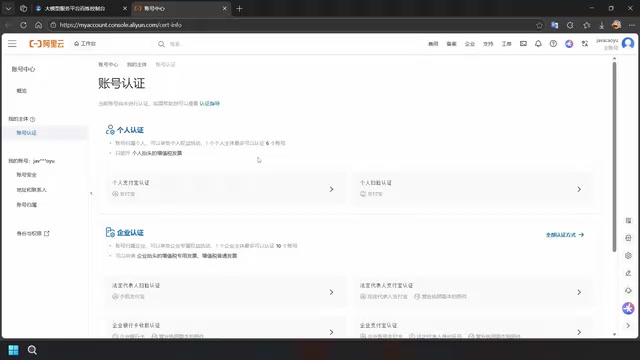
After verification, reopen the Bailian website — a pop-up will notify you of your gifted free quota. Click "Start Experience" to enter the model interface. Here you can test the account by chatting directly with models, just like using the DeepSeek or ChatGPT web interface.
Creating an API Key: Your Credential for Code-Based Access
The web chat interface is just an entry point for exploration. As a developer, the real value lies in calling models through code — and that requires creating an API Key first.
Scroll down the left-side menu on the Bailian platform to find the "API Key Management" section. New accounts have no API Keys by default. Click the create button, select your account, skip any business workspace options, and click confirm to generate an API Key string.
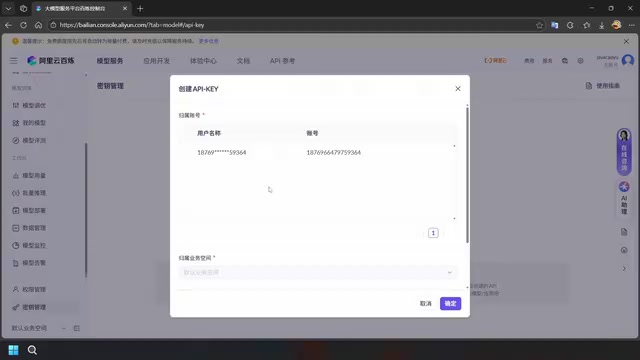
This string is your unique credential for accessing Bailian models over the network from code. Copy and save it — by including this key in your code, you can remotely call cloud-hosted models like Qwen and DeepSeek. Keep in mind that an API Key is essentially the password to your account: guard it carefully and avoid exposing it.
API Keys are fundamentally randomly generated strings used in HTTP request headers to identify the caller's identity and permissions. When your code sends a request to a cloud model, the server validates the key included in the request, then tracks usage and deducts quota accordingly. This is why a leaked API Key allows others to impersonate your account, consume your quota, or even incur charges on your behalf. Common security practices include: storing the key in your operating system's environment variables rather than hard-coding it directly into source files; and when using Git for version control, ensuring any configuration files containing the key are added to .gitignore to prevent accidental uploads to public repositories like GitHub.
Managing Your Free Quota to Avoid Unexpected Charges
Bailian's free quota is quite generous — another key reason it's well-suited as a learning foundation.
In the "Model Usage Workbench", find the "Model Usage" button and navigate to the "Free Quota" tab. This lists the available models and their remaining quotas. The platform offers a huge selection of models — according to the video demonstration, 172 models have quota available, and nearly every model offers 1 million tokens of free usage.
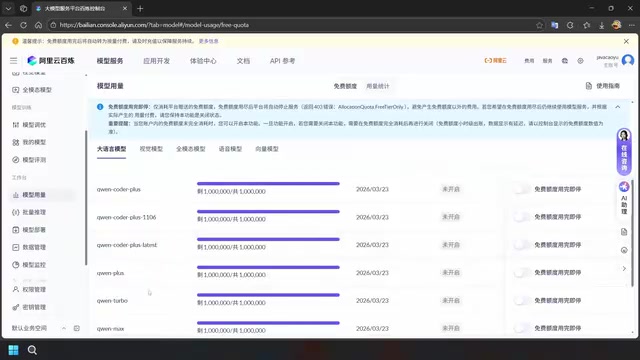
This means learners can use one model until its quota runs out, then switch to another — for example, starting with Qwen Plus, moving to Qwen Max once that's exhausted, then continuing with other models. Combined, these free quotas are more than enough to complete an entire LLM development course without paying a cent.
For users concerned about unexpected charges, the platform also provides a safety mechanism: enable "Stop When Free Quota Exhausted" on your frequently used models. Once the quota is depleted, that model automatically deactivates, completely eliminating the risk of overage charges.
Wrap-Up: Nailing This First Step
Connecting a model is the starting point of the entire development learning journey. Local deployment suits scenarios where you need complete freedom and data privacy; cloud platforms have a clear edge in model quality and ease of getting started. For newcomers, Alibaba Cloud's Bailian platform offers a low-barrier practical option thanks to its full-parameter models, generous free quotas, and straightforward onboarding process.
Once you've completed registration, real-name verification, and API Key creation, the next step is to actually call the cloud model through code and verify that the full pipeline is working — and that's the true beginning of your journey into RAG and Agent development.
Related articles
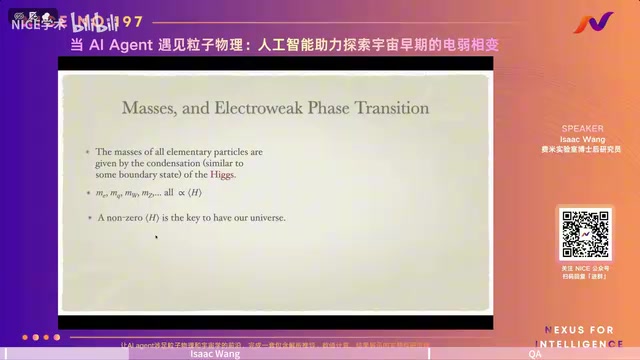
AI Agents Tackle Particle Physics: How the LEBRON Framework Computes Electroweak Phase Transitions
Fermilab postdoc Isaac Wang presents LEBRON, an AI Agent framework for computing electroweak phase transitions. Covers four LLM failure modes in rigorous physics, auditor mechanisms, and why AI hasn't revolutionized theoretical physics the way it has math.
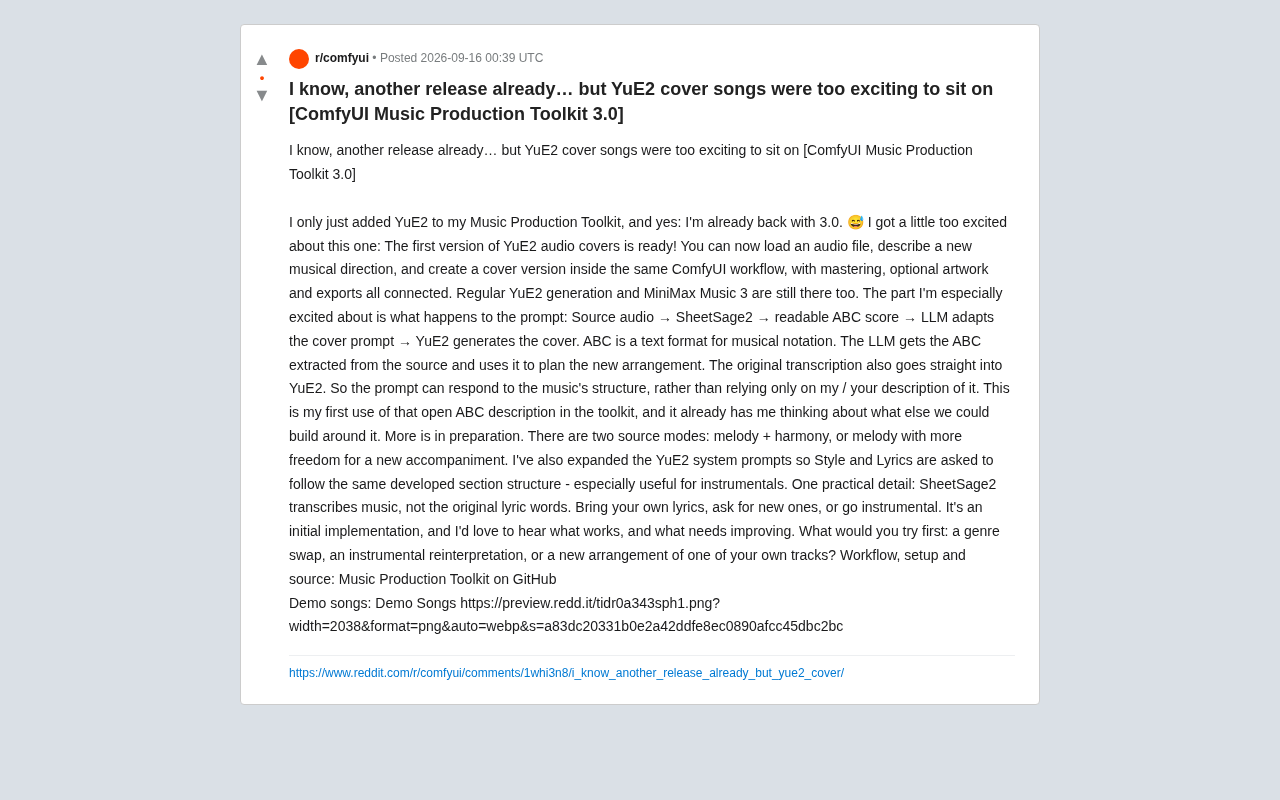
ComfyUI Music Production Toolkit 3.0: AI Arrangement with YuE2 Cover Generation and ABC Notation
ComfyUI Music Production Toolkit 3.0 adds YuE2 cover generation, transcribing source audio to ABC notation via SheetSage2 and using LLMs to rewrite structure-aware prompts for AI arrangement.
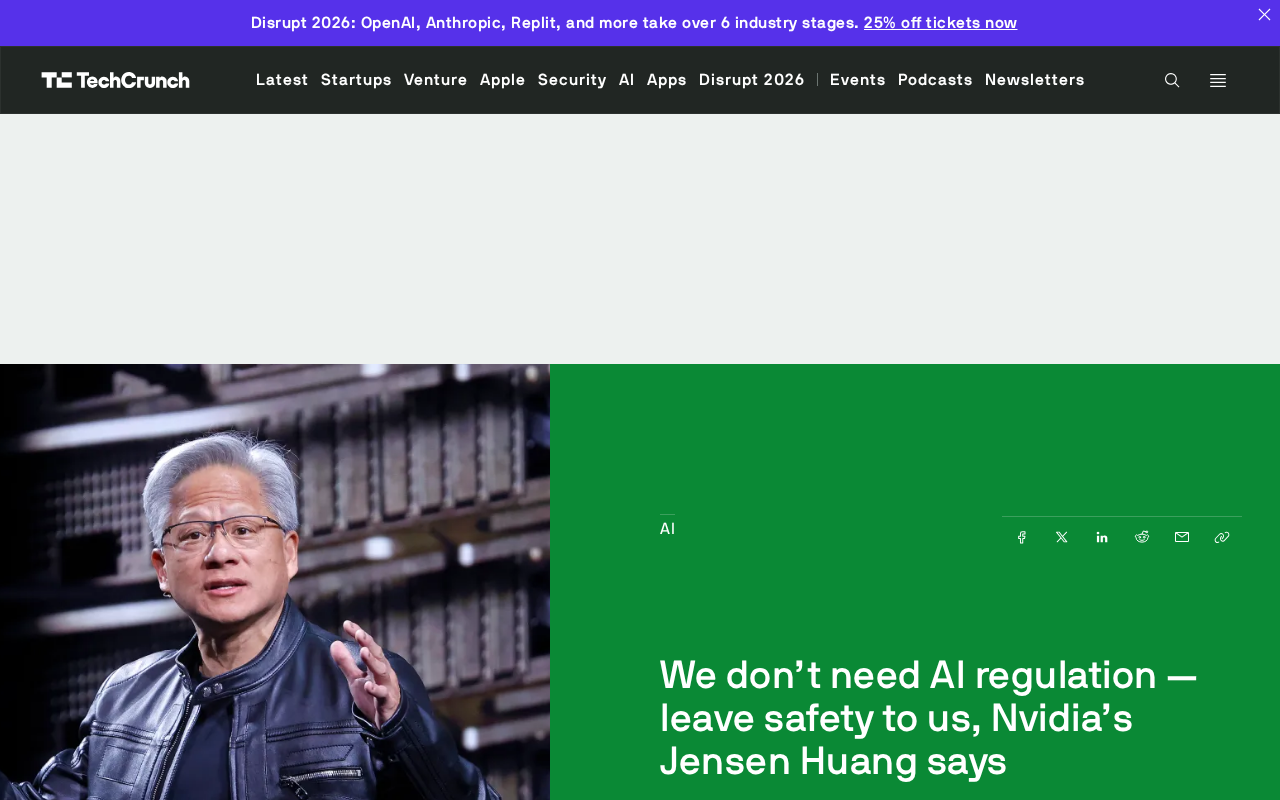
Jensen Huang Opposes AI Regulation: Safety Should Be Left to Vendors
Nvidia CEO Jensen Huang publicly opposes dedicated AI regulation, arguing AI is just hardware and software and safety should be handled by vendors. We examine the technical logic, commercial interests, and governance implications.