Getting Started with n8n: A Complete Guide to Low-Code Workflows and AI Applications

A complete beginner's guide to building workflows and AI applications with n8n's low-code platform.
n8n is an open-source, self-hostable low-code workflow automation platform that goes far beyond AI workflows. This guide breaks down its three core AI modules — AI Agent nodes, Chain nodes, and Tool nodes — and explains how to build RAG systems, with a practical learning path for developers getting started.
What Is n8n: More Than Just an AI Workflow Platform
For many people, n8n immediately brings to mind the buzz around AI workflows. But that association can actually limit your understanding of what this tool is capable of — at its core, n8n is a low-code workflow automation platform, and AI integration is just one part of its broader feature set.
Low-code platforms are a software development paradigm that emerged over the last decade, allowing developers and business users to build applications through visual interfaces and drag-and-drop components, dramatically lowering the barrier to traditional programming. Gartner has predicted that by 2025, low-code development will account for over 70% of enterprise application development activity. n8n is one of the leading tools in this wave, distinguished by its open-source, self-hostable architecture — setting it apart from commercial competitors like Zapier and Make (formerly Integromat). This means your data stays entirely on your own servers, which is particularly valuable for organizations with strict data security requirements.
Simply put, n8n lets you build automated workflows by dragging and connecting nodes in a visual interface. These workflows can have nothing to do with AI at all — for example:
- Data cleaning workflows: Automatically scrape, organize, and store data
- Video publishing workflows: Schedule or trigger content publishing
- Content analysis workflows: Crawl video links and comments for analysis
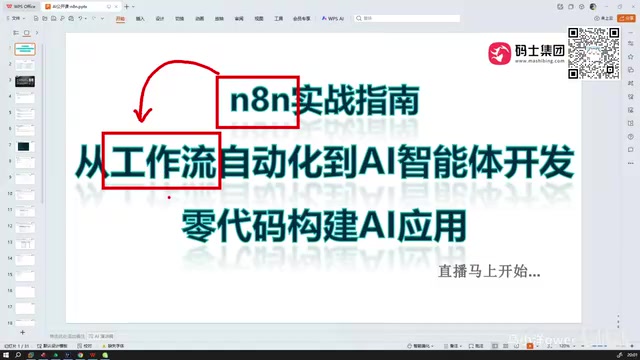
This design philosophy makes n8n a general-purpose automation engine. Think of it as the "glue layer" connecting various services and data sources — whether databases, APIs, or third-party SaaS applications, they can all be linked together through nodes to form complete automated pipelines.
n8n's Deep Integration with AI
In recent years, n8n has invested heavily in AI capabilities. As demand for AI applications has grown rapidly, n8n has deeply integrated AI into the platform, making it easier for developers to build AI Agents and RAG (Retrieval-Augmented Generation) systems.
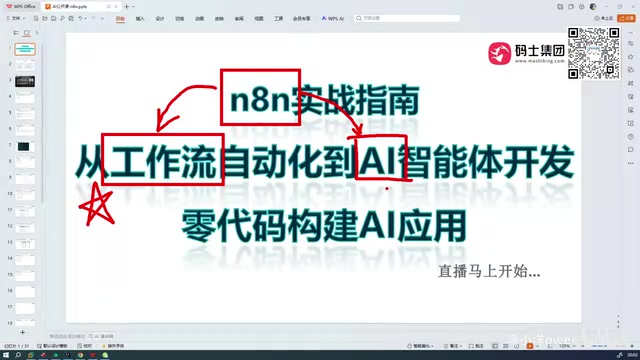
If traditional workflows represent n8n's foundational strength, AI integration is its most compelling differentiator today. For teams and individuals looking to build AI applications quickly, n8n significantly lowers the technical barrier: there's no need to write complex scheduling logic or API integration code from scratch — you can prototype an AI application simply by configuring nodes.
Mastering n8n's AI capabilities comes down to understanding three core modules. Let's break them down one by one.
The Three Core Modules of n8n + AI
The heart of n8n's AI integration revolves around three areas. Once you've grasped these three, you've got the main thread of n8n AI development.
1. AI Agent Node: The Core of Building Intelligent Agents
The AI Agent node is the central building block for creating AI agents in n8n. An agent is an AI entity that can autonomously understand tasks, invoke tools, and deliver results.

Under the hood, AI Agents are typically built on the ReAct (Reasoning + Acting) framework — a loop where the large language model alternates between reasoning and action: the model first analyzes the task and generates an action plan, calls tools to gather feedback, then adjusts its next steps based on that feedback, repeating until the task is complete. This "think–act–observe–think again" cycle gives the AI a degree of autonomy, enabling it to handle complex, multi-step tasks across different systems rather than just providing a single response.
In n8n, the AI Agent node acts as the "brain." It can connect to different large language models, receive user input, reason through the problem, and decide whether to invoke external tools to complete the task. This is the foundation for building conversational bots, automated assistants, and similar AI applications.
2. Chain Nodes: Handling Different Types of Tasks
Beyond Agents, n8n also provides a category of Chain nodes, available in three types, which also support AI integration and are suited for different task scenarios.
The design philosophy behind n8n's Chain nodes is heavily influenced by the LangChain framework. LangChain abstracts LLM calls into composable Chains, where each chain handles one deterministic task and multiple chains connect end-to-end to form a processing pipeline. Unlike the dynamic decision-making of Agents, a Chain's execution path is fixed at configuration time — making it easier to debug, more predictable in its output, and particularly well-suited for production environments where reliability is critical.
Chain nodes are oriented toward fixed-pipeline task processing. When the requirement is a clear, predictable processing path — such as text summarization, translation, or classification — Chain nodes are often more efficient and controllable than Agents. Understanding the distinction between the two and when to use each is key to getting the most out of n8n's AI capabilities.
3. Tool Nodes: Giving AI the Ability to Act
The third key area is Tool Nodes. What makes AI Agents powerful is precisely their ability to call various tools to extend their capabilities.
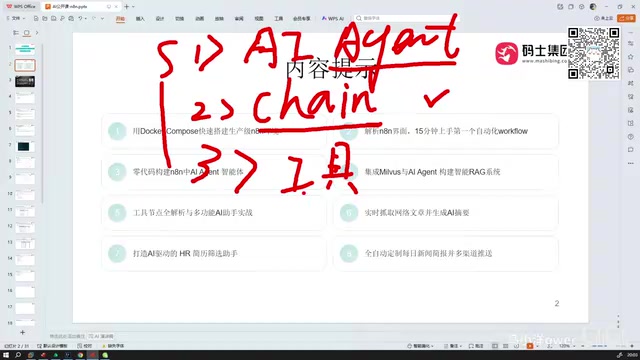
Tool nodes transform AI from something that merely "talks" into something that can truly "do" — querying databases, calling external APIs, performing searches, reading documents, and more. n8n comes with a rich set of built-in tool nodes that, when used alongside the AI Agent, enable the agent to complete complex, multi-step tasks.
How to Build a RAG System in n8n
RAG (Retrieval-Augmented Generation) is one of the most widely adopted architectures in enterprise AI applications today. Originally proposed by Meta AI in 2020, its core pipeline consists of two phases: the indexing phase (splitting documents into chunks, vectorizing them, and storing them in a vector database) and the retrieval-and-generation phase (vectorizing the user query, performing a similarity search in the vector store to retrieve the top-K relevant chunks, injecting them into the prompt, and then having the LLM generate an answer). Compared to fine-tuning large models directly, RAG is lower cost, more flexible to update, and is the dominant approach for enterprise private-knowledge Q&A systems.
The core idea is: before generating an answer, first retrieve relevant content from a knowledge base, then pass it as context to the LLM — resulting in responses that are more accurate and better aligned with the business domain.
Building a RAG system in n8n requires combining Chain nodes and Tool nodes. By configuring a sequence of nodes for document loading, vectorization, retrieval, and generation, you can assemble a Q&A system grounded in your own knowledge base — particularly useful for internal knowledge management, customer service automation, and similar use cases.
Recommended Learning Path for n8n
For developers looking to learn n8n systematically, here's a recommended step-by-step progression:
- Set up your environment: Deploy n8n locally or in the cloud and get familiar with the basic interface
- Start with basic workflows: Begin with simple, non-AI examples to understand nodes, triggers, and data flow
- Dive into AI Agents: Learn how to configure the AI Agent node and connect language models
- Explore Chain and Tool nodes: Understand the appropriate use cases for each node type
- Build a RAG system end-to-end: Tie all the concepts together through a complete project
This progression — from general workflows to AI integration — helps learners build a solid conceptual framework rather than getting lost in AI specifics from day one. Start by understanding n8n as a workflow platform, then explore its AI integrations — that's the path to truly making the tool work for you.
Summary
As a low-code automation platform, n8n is becoming a compelling choice for rapidly building AI applications, thanks to its flexible workflow capabilities and continuously maturing AI integration. By mastering the three core modules — AI Agent, Chain nodes, and Tool nodes — you can get up to speed with enterprise-grade AI application development in a relatively short time. For teams looking to reduce development costs and boost automation efficiency, n8n is well worth a deep investment in learning and practice.
Key Takeaways
Related articles

The Truth Behind Codex 'Build a Website in 5 Minutes': AI Isn't Creating Sites—It's Helping You Copy Them
Exposing the truth behind viral Codex 5-minute website videos: creators aren't building original sites with AI—they're copying shared prompts or scraping others' work. Learn AI coding tools' real limits.

Getting Started with AI Agent Development: A Complete Guide from Concept to Practice
A comprehensive guide to AI Agent architecture and development, covering automated marketing, intelligent customer service, and investment analysis scenarios with single and multi-agent collaboration.

The Truth Behind Codex 'Build a Website in 5 Minutes': AI Isn't Creating Sites — It's Helping You Copy Them
Exposing the truth behind viral Codex 5-minute website videos: creators aren't building original sites with AI — they're copying shared prompts or scraping others' work.