Getting Started with Orca: Running Multiple AI Coding Agents in Parallel with Git Worktree
Orca isolates tasks with independent Git worktrees, orchestrating multiple AI coding agents in parallel within one environment.
Orca is an open-source ADE that runs Claude Code, Codex, Cursor CLI, Gemini CLI, and other command-line coding agents simultaneously in one interface, like a command center. Its core mechanism creates an independent Git worktree per task so agents each have their own working copy, avoiding write conflicts, with humans deciding what to merge afterward. It also has a built-in editor, terminal, browser, and Git integration, plus design mode, GitHub/Linear integration, and a mobile companion app. It's free and open source but BYO for agent subscriptions. The author warns: more agents doesn't mean better software — review and engineering decisions remain essential.
Getting Started with Orca: Running Multiple AI Coding Agents in Parallel with Git Worktree
If an AI coding agent can only do one thing at a time, building a SaaS product becomes a series of waits. Video creator Raghunath Heidel's idea: let multiple agents work at once — one builds the auth system, one writes the dashboard, one integrates payments — while you orchestrate them all from a single app. The tool that carries this idea is called Orca, and he calls it an ADE (Agent Development Environment).
What Problem Does Orca Actually Solve
Orca's core positioning is clear: bring multiple AI coding agents into a single development environment. According to the video, you can run Claude Code, OpenAI Codex, Cursor CLI, Gemini CLI, and other command-line agents simultaneously. The author puts it this way — it's like the command center for your AI development team.
There's a layer worth unpacking here. Over the past year, coding agents have improved rapidly, but the usage pattern has remained essentially "one-to-one": open a terminal, give one agent a task, wait for it to finish, then check the code. Once you have many tasks, human attention becomes the bottleneck. Orca aims to address that bottleneck: not by making a single agent stronger, but by lowering the organizational cost of coordinating multiple agents.
The Claude Code, OpenAI Codex, Cursor CLI, and Gemini CLI mentioned are all command-line coding agents (CLI coding agents). Their common form: launched in a terminal, they receive natural-language instructions, autonomously read repository files, execute commands, modify code, and run tests to verify results. Unlike completion-style assistants embedded in IDEs, these agents work in units of "completing a task" — a single run may last from several minutes to tens of minutes, consuming large amounts of tokens and generating multiple rounds of tool calls. For this reason, their costs are calculated by subscription quota or API usage, and their command formats, permission models, and configuration methods differ — precisely the differences that an aggregation layer like Orca is meant to smooth out: unified orchestration at the entry point, but still reusing each agent's own underlying capabilities.
Key Mechanism: A Separate Worktree for Each Task
Orca's most notable design is that it creates an independent Git worktree for each task, giving every agent its own working copy of the project. Agents don't overwrite each other's files, and when a task is done you compare the code and decide which parts to merge.
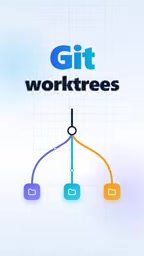
This detail may look unremarkable, but it's actually the precondition for the whole approach to work. If multiple agents share the same working directory, concurrent writes will inevitably conflict, and the merge cost will be so high that people give up on parallelism. Using worktrees for physical isolation effectively defers "conflict resolution" to after the task ends, turning it into a merge decision that can be reviewed by a human. In other words, Orca doesn't eliminate collaboration complexity — it consolidates it into a controllable point.
Beyond worktrees, Orca also provides an integrated editor, terminal, built-in browser, and Git integration. One of the more interesting features is design mode: with a single button in Orca's built-in browser, you can send an element's HTML, CSS, and visual context directly to an AI agent. For frontend tasks, this is far more precise than describing "move that button a little to the left" in words.

In addition, Orca integrates with GitHub and Linear and comes with a mobile companion app, so you can check on agent progress when you're away from your computer.
Git worktree is a feature introduced in Git 2.5 that allows multiple working trees to be checked out simultaneously on the same repository (sharing the .git directory), each corresponding to an independent branch or commit. Compared with the traditional approach of cloning multiple copies, worktrees don't duplicate the object database or re-download history, so disk and network overhead are much lower; compared with git stash or frequently switching branches, they let multiple lines of work truly run in parallel without interfering with each other. Common commands are git worktree add <path> <branch> to create, git worktree list to view, and git worktree remove to clean up. This mechanism is naturally suited to parallel agent scenarios: each agent's changes land in its own worktree and branch, the main workspace stays clean, and you decide whether to merge afterward via diff or PR review. Note that the same branch generally cannot be checked out by two worktrees at once, so creating a new branch for each task is standard practice.
Differences from VS Code and Anti-Gravity
The video makes a three-way comparison and draws the boundaries fairly clearly:
- VS Code is a general-purpose code editor; AI capabilities are extended via plugins, and isolation and orchestration between agents are not its native responsibility.
- Anti-Gravity is Google's agentic environment, covering the three surfaces of editor, terminal, and browser.
- Orca's strength lies in bringing different coding agents together through isolated Git worktrees.
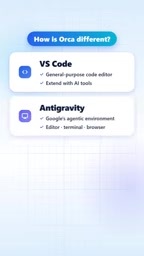
In terms of positioning, Anti-Gravity looks more like an all-in-one solution within Google's own ecosystem, while Orca takes the route of "aggregating multiple agents." For developers already using multiple CLI agents, the latter is closer to existing workflows; if you prefer an environment uniformly provided by a single vendor, the former's approach is more natural.
An ADE (Agent Development Environment) is a type of development environment designed around coding agents rather than people writing code directly, as opposed to an IDE (Integrated Development Environment). The core objects of a traditional IDE are files, editors, and debuggers, with humans always in the loop; the core objects of an ADE are "tasks" and "agent sessions," with humans playing more of a role in dispatching tasks and reviewing output. A typical ADE usually has several elements: multi-agent or session management, task-level workspace isolation, terminals and browsers that let you directly view running results, and integration with Git and issue systems. This concept currently has no unified standard, and product boundaries vary widely; Orca chooses the route of "aggregating multiple CLI agents + worktree isolation," making orchestration and isolation its main selling point rather than self-developed model capabilities.
Free and Open Source, But Agent Subscriptions Are on You
Orca itself is free and open source, but it follows a BYO model — you need to bring your own subscriptions to the various AI agents. This means there's no cost barrier at the tool level; the actual expense depends on which agents you're using and their respective price points. For teams already subscribed to multiple agents, this is essentially zero incremental cost; for individual developers just starting out, you should first weigh your subscription combination.
Parallel Isn't Automatically Better: The Author Himself Warns
There's a warning in the video worth calling out separately: more agents doesn't automatically mean better software. You still need to review code and make the final engineering decisions.
This isn't just a polite disclaimer. The direct consequence of parallel agents is faster output, but if your review capacity can't keep up, the pileup of unmerged branches and unchecked code will actually slow the project down. Worktree isolation solves file conflicts, but it doesn't solve architecture consistency, naming conventions, dependency choices, and other issues that require human judgment. What really determines whether parallelism pays off is the team's code review throughput.
The author's conclusion lands here too: don't just use AI to generate code — learn to manage AI-driven development. Tools make parallelism possible; management capability determines whether parallelism translates into output.
Who Should Try It
If you subscribe to multiple coding agents and want to push different features forward in parallel within a single interface, Orca's worktree isolation and unified orchestration are worth a try. If you currently use just one agent and your tasks aren't dense, the benefits of parallelism are limited — getting a smooth review process for a single agent in place first is probably more practical.
One-line Summary
Orca isolates tasks with independent Git worktrees, orchestrating multiple AI coding agents in parallel within one environment.
Paragraph Summary
Orca is an open-source ADE (Agent Development Environment) that runs Claude Code, Codex, Cursor CLI, Gemini CLI, and other command-line coding agents simultaneously in a single interface, orchestrating them like a command center. Its core mechanism is creating an independent Git worktree for each task, giving every agent its own working copy to avoid concurrent write conflicts, with humans comparing code and deciding what to merge after tasks finish. Orca also includes a built-in editor, terminal, browser, and Git integration; design mode can send a web element's HTML, CSS, and visual context directly to agents, and it connects to GitHub, Linear, and a mobile companion app. Compared with VS Code's plugin-based AI and Anti-Gravity's single-vendor all-in-one approach, Orca's difference lies in aggregating multiple agents. The tool is free and open source but follows a BYO model, so agent subscriptions are on you. The author reminds us: more agents doesn't mean better software — review and engineering decisions are still essential.
Related articles

AI Writes Your Code—Do You Still Need to Learn Git? Five Reasons
AI coding agents handle Git operations automatically—is it still necessary to learn Git? Five reasons: team communication, reviewing agent PRs, monitoring code changes, fallback when AI goes down, and the joy of learning—plus how the focus of learning Git is shifting in the agent era.

Anthropic Reportedly Prices IPO at $83 Per Share, Valuing Company at $1.5 Trillion
Anthropic reportedly prices IPO at $83 per share, above the expected range, with a fully diluted valuation of $1.5 trillion. This article analyzes the signal significance of the pricing and its impact on the AI industry's financing environment.

Open-Source Code Hosting Platform Codeberg Suffers Outage, Sparking Debate in Developer Community
Open-source code hosting platform Codeberg.org suffered an outage, sparking Hacker News debate over nonprofit platform stability and open-source infrastructure dependency risks.