Getting Started with Spring AI Alibaba: Prerequisites and a Fast-Track Path

Master Spring Boot 3, JDK 17+, and other Java fundamentals before learning Spring AI Alibaba—an 18-hour crash course can help.
Based on Bilibili creator Shan Shan's course, the main obstacle to learning Spring AI Alibaba isn't AI concepts but missing engineering prerequisites. The article lists the required toolkit: Spring Boot 3, JDK 17+, Maven, MySQL, Redis, and experience with at least one general LLM (like DeepSeek or Tongyi Qianwen). For developers with weak fundamentals, it recommends a free ~18-hour crash course covering Java syntax, multithreading, MySQL, SSM, Spring Boot, and microservices—completable in three days at 6 hours daily. It also outlines a sensible learning path and common pitfalls, emphasizing that solidifying the Java enterprise stack first makes Ollama local LLM integration and chatbot practice much easier.
Why You Should Care About Prerequisites
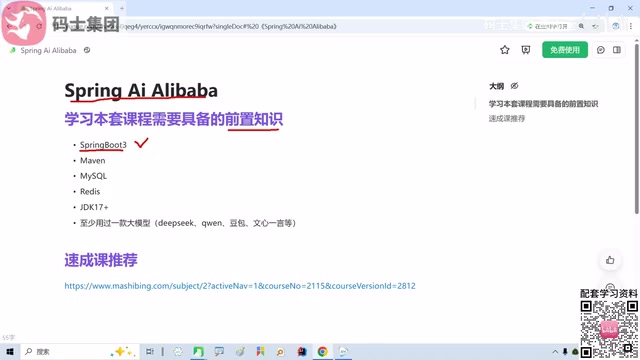
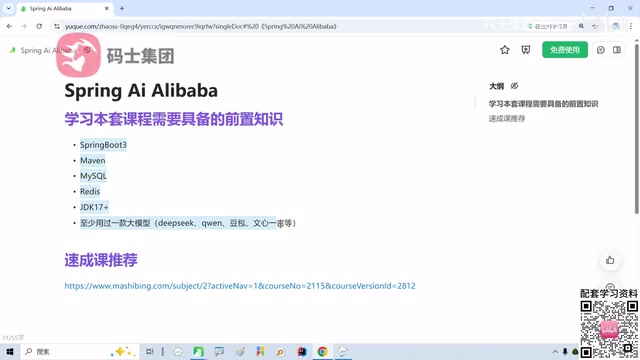
Many developers see "Spring AI Alibaba" and want to dive right in, only to get stuck on environment setup or basic concepts. At the start of her course, Bilibili creator Shan Shan explicitly states: before learning Spring AI Alibaba, you need a solid foundation in the Java ecosystem—otherwise the learning experience will suffer significantly. Her prerequisite list includes Spring Boot 3, JDK 17+, Maven, MySQL, Redis, and experience using at least one general-purpose LLM (such as DeepSeekAd, Tongyi Qianwen, Doubao, Wenxin Yiyan, etc.).
These requirements aren't harsh, but they cover the full chain from language fundamentals to frameworks, databases, caching, and LLM invocation. In other words, Spring AI Alibaba isn't an isolated technology—it's an AI integration solution built on top of a mature Java enterprise development stack.
Breaking Down the Prerequisite List
Spring Boot 3 and JDK 17+
The course explicitly uses Spring Boot 3, so the JDK must be 17 or higher. This is a hard requirement because Spring Boot 3 itself mandates Java 17 as the minimum version. If you're still on JDK 8 or 11, you'll need to upgrade your environment first.
Key changes in Spring Boot 3: Released in November 2022, Spring Boot 3's biggest change is the full migration to Jakarta EE 9+ (namespaces changed from javax.* to jakarta.*), along with a mandatory minimum of Java 17. This means older projects built on Spring Boot 2 and JDK 8/11 cannot be upgraded directly—dependencies and code must be updated in tandem. Additionally, Spring Boot 3 natively supports GraalVM native images, significantly optimizing startup speed and memory footprint. For Spring AI Alibaba, its auto-configuration and dependency management are built on Spring Boot 3 mechanisms, so environment versions must match strictly.
Build Tools and Data Layer
Maven handles dependency management, while MySQL and Redis correspond to data persistence and caching scenarios in real projects. Spring AI Alibaba sample applications often need to store sessions, configurations, or business data, making experience with these foundational components essential.
LLM Experience
You should have used at least one general-purpose LLM and understand basic concepts like API calls, tokens, and prompts. Shan Shan emphasizes that "using just one is enough"—the point is to build intuition for how LLMs interact, not to master every platform.
Token and API call basics: A token is the basic unit of text processed by an LLM, roughly analogous to a "word fragment." One token corresponds to approximately 0.75 English words or half a Chinese character, and both the model's context window and billing are calculated in tokens. Calling an LLM API typically involves: obtaining an API Key, selecting a model name, constructing a request body containing a messages array (distinguishing system/user/assistant roles), and handling the JSON response. Once you understand these concepts, configuring ChatClient and ChatModel in Spring AI Alibaba becomes much more intuitive, since the framework simply abstracts and encapsulates these low-level calls.
How to Catch Up Quickly from Zero
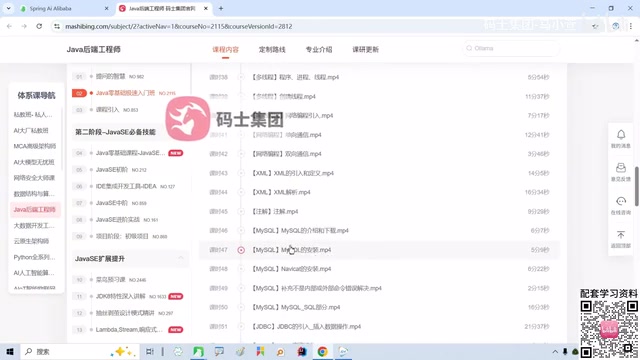
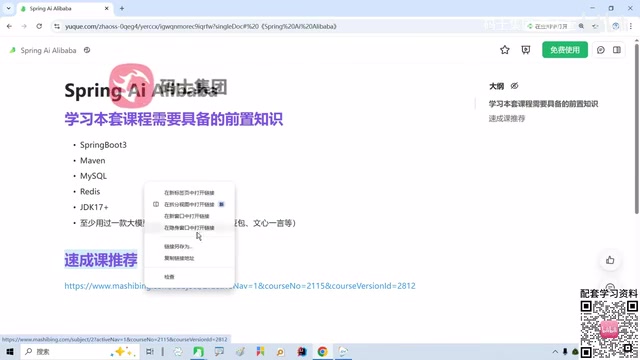
If there are gaps in the above knowledge—especially if your Java fundamentals are weak or you can't keep up with the framework—Shan Shan recommends a free crash course. The course runs about 18 hours total, starting from Java introduction, JDK installation, and IDE setup, covering basic syntax, control flow, and object-oriented programming, with a mini-project after each module.
The course also includes multithreading, network programming, MySQL, JDBC, Maven, the SSM framework, the Spring Boot framework, and supplementary microservices crash content. At 6 hours of study per day, you can complete the Java introduction in three days. For complete beginners, going through this crash course first before returning to Spring AI Alibaba makes the learning path much smoother.
Suggested Learning Path
Given the course's positioning, a reasonable path is: first confirm that JDK 17+ and Spring Boot 3 environments are ready, then use the crash course to fill gaps in Java SE and framework fundamentals, followed by getting familiar with basic Maven, MySQL, and Redis operations while trying out one LLM's API calls. Once these are done, move on to Spring AI Alibaba integration practice—such as using Ollama to connect a local LLM and building an AI chatbot—and the learning cost drops dramatically.
Shan Shan also mentions that if all prerequisites are in place, you'll be in a "worry-free state" during the course. This reminds us: the barrier to AI application development isn't AI itself—it's the solidity of your engineering fundamentals.
What Ollama does: Ollama is a local LLM runtime tool that supports deploying and running open-source models like Llama, Qwen, and DeepSeek on a personal computer without relying on cloud APIs. It provides a simple command-line interface and REST API, listening on http://localhost:11434 by default. In Spring AI Alibaba, you can point chat requests to a local Ollama service by configuring spring.ai.ollama.base-url, enabling offline, low-cost AI application development. For learners, Ollama is the lowest-barrier way to experience LLM integration, avoiding the hassle of API Key applications and network restrictions.
Common Pitfalls
Many learners hope to skip Java fundamentals and go straight to AI frameworks, only to get repeatedly stuck on dependency injection, configuration management, and database connections. Spring AI Alibaba's value lies in embedding LLM capabilities into the Spring ecosystem—if you're unfamiliar with Spring Boot's auto-configuration and Bean management mechanisms, it's hard to truly make use of it. Another pitfall is trying to learn everything at once, attempting to master all LLM platforms simultaneously. In reality, mastering one first to build calling and debugging experience makes subsequent migration costs quite low.
Conclusion
Spring AI Alibaba's learning curve comes primarily from prerequisite engineering knowledge, not AI concepts themselves. Confirming each item on Shan Shan's list, using the 18-hour crash course to fill gaps, and then moving on to Ollama local LLM integration and chatbot practice is a proven, viable path. For developers with limited time, prioritize JDK 17+, Spring Boot 3, and LLM API call experience—the rest can be filled in gradually through practice.
One-line Summary
Before learning Spring AI Alibaba, master Java ecosystem fundamentals like Spring Boot 3 and JDK 17+—an 18-hour crash course can fill the gaps.
Related articles

RePlan-VLA: Progress-Aware Replanning Breakthrough for Long-Horizon Robotic Manipulation
The RePlan-VLA framework converts VLA models' short-horizon capabilities into reliable long-horizon execution through progress-aware adaptive replanning, improving success rates by 21.9% and 10.4% on RoboCasa365 and CALVIN, and validating real-world deployment on a Franka Research 3 robot.

Geometric Bridge Flow Matching: A New Breakthrough in Blind Rigid Motion Correction
Geometric bridge flow matching enables blind rigid motion correction in head CBCT, achieving 37.1 dB PSNR and 0.27 mm RPE on simulated data in ~9.1 minutes, outperforming existing methods.

Google Releases Gemini 4 Hydrogen: 2.5x Faster Without Sacrificing Intelligence
Google releases the lightweight Gemini 4 Hydrogen: 2.5x faster task completion, AA Intelligence Index of 54 beating its flagship sibling, 7.3s single-step on Agent Arena faster than Claude and GPT rivals, four thinking levels with pay-as-you-need pricing, now available across AI Studio and more.