Ghostty: A Cross-Platform Terminal Emulator with Native UI and GPU Acceleration

Ghostty is written in Zig with native UI and GPU acceleration, and has surpassed 63,000 GitHub stars.
Ghostty is an open-source cross-platform terminal emulator written in Zig, centered on "native platform UI + GPU acceleration" and focused on speed, rich features, and cross-platform consistency. It avoids unified shells like Electron, using AppKit on macOS and GTK on Linux for a native feel, while GPU rendering reduces frame drops in log scrolling and TUI apps. Zig's manual memory management and C interoperability suit low-latency, low-level control needs. The project has over 63,000 GitHub stars and 3,800+ forks, with 556 new stars in a week. The article also notes that star popularity does not equal maturity: terminals demand extremely high stability, and Ghostty's long-term reliability still depends on iteration pace and issue response quality.
Ghostty: A Cross-Platform Terminal Emulator with Native UI and GPU Acceleration
In the seemingly stable yet fiercely competitive world of terminal emulators, Ghostty has rapidly gained significant attention with its differentiated approach of "native platform UI + GPU acceleration." This open-source project, written in the Zig language, has now surpassed 63,000 stars on GitHub, with 556 new stars added in just one week—a clear sign of its popularity.
Core Positioning: An Uncompromising Terminal Experience
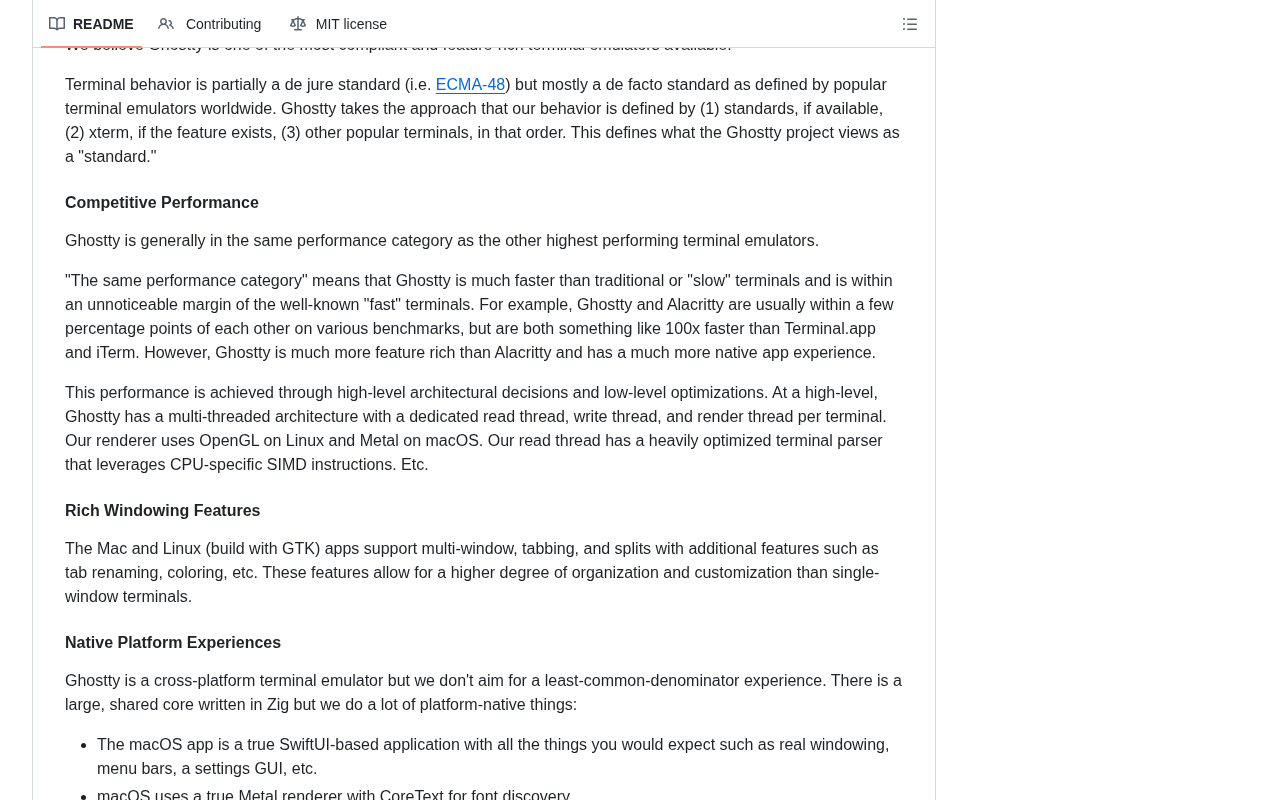
Ghostty's self-description is very direct: fast, feature-rich, cross-platform, and built with native platform UI and GPU acceleration. These three points are almost exactly the combination terminal users care about most—speed determines daily efficiency, features determine workflow ceilings, and cross-platform support determines migration costs.
Unlike many terminals that rely on Electron or custom-drawn UI frameworks, Ghostty emphasizes "native platform" design. This means that on macOS it follows system window and interaction conventions, while on Linux it integrates into the corresponding desktop environment. This strategy makes it feel and behave closer to a system-native application, reducing any sense of incongruity.
The Technical Combination of GPU Acceleration and the Zig Language
Ghostty's choice of Zig as its implementation language deserves separate discussion. Zig is known for manual memory management, compile-time execution, and clean C interoperability, making it suitable for system-level software that requires fine-grained performance control. Terminal emulators sit in a sensitive zone where they must both handle large amounts of text rendering and maintain low-latency input, and Zig's low-level control capabilities match this need precisely.
GPU acceleration directly targets the bottleneck of terminal rendering. Terminal output is essentially high-frequency character grid updates, and traditional CPU rendering tends to drop frames when scrolling through large logs or running TUI applications. Offloading rendering to the GPU can significantly improve smoothness in high-refresh-rate scenarios.
About the Zig language: Zig is a relatively young system-level programming language (its first version was released in 2016) and is often compared with C. It has no garbage collector and introduces no hidden control flow, emphasizing "explicit over implicit"—memory allocation and error handling must be written explicitly by the developer. Zig's comptime mechanism allows code execution at compile time and can be used for generics and zero-cost abstractions; at the same time, it can directly import C header files via @cImport, enabling seamless interoperability with the existing C ecosystem. These characteristics make Zig particularly suitable for scenarios sensitive to latency and memory layout, such as operating systems, databases, game engines, and terminal emulators. The trade-off is that the ecosystem and third-party libraries are not yet mature, and teams must bear more low-level work.
About the principles of terminal GPU rendering: Traditional terminals use the CPU to rasterize characters into bitmaps and then copy them frame by frame to the window, consuming a large number of CPU cycles when the character grid refreshes frequently. GPU-accelerated terminals instead pre-bake glyphs into a glyph atlas, organize the drawing of each cell into instancing or batching instructions, and submit them to the graphics pipeline in one go, thereby shifting refresh costs to the highly parallel GPU. This approach was first popularized by terminals such as Alacritty, followed by Kitty, WezTerm, and others. The main difficulties lie in handling compatibility across different GPU backends (OpenGL, Metal, Vulkan), managing texture caches, and falling back to a reliable path on low-end integrated graphics or in remote desktop environments.
Balancing Rich Features and Cross-Platform Support
In the terminal world, "feature-rich" usually means completeness in capabilities such as split panes, tabs, theme customization, font ligatures, and shell integration. Ghostty treats cross-platform support as a first-class goal, which means these features must behave consistently across different operating systems—a considerable engineering challenge.
From community feedback, the project's appeal lies not only in performance metrics but also in its attempt to find a balance between "native experience" and "modern features." Many terminals are either native but conservative in features, or aggressive in features while sacrificing system integration. Ghostty's positioning hits exactly this gap.
About the specific meaning of "native UI": A terminal emulator usually consists of two parts—the "terminal core" responsible for parsing escape sequences and maintaining the character grid, and the "shell UI" responsible for windows, tabs, and menus. Electron-based terminals (such as Hyper) use web technologies to unify the shell, which lowers cross-platform costs but increases resource usage and makes interaction details inconsistent with the system. Ghostty's approach is to make the core logic a reusable library, while the shell uses Swift and AppKit on macOS and GTK on Linux, so that menu bars, shortcuts, window animations, and font rendering all follow each platform's conventions. This "one core, multiple shells" architecture balances consistency with a native feel, but means the UI layer for each platform must be independently maintained and adapted.
What Community Popularity Means
With 63,000+ stars and 3,800+ forks, plus 556 stars added in a single week, the project has clearly moved beyond the "niche experiment" stage and entered a state with active contributors and a user base. For infrastructure software like terminals, community size directly affects plugin ecosystems, bug-fix speed, and long-term maintenance confidence.
Of course, star count does not equal maturity. Terminal emulators have extremely high stability requirements, and any rendering bug or input latency can affect production use. Whether Ghostty can turn its popularity into a long-term reliable daily tool still depends on its subsequent iteration pace and the quality of issue response.
Who Should Pay Attention
If you are a heavy user sensitive to terminal response speed and rendering smoothness, or if you appreciate native UI design and do not want your terminal to look like "just another app," Ghostty is worth adding to your watchlist. For developers interested in the Zig language who want to study a real system-level project, its code organization also provides a valuable reference sample.
One-line Summary
Ghostty is written in Zig with native UI and GPU acceleration, and has surpassed 63,000 GitHub stars.
Paragraph Summary
Ghostty is an open-source cross-platform terminal emulator written in Zig, positioned around "native platform UI + GPU acceleration" and built on three selling points: speed, rich features, and cross-platform consistency. It abandons unified shell solutions such as Electron, using AppKit on macOS and GTK on Linux to make interaction and appearance close to native system applications; at the same time, it offloads rendering to the GPU to alleviate frame drops when scrolling through large logs or running TUI applications. Zig's manual memory management and C interoperability match the terminal's need for low latency and low-level control. The project now has more than 63,000 GitHub stars and 3,800+ forks, with 556 new stars in a single week. The article also reminds readers that star popularity does not equal maturity: terminals demand extremely high stability, and whether Ghostty can become a long-term reliable daily tool still depends on its iteration pace and issue response quality.
Related articles

Qwen 3.8 Beats Opus at Coding—But Can Your Mac Run It?
Open-source Qwen 3.8 beats Opus 4.6 at coding at just 18GB, but how much Mac memory do you need? 24GB crashes; 32GB is the sweet spot. Full config guide inside.

Claude Code + Agent: Building a Fully Automated AI Testing Loop
Bilibili course breakdown: how test developers can use Claude Code terminal-based Agents to build a fully automated AI testing loop. Compares permission boundaries of terminal vs. device Agents, explains why enterprise projects choose Claude Code over Open Claude-type tools, and outlines the Node.js environment setup and DeepSeek model integration path.

Working with AI Agents Requires Nerves of Steel
The more autonomous AI agents become, the heavier the user's psychological burden. Drawing from a Hacker News discussion, this article analyzes black-box anxiety, behavior drift, and monitoring fatigue in agent collaboration, and offers practical approaches like sandbox isolation, permission control, and task granularity management to reduce cognitive load.