Git-AI: A Concurrent Commit Tool Designed for Multi-Agent Development Workflows

Git-AI uses a server-side architecture to provide concurrent commits and automatic conflict resolution for multiple AI agents.
The article introduces Git-AI, a tool recommended by Bilibili creator Lao Liao, which addresses the problem of frequent code conflicts and queuing that slow down efficiency when multiple AI agents modify the same project at the same time, and proposes restructuring the version control workflow with a server-side architecture. Its core design includes: the AI client pulls data on demand rather than cloning the entire repository, and history tracking and search are completed on the server side, thereby reducing traffic and local resource overhead; the conflict resolution method is configurable, for example, delegating to AI to decide how to merge; every change is logged, supporting auditing and backtracking. The article points out that the tool targets scenarios with intensive commits by AI agents rather than replacing humans' daily Git operations; it has currently received 1,058 favorites, but its specific implementation, open-source licensing, and performance data have not yet been disclosed, and actual results remain to be verified.
When multiple AI agents modify the same project simultaneously, code conflicts and queuing often become efficiency bottlenecks. Bilibili creator Lao Liao introduced a new tool called Git-AI, designed specifically for AI workflows, which attempts to solve the challenges of concurrent commits and conflict merging with a server-side architecture.
Why Does AI Collaborative Development Need a New Tool?
The traditional Git workflow assumes that committers are human developers, and conflict resolution relies on manual merging. When multiple AIs modify code simultaneously within a team, the frequency of conflicts and the complexity of merging rise sharply. The scenario described by the creator in the video is typical: "Several AIs modifying the same project at the same time cause code conflicts and queuing, and development efficiency gets entirely stuck at the merging step."
Git-AI's starting point is precisely to bypass this bottleneck: enabling code modified by AIs to be committed concurrently, with conflicts resolved automatically, reducing manual intervention.
The basic mechanism of Git branches and merge conflicts: Git is a distributed version control system, where each commit forms a history chain in the form of a directed acyclic graph (DAG). When two branches diverge from the same node and each produces new commits, and then attempt to merge, Git compares the differences of both sides relative to their common ancestor line by line; if the same region of the same file is modified differently by both sides, a merge conflict occurs, and a human must choose which version to keep or manually rewrite it. This approach is effective enough for low-frequency, serial commits by humans, but when multiple AI agents rewrite the same batch of files in parallel at high frequency and in short cycles, conflicts are almost inevitable, and every manual intervention interrupts the automated pipeline—this is precisely the fundamental reason why the traditional Git workflow fails in AI collaboration scenarios.
Multi-agent concurrent writes and the lock/queuing problem: Concurrent writes refer to multiple executors modifying the same shared state at almost the same time. The traditional approach is to use locks or serial queues to ensure consistency, but the cost is that later arrivals must wait, forming a queue. AI agents typically produce small batches of changes quickly according to tasks; if each change has to queue up waiting for the previous one to be merged, overall throughput is severely slowed down. Therefore, tools oriented toward AI often shift to optimistic concurrency strategies: allowing all parties to commit in parallel first, and then having the server uniformly detect conflicts and automatically merge or adjudicate them, thereby exchanging waiting cost for merging cost and using automation to minimize the latter.
How Does the Server-Side Architecture Reduce Client Burden?
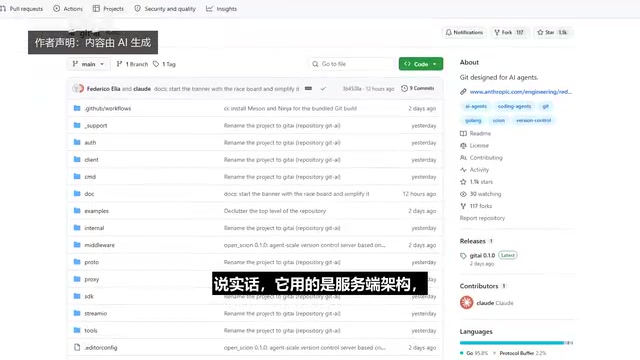
Git-AI adopts a server-side architecture, where the AI client only pulls the data it needs rather than cloning the entire repository. This design is friendlier to both traffic and local resources, and is especially suitable for AI workflows with frequent commits.
History tracking and search functions are also completed on the server side, so the client does not need to maintain a complete local history. For AI development scenarios that require rapid iteration, this lightweight client can significantly reduce synchronization overhead.
Partial clone and on-demand pulling (partial clone / sparse checkout): Traditional Git cloning copies the entire repository's object database and history to the local machine; the larger the repository and the longer the history, the higher the cost of the first clone and subsequent synchronization. Partial clone allows the client to fetch only the objects currently needed, requesting the rest from the server on demand when they are actually used; sparse checkout further limits the workspace to expanding only part of the directories. Combined, these allow the AI client to complete commits and reads without holding the full history, significantly reducing disk usage and network traffic, and also shortening the startup and synchronization wait time for each agent.
Server-side search and history indexing: If history retrieval were placed on the client side, the complete commit graph and object database would need to be stored locally; by placing search, log queries, and change tracing on the server side, the client only needs to send query requests and receive results. This centralized indexing facilitates the unified construction of inverted or path indexes, making queries faster and avoiding each client repeatedly maintaining the same copy of historical data. For AI workflows with frequent commits and frequent backtracking, this is a typical trade-off of centralizing heavy assets and distributing lightweight clients.
Conflict Resolution and Audit Tracing
Git-AI allows configuration of the conflict resolution method, for example, delegating to AI to decide how to merge. At the same time, every change is logged, making it possible to trace who did what and when.
This auditing capability is important for team collaboration: when multiple AI agents work in parallel, humans need to know the source and order of changes in order to troubleshoot problems or roll back.
Audit logs and tamper-evident tracing: Audit tracing requires the system to fully record the subject, time, content, and before-and-after state of every change, and to ensure that records are difficult to tamper with after the fact. In the context of version control, this is usually achieved through commit hash chains, append-only logs, or signing mechanisms: each change entry references the digest of the previous entry, and any modification will cause subsequent hashes to mismatch, thereby being detectable. For teams with multiple AI agents working in parallel, audit logs are not only a compliance requirement but also a prerequisite for troubleshooting and rollback—only by being able to accurately answer "which agent changed what and when" can one quickly locate the responsible change and undo it when a regression occurs, without having to roll back everything.
Applicable Scenarios and Limitations
Git-AI targets scenarios with intensive commits by AI agents, rather than replacing human developers' daily Git operations. It is more suitable for teams that have already introduced multi-AI-agent collaboration, especially projects whose pace has been slowed by merge conflicts.
Currently, this tool has received 1,058 favorites on Bilibili, indicating that many developers are interested in the direction of "Git for AI." However, the video does not mention specific implementation details, open-source licensing, or performance data, so actual results still need to be verified in practice.
Summary
The core idea of Git-AI is to place conflict resolution and version tracking on the server side, allowing AI clients to commit lightweight changes and merge automatically. For multi-agent development workflows, this may reduce the burden of manual merging, but the tool's maturity and ecosystem support remain to be seen.
One-line Summary
Git-AI uses a server-side architecture to provide concurrent commits and automatic conflict resolution for multiple AI agents.
Paragraph Summary
The article introduces Git-AI, a tool recommended by Bilibili creator Lao Liao, which addresses the problem of frequent code conflicts and queuing that slow down efficiency when multiple AI agents modify the same project at the same time, and proposes restructuring the version control workflow with a server-side architecture. Its core design includes: the AI client pulls data on demand rather than cloning the entire repository, and history tracking and search are completed on the server side, thereby reducing traffic and local resource overhead; the conflict resolution method is configurable, for example, delegating to AI to decide how to merge; every change is logged, supporting auditing and backtracking. The article points out that the tool targets scenarios with intensive commits by AI agents rather than replacing humans' daily Git operations; it has currently received 1,058 favorites, but its specific implementation, open-source licensing, and performance data have not yet been disclosed, and actual results remain to be verified.
Related articles

FunOS Lightweight Linux Review: JWM Window Manager and Blazing-Fast Installation
FunOS is a lightweight Ubuntu LTS-based Linux distro using the JWM window manager, removing Snap for blazing-fast installation. This article details its installation flow, preinstalled software, resource usage, and the Rust toolchain controversy, assessing whether it suits older hardware.

Trained Two ML Models but Forgot the Accuracy: AI Practice Lessons Behind a Self-Deprecating Post
A developer jokes about training sentiment and 59-language classifiers but forgetting accuracy and losing datasets. We analyze why personal AI projects flop and why model documentation matters.

CodeSmith Injection Defense: Constitution, Sanitization, and Approval Gates
A deep dive into CodeSmith's six-layer prompt injection defense: constitutional hierarchy, Unicode sanitization, permission ratchets, semantic command analysis, network boundaries, and output forgery prevention.