GitHub 8000+ Stars: A Deep Dive into awesome-LLM-resources — The Most Comprehensive Large Language Model Resource Collection

awesome-LLM-resources on GitHub is the most comprehensive LLM resource aggregation for the Chinese-speaking community.
The GitHub project awesome-LLM-resources (8,200+ Stars) is one of the most comprehensive LLM resource collections in the Chinese-speaking community, covering model training and inference (distributed training, quantization), multimodal generation, AI Agents and MCP protocol, AI-assisted coding, AI paper review, o1 reasoning models, small language models, and over a dozen other core areas — providing practitioners of all roles with systematic learning paths and cutting-edge technology indices.
Project Overview: Why This LLM Resource Collection Deserves Your Attention
Large Language Model (LLM) technology evolves at a breathtaking pace, and practitioners face a common pain point: high-quality resources are scattered everywhere, making it difficult to plan a systematic learning path. The awesome-LLM-resources project on GitHub was created to solve exactly this problem.
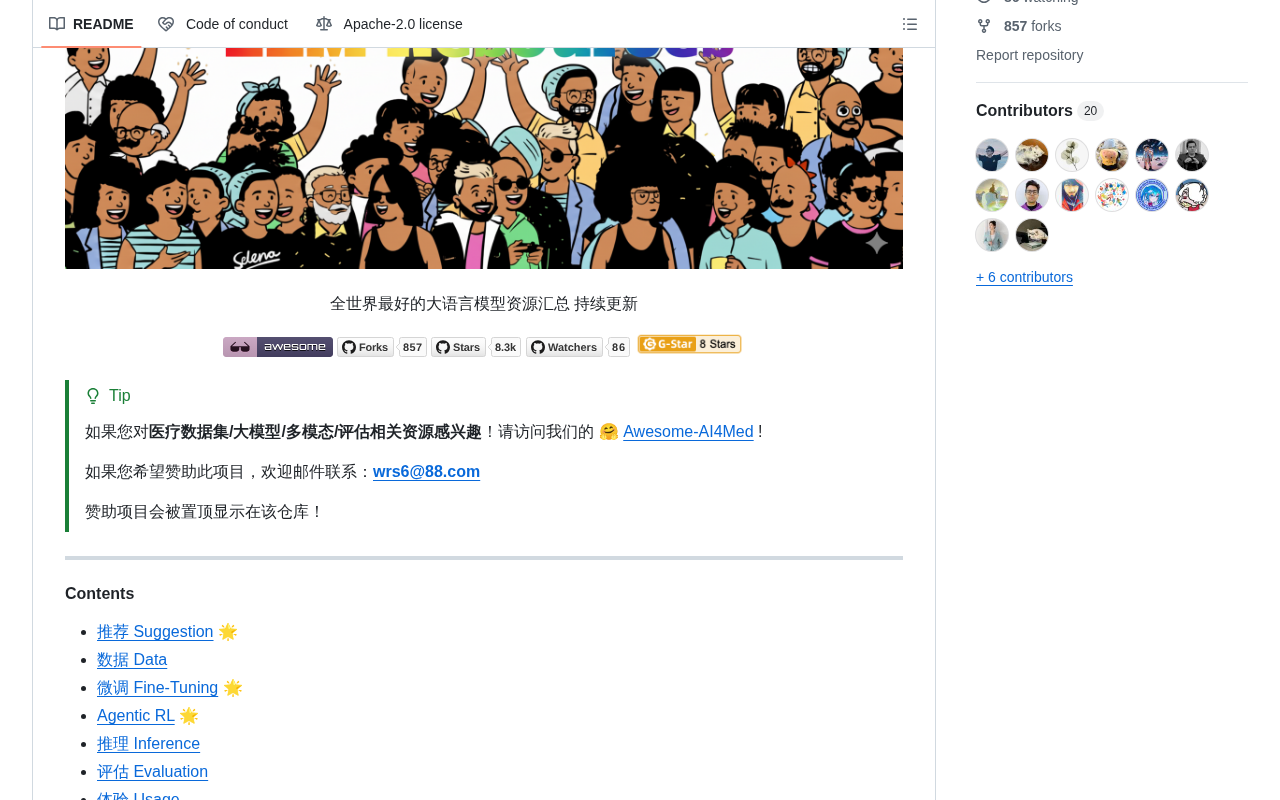
Maintained by developer WangRongsheng, the project has accumulated over 8,200 Stars and 843 Forks, making it one of the most comprehensive LLM resource aggregation repositories in the Chinese-speaking community. The project's mission is crystal clear — to create "the best LLM resource compilation in the world," covering a complete knowledge graph from foundational theory to cutting-edge applications, spanning multimodal generation, AI Agents, AI-assisted coding, AI paper review, data processing, model training and inference, and more than a dozen other core areas.
In-Depth Analysis of Core Content Sections
Model Training and Inference: The Two Pillars of LLM Development
Model training and inference are the two most critical stages in the LLM development pipeline. This section is extremely valuable for two groups: developers who want to train their own models from scratch, and engineers who need to deploy efficient inference services in production environments.
The resource library covers the complete technical pipeline:
- Pre-training data preparation and cleaning
- Distributed training framework selection (DeepSpeed, Megatron-LM, etc.)
- Model quantization and compression
- Inference acceleration and service deployment
Distributed Training: The Core Technology for Breaking Single-Machine Bottlenecks
Distributed training is the core technical approach to addressing the explosive growth in large language model parameter counts. Take GPT-3's 175 billion parameters as an example — a single GPU's memory is far from sufficient to hold the entire model, requiring model parameters, gradients, and optimizer states to be distributed across multiple GPUs or even multiple machines. DeepSpeed is a deep learning optimization library developed by Microsoft, whose core innovation ZeRO (Zero Redundancy Optimizer) technology dramatically reduces per-device memory requirements by sharding optimizer states, gradients, and parameters across different devices. Megatron-LM, developed by NVIDIA, focuses on tensor parallelism and pipeline parallelism, efficiently splitting Transformer layers across multiple GPUs for execution. The two are often combined (as in Megatron-DeepSpeed), forming a 3D parallelism strategy of data parallelism + tensor parallelism + pipeline parallelism — the mainstream approach for training models with tens of billions of parameters or more.
Quantization and Compression: Making Large Models "Travel Light"
Model quantization converts model weights from high-precision floating-point numbers (such as FP32 or FP16) to low-precision representations (such as INT8, INT4, or even lower bit widths). The core idea is to use fewer bits to approximate model parameters, thereby reducing memory footprint and computational overhead. Popular quantization methods include GPTQ (a post-training method based on layer-wise optimal quantization), AWQ (Activation-aware Weight Quantization, which differentially quantizes weights based on activation importance), and NF4 quantization provided by the bitsandbytes library. Quantization technology enables 70B parameter models — which originally required multiple high-end GPUs — to perform inference on a single consumer-grade GPU, dramatically lowering the barrier to deploying large models.
Each stage provides systematic resource indices, helping developers quickly locate the technical solutions they need.
Multimodal Generation and Vision-Language Models
In 2024–2025, multimodal capabilities have become the hottest development direction in the LLM field. The project has dedicated sections for both multimodal generation and Vision-Language Models (VLMs), tracking the latest advances from GPT-4V to various open-source multimodal models.
The core challenge of multimodal large models lies in how to unify information from different modalities (text, images, audio, video) into a shared semantic space for understanding and generation. Early approaches like CLIP used contrastive learning to map images and text into a shared vector space, establishing the foundation for vision-language alignment. The emergence of GPT-4V marked a qualitative leap in multimodal understanding, capable of handling complex chart analysis, scene understanding, and visual reasoning tasks. The open-source community subsequently produced models like LLaVA, InternVL, and Qwen-VL, which typically adopt a "visual encoder + projection layer + language model" architecture and achieve multimodal dialogue capabilities through visual instruction tuning. In 2024–2025, video understanding and generation (such as Sora) further pushed multimodal into the temporal dimension, placing higher demands on models' spatiotemporal modeling capabilities.
This section's practical value manifests on three levels:
- Systematic compilation of key papers and technical reports
- Application cases in image-text understanding, video generation, and other directions
- Links to open-source projects ready for hands-on experimentation
For researchers and developers looking to explore the multimodal direction, this is an ideal starting point.
AI Agents and MCP Protocol
AI Agents represent the core paradigm for deploying large model applications in production. The project provides a dedicated compilation of Agent-related resources, covering architecture design, tool calling, multi-agent collaboration, and more.
Particulary noteworthy is the MCP (Model Context Protocol) section. MCP is an open protocol officially released by Anthropic in late 2024, designed to standardize the interaction between large language models and external data sources and tools. Before MCP, each AI application needed custom integration code for every external service, creating an M×N complexity problem. MCP simplifies this to M+N by defining a unified client-server architecture: the model side implements an MCP client, the tool side implements an MCP server, and they communicate via standardized JSON-RPC protocol. MCP supports three core capabilities — Resources (context data provisioning), Tools (functions the model can invoke), and Prompts (predefined interaction templates). This protocol is being adopted by products like Cursor and Claude Desktop, and is poised to become the infrastructure-layer standard for the AI Agent ecosystem, analogous to HTTP's role for the Web. The project's forward-looking inclusion of this emerging protocol reflects the maintainer's keen judgment on technology trends.
AI-Assisted Coding and AI Paper Review: Two Quintessential Productivity Scenarios
At the application layer, the project focuses on two highly representative deployment scenarios:
AI-assisted coding covers evaluations of mainstream tools from GitHub Copilot to Cursor, along with best practices for code generation and code review. Developers who regularly use AI coding assistants can find numerous efficiency tips here.
AI paper review is a relatively niche topic, but extremely valuable for academics. This section collects tools and research results for using LLMs to assist in academic paper review — one of the few resources to systematically organize this vertical scenario.
o1 Reasoning Models and Small Language Models: Two Trends Worth Watching
The project also astutely captures two important technology trends:
The o1 series models represent a new paradigm for reasoning capabilities. Their core mechanism is "inference-time compute scaling" — unlike traditional models that invest all computational resources during the training phase, o1 performs deep reasoning during inference by generating long Chain-of-Thought processes, essentially trading more inference time for higher answer quality. The model internally generates numerous intermediate reasoning steps, performs self-verification and backtracking corrections, and ultimately outputs a well-considered answer. This paradigm performs particularly well on tasks requiring multi-step logical deduction, such as math competitions, code generation, and scientific reasoning. Open-source community attempts to reproduce o1 have primarily focused on two routes: reinforcement learning training (such as using Process Reward Models/PRM for MCTS search) and distillation. The project provides a dedicated compilation of the o1 series and its open-source reproduction approaches, making it easy for researchers to follow this direction.
Small Language Models (SLMs) represent the "small but mighty" technical path. SLMs typically refer to models with parameters in the low billions or less, with notable examples including Microsoft's Phi series (Phi-3 has only 3.8B parameters but matches larger models in performance), Google's Gemma 2B, and Meta's Llama 3.2 1B/3B. The rise of SLMs is driven by three industry forces: first, the explosive demand for on-device AI, where smartphones and IoT devices need to run models locally for privacy and latency; second, economic considerations around inference costs, where using small models can reduce API costs by 10–100× for many simple tasks; and third, improvements in training data quality and maturation of distillation techniques, enabling small models to inherit core capabilities from larger ones. This trend has also spawned the "model routing" architectural pattern — dynamically selecting models of different scales based on task complexity to achieve optimal balance between performance and cost. The inclusion of this section reflects the industry's shift from purely "chasing scale" to "pursuing efficiency and practicality."
Project Value and Efficient Usage Guide
Four Core Advantages
- Comprehensive coverage: From data processing to model deployment, from fundamental research to production applications, forming a complete knowledge chain
- Cutting-edge tracking: Latest technical directions like MCP and o1 are all included, with relatively frequent updates
- Chinese-friendly: Primarily in Chinese, significantly lowering the learning barrier for Chinese-speaking developers
- Active community: 8,000+ Stars means continuous community contributions and content iteration
Usage Strategies for Different Roles
Depending on your role and needs, different entry points are recommended:
| Role | Recommended Sections | Usage Goal |
|---|---|---|
| Beginners | Model Training, Data Processing | Build foundational cognitive framework |
| Researchers | o1 Models, Multimodal Generation | Track cutting-edge paper indices |
| Engineers | Model Inference, AI-Assisted Coding, MCP | Solve engineering practice problems |
| Product Managers | Agents, Application Scenarios | Understand capability boundaries and deployment directions |
Conclusion: An Indispensable Learning Map for the LLM Era
In the information-explosive LLM era, the value of a high-quality resource aggregation project cannot be overstated. awesome-LLM-resources provides the Chinese-speaking community with a rare "LLM learning map" through systematic categorization and continuous updates.
Whether you're a newcomer just getting started or a seasoned practitioner with years of experience, you'll find valuable reference materials here. We recommend bookmarking the project and periodically reviewing updated content, making it a go-to tool in your LLM learning and work.
Project URL: github.com/WangRongsheng/awesome-LLM-resources
Related articles
 Product Reviews
The Programmer's Desk Setup Guide: Building a Workspace That Feels Like Home
Discover how programmers build productive, comfortable workspaces. From multi-monitor setups to ergonomic design, explore the desk philosophy that drives focus and flow.
 Product Reviews
Qoder vs Cursor Real-World Comparison: Which $20/Month AI IDE Is Better?
Hands-on comparison of Qoder vs Cursor AI IDEs: Agent autonomy, human interaction count, and architecture decisions. Qoder needed only 2 interactions vs Cursor's 8.
 Product Reviews
Cursor Cloud Agent Demo: Eliminating Bottlenecks Across the Entire Software Development Lifecycle
Deep analysis of Cursor's Cloud Agent demo showing how cloud VMs, automated test artifacts, and a full-chain control plane systematically eliminate human bottlenecks across the software development lifecycle.