GitHub 8K Stars: Deep Dive into the Most Comprehensive LLM Resource Repository

awesome-LLM-resources on GitHub is the most comprehensive resource aggregation repository for the LLM field.
awesome-LLM-resources is a GitHub project with 8,200+ Stars that aggregates LLM resources across more than ten core directions including multimodal generation, AI Agents, MCP protocol, model training and inference optimization, o1 reasoning enhancement, and small language models. It provides learners at all stages with complete knowledge navigation from foundational theory to cutting-edge applications, serving as a structured knowledge map for the large model domain.
Project Overview
Large Language Model (LLM) technology evolves at breakneck speed, with high-quality learning resources scattered across paper repositories, blogs, code repositories, and countless other corners of the internet. Systematically accessing quality materials is far from easy. Large Language Models are deep learning models built on the Transformer architecture and pre-trained on massive text corpora, deriving their core capabilities from the self-attention mechanism's ability to model long-range semantic dependencies. Starting with GPT-3's 175B parameters in 2020, LLMs have rapidly evolved from pure text generation to multimodal understanding, and from single-turn dialogue to complex reasoning. Current mainstream technical approaches include dense models (such as GPT-4 and Claude) and Mixture of Experts models (MoE, such as Mixtral), while training paradigms have expanded from simple pre-training to multi-stage alignment pipelines incorporating SFT and RLHF.
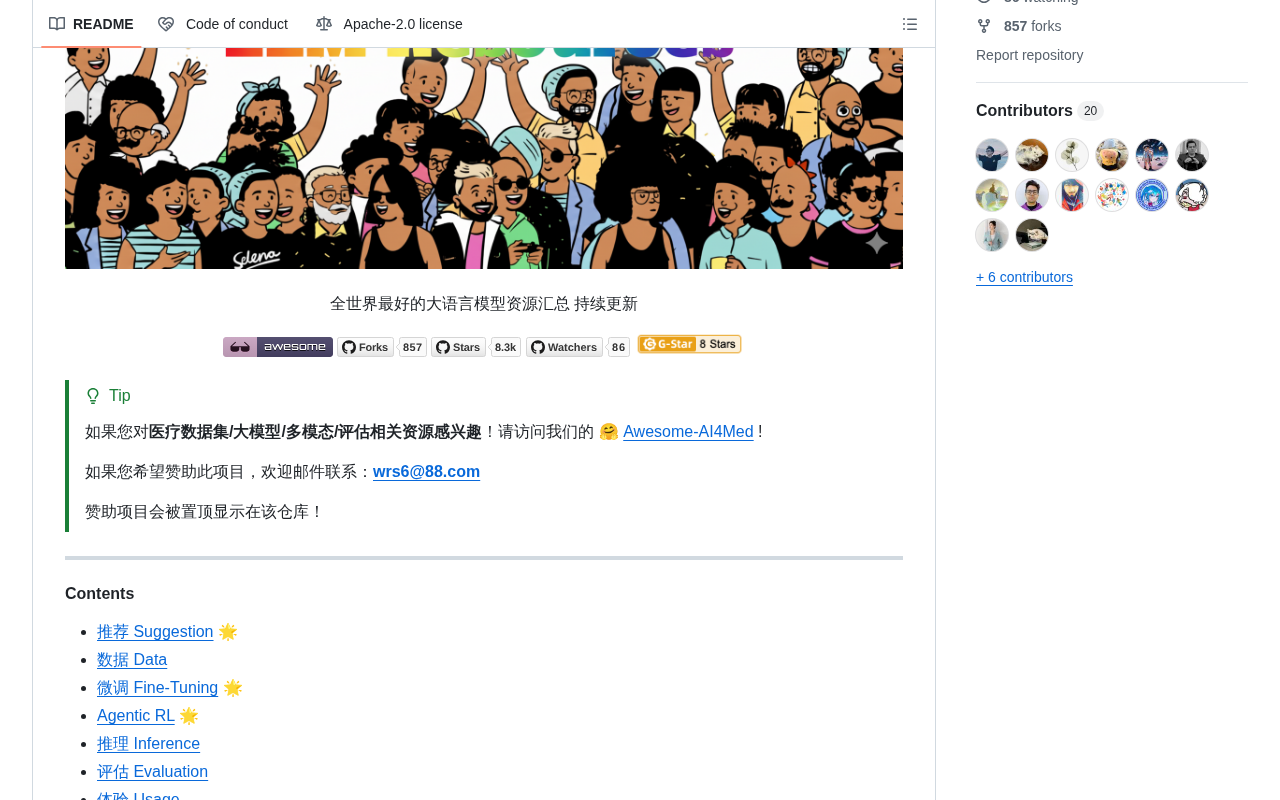
The awesome-LLM-resources project maintained by WangRongsheng on GitHub, with over 8,200 Stars and 843 Forks, has become one of the most popular LLM resource aggregation repositories—a true "encyclopedia" for the large model domain.
The project covers a complete knowledge graph from foundational theory to cutting-edge applications, spanning multimodal generation, AI Agents, coding assistance, AI-powered paper review, data processing, model training and inference, o1 models, MCP protocol, small language models, vision-language models, and more than ten other core directions, providing clear navigation paths for learners at every stage.
Core Content Sections Analyzed
Multimodal Generation and Vision-Language Models
Multimodal capability is the dominant theme in current LLM development. The core challenge of multimodal generation lies in cross-modal semantic alignment—how to make models understand the correspondence between text descriptions and visual or auditory signals. Current mainstream technical approaches include: Diffusion Model-based image/video generation (such as Stable Diffusion and Sora), visual-language alignment based on contrastive learning frameworks like CLIP, and Codec-based audio generation.
The project systematically compiles key papers, open-source projects, and tutorial resources across multimodal generation domains including text-to-image, video, and audio. Vision-Language Models (VLM) are featured as a standalone section, reflecting the visual understanding wave led by models like GPT-4V, LLaVA, and Qwen-VL. VLMs typically adopt a three-stage architecture of visual encoder (such as ViT) + projection layer + language model, and the visual instruction tuning paradigm pioneered by LLaVA has become the standard methodology in this field.
For developers looking to enter the multimodal space, this section provides a complete learning path from beginner to advanced, saving enormous time that would otherwise be spent gathering materials independently.
AI Agent and MCP Protocol
AI Agent is one of the hottest technical directions in 2024-2025. The core idea behind AI Agents is to free LLMs from being limited to text generation, instead serving as a "brain" that perceives environments, formulates plans, invokes tools, and executes actions. A typical Agent architecture contains four key modules: Planning (such as ReAct and Chain-of-Thought), Memory (including short-term working memory and long-term vector databases), Tool Use (calling APIs via Function Calling), and Action (executing specific operations and obtaining feedback). Multi-Agent collaboration introduces role division, message passing, and conflict resolution mechanisms, with representative frameworks including AutoGen, CrewAI, and MetaGPT.
The project includes core resources on Agent architecture design, tool invocation, and multi-Agent collaboration.
Notably, MCP (Model Context Protocol) is listed as a standalone section. Officially released by Anthropic in late 2024, MCP's design philosophy is similar to what the USB protocol is to hardware devices—providing a standardized interface layer that allows any LLM to connect to any external data source or tool in a unified manner. MCP adopts a client-server architecture: the MCP Host (such as Claude Desktop or IDE plugins) acts as the client initiating requests, while the MCP Server acts as the server exposing three types of capabilities: Resources, Tools, and Prompts. Compared to traditional Function Calling, MCP's advantage lies in decoupling the binding between models and tools—developers only need to write an MCP Server once, and it can be called by any MCP-supporting client, dramatically reducing integration costs for Agent applications.
This model context protocol proposed by Anthropic provides a unified framework for standardized interaction between LLMs and external tools/data sources, and is becoming critical infrastructure for building production-grade Agent applications. The fact that MCP is given its own dedicated section also indicates its rapidly rising importance in the Agent ecosystem.
Coding Assistance and AI Paper Review
These two sections demonstrate the deep deployment of LLMs in professional scenarios. The coding assistance section covers usage tips and underlying principles of mainstream tools like Cursor, GitHub Copilot, and Cline; the AI paper review section focuses on academic scenarios, compiling tools and methodologies for using large models to assist with paper writing, peer review, and literature analysis.
These vertically-focused resource compilations make the project valuable not only to model developers but also to end users who use AI tools in their daily work.
Model Training and Inference Optimization
The project's resource compilation on the engineering practice front is equally solid. Modern LLM training typically consists of three stages: Pre-training learns language modeling capabilities from massive unlabeled text; Supervised Fine-Tuning (SFT) uses human-annotated instruction-response pairs to teach the model to follow instructions; the alignment stage ensures model outputs conform to human preferences. RLHF (Reinforcement Learning from Human Feedback) trains a reward model and uses the PPO algorithm to optimize the policy—this is the classic approach adopted by ChatGPT. DPO (Direct Preference Optimization) bypasses reward model training entirely, directly optimizing the policy from preference data pairs, greatly simplifying the training pipeline with better stability, and has become the mainstream alignment method since 2024.
The model training section covers the entire pipeline including pre-training, fine-tuning (SFT/RLHF/DPO), and data engineering; the model inference section focuses on deployment optimization techniques such as quantization, distillation, and inference acceleration (vLLM, TensorRT-LLM, etc.).
On the inference optimization front, the core objective is to reduce latency and cost while maintaining model quality. Quantization reduces memory usage by converting model weights from FP16 to INT8/INT4, with representative solutions including GPTQ, AWQ, and GGUF. Knowledge Distillation transfers large model capabilities into smaller models. At the inference engine level, vLLM achieves efficient KV Cache management through the PagedAttention mechanism, boosting throughput by several times; TensorRT-LLM leverages NVIDIA GPU Tensor Cores for operator fusion and kernel optimization. Additionally, Speculative Decoding accelerates autoregressive generation through a small-model-draft + large-model-verification approach, and is another hot optimization direction.
For engineering teams that need to deploy LLMs in production environments, these resources help quickly understand mainstream training and inference optimization solutions in the industry, avoiding unnecessary detours.
o1 Model and Reasoning Enhancement
OpenAI's o1 series models pioneered the "slow thinking" paradigm, significantly improving model performance on mathematics, programming, and complex logic tasks through chain reasoning. The core innovation of o1 lies in introducing the concept of "chain-of-thought test-time compute"—the model performs extensive reasoning steps internally before generating the final answer, similar to human deep thinking processes. This paradigm breaks through the limitation of traditional Scaling Laws that only focus on training-stage compute investment, proving that investing more computation during inference can also significantly enhance model capabilities. o1 dramatically outperforms GPT-4 on tasks requiring multi-step reasoning such as math competitions (AIME) and programming (Codeforces). Open-source community reproduction attempts (such as DeepSeekAd-R1 and QwQ) indicate that training the model's reasoning process through reinforcement learning is the key path to achieving similar capabilities.
The project lists the o1 model as a standalone section, compiling related technical analyses, reproduction attempts, and open-source alternatives. Reasoning enhancement has become a crucial direction for improving large model capabilities, and this section helps researchers systematically track the latest developments in this field.
Small Language Models (SLM)
On the other side of the large model arms race, Small Language Models are becoming the core choice for edge deployment and cost-sensitive scenarios. Small language models typically refer to models with 0.5B-7B parameters, and their core technical challenge lies in maximizing model capability within a limited parameter budget. Mainstream approaches include: high-quality data curation (Microsoft's Phi series demonstrated that data quality matters more than quantity), architecture optimization (such as Grouped Query Attention/GQA to reduce KV Cache overhead), and knowledge distillation from larger models.
In terms of deployment scenarios, SLMs are suitable for mobile devices (such as the on-device models used by Apple Intelligence), IoT devices, offline environments, and real-time applications requiring low-latency responses. The popularity of tools like Ollama and llama.cpp has made running SLMs on consumer hardware extremely convenient.
The project includes resources on representative SLMs such as Phi, Gemma, and small-parameter versions of Qwen, reflecting the industry's pragmatic shift from "pursuing parameter scale" to "pursuing deployment efficiency." For resource-constrained teams and individual developers, the small language model section offers particularly outstanding reference value.
Project Value and Usage Recommendations
Why This Project Is Worth Bookmarking
- Comprehensive Coverage: From theoretical research to engineering deployment, from foundational models to vertical applications, it covers virtually every important direction in the LLM field
- Continuously Updated: The project is actively maintained, keeping pace with the latest technology trends such as MCP protocol and o1 models
- Community Validated: 8,000+ Stars of community approval means the curated resources have been screened and verified by a large number of developers
Usage Recommendations for Different Stages
- Beginners: Start with the model training and inference sections to build a fundamental understanding of the full LLM pipeline
- Intermediate to Advanced Developers: Focus on AI Agent, MCP protocol, and multimodal sections for project inspiration and technology selection guidance
- Researchers: Leverage the o1 model and vision-language model sections to track the latest academic developments and quickly locate relevant papers and open-source implementations
Conclusion
The core value of the awesome-LLM-resources project lies not only in resource aggregation but in providing a structured knowledge map for the rapidly evolving large language model field. In an era of information overload, curated projects like this can significantly reduce learning costs, helping practitioners invest their limited time in the most valuable directions.
Whether you're a newcomer to AI or a veteran engineer with years of experience, this repository is worth bookmarking and revisiting regularly.
Related articles
 Product Reviews
The Programmer's Desk Setup Guide: Building a Workspace That Feels Like Home
Discover how programmers build productive, comfortable workspaces. From multi-monitor setups to ergonomic design, explore the desk philosophy that drives focus and flow.
 Product Reviews
Qoder vs Cursor Real-World Comparison: Which $20/Month AI IDE Is Better?
Hands-on comparison of Qoder vs Cursor AI IDEs: Agent autonomy, human interaction count, and architecture decisions. Qoder needed only 2 interactions vs Cursor's 8.
 Product Reviews
Cursor Cloud Agent Demo: Eliminating Bottlenecks Across the Entire Software Development Lifecycle
Deep analysis of Cursor's Cloud Agent demo showing how cloud VMs, automated test artifacts, and a full-chain control plane systematically eliminate human bottlenecks across the software development lifecycle.