GitHub Copilot Fusion: A Multi-Model Programming Agent

GitHub launches Copilot Fusion, automatically routing and combining multiple models to collaboratively complete programming tasks.
GitHub launches Copilot Fusion to address the pain point of manually switching models in AI programming assistants. It automatically routes each task to the appropriate model and can combine multiple models into a "write—review—improve" pipeline, offering Standard, High, and Max effort tiers to balance speed, quality, and cost. Fusion covers VS Code, Copilot CLI, the Copilot app, and JetBrains IDEs, reflecting a shift from single-model competition to model orchestration, though its actual routing accuracy and cost control remain to be validated.
From Manual Model Switching to Automatic Routing
When using AI programming assistants, developers often face a tough choice: prioritize speed or code quality? Different tasks may require the capabilities of different large models, and manually switching between multiple models is not only inefficient but also disrupts workflow. GitHub's Copilot Fusion is designed to solve this pain point—it no longer requires you to pick just one model, but automatically routes each task to the appropriate model and combines multiple models to work together when needed.
Specifically, one model can be responsible for writing code, while another reviews or improves it. This "write—review—improve" pipeline upgrades quality control in AI programming from a single generation to multi-round collaboration.
Model Routing has been a key design pattern in the large-model application layer in recent years. Its core idea: instead of having users manually specify a model for each request, perform a lightweight intent or complexity assessment when the request comes in, then dispatch the request to the most suitable model based on the result. Routing strategies are typically based on signals such as task type (e.g., code completion, code refactoring, natural language Q&A), input length, latency budget, and per-call cost. Unlike simple rule matching, modern routing systems often use small classifiers or heuristic scoring to decide the route, and support on-demand escalation—calling a stronger model when a lower-tier model's confidence is insufficient. The advantage of this pattern is that it balances response speed and output quality while hiding the technical details of model selection from users, making the product experience more stable. Copilot Fusion's multi-model collaboration and effort tiers essentially add orchestration capabilities on top of the routing layer.
Three-Tier Compute Strategy: Balancing Speed, Quality, and Cost
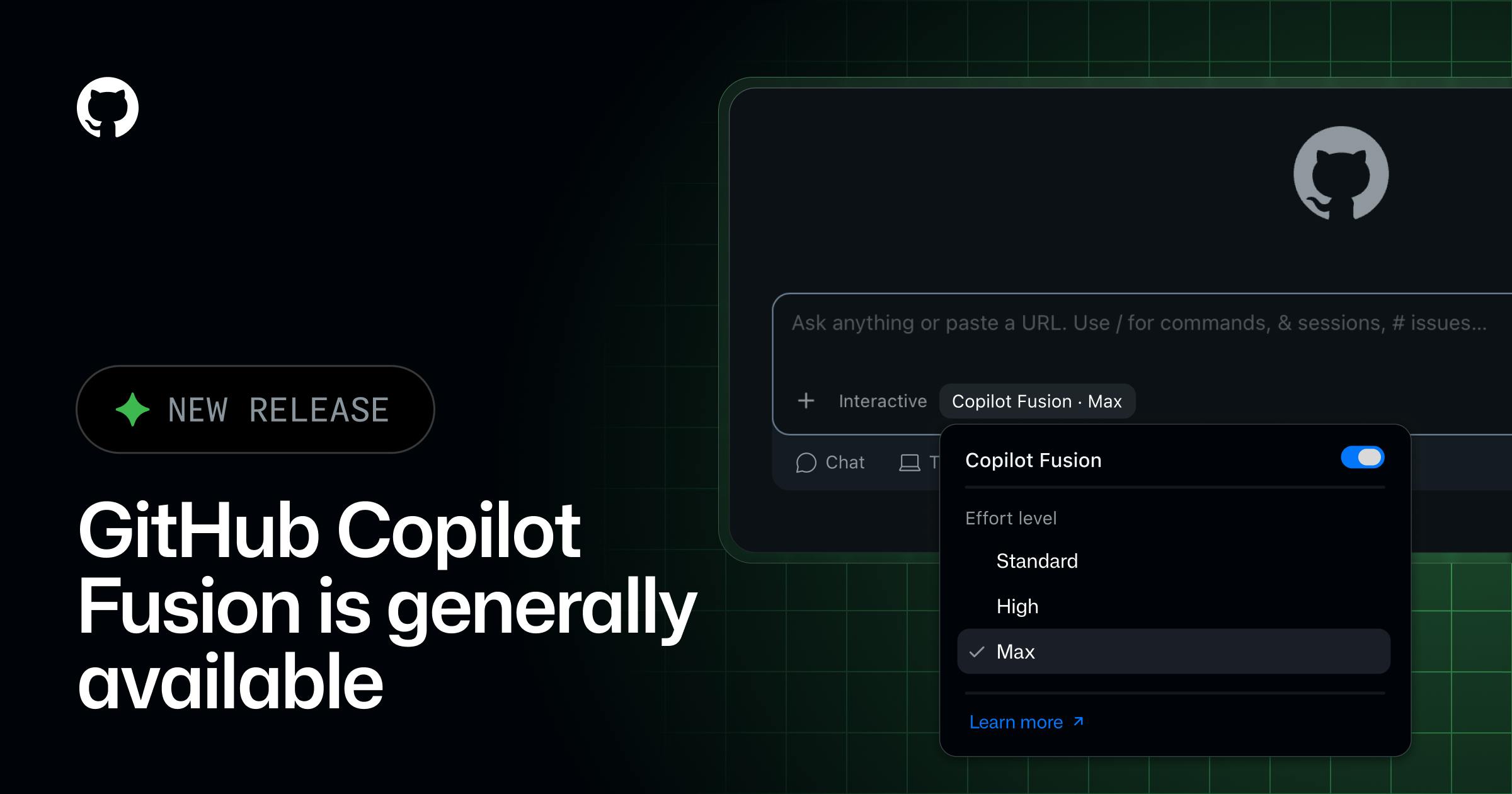
Copilot Fusion offers three effort options: Standard, High, and Max, allowing developers to flexibly balance speed, quality, and cost according to the current scenario. For simple completions or boilerplate code, a lower tier can complete the task quickly; for complex logic or critical modules, raising the effort lets multiple models participate deeply in exchange for higher code quality.
This tiered design effectively transforms the technical decision of "model selection" into a choice of "work mode," lowering the barrier for ordinary developers while also providing teams with an adjustable knob to control API call costs.
Effort tiers in AI products typically correspond to compute budget allocation during the inference phase. When the tier is raised, the system may employ various means to increase compute investment: calling larger-parameter models, having multiple models generate in parallel and then vote or select the best, allowing multiple rounds of self-checking and correction, extending chain-of-thought reasoning time, etc. These measures significantly increase token consumption and response latency, but often improve accuracy on complex tasks. Conversely, lower tiers prioritize fast, low-cost models and limit retries and multi-round interactions. For teams, effort tiers are essentially a configurable cost-control knob: default tiers can be set based on task importance, developer role, or project phase, avoiding indiscriminate use of expensive models for all requests. Understanding the compute allocation logic behind the tiers helps developers make more economical choices in daily use.
Covering Mainstream Development Environments
Fusion is not limited to a single tool. It can be used in VS Code, Copilot CLI, the Copilot app, and JetBrains IDEs, and covers all GitHub Copilot subscription plans. This means that whether you prefer coding in an editor, using the command line in a terminal, or working in JetBrains IDEs, you get a consistent multi-model collaboration experience.
For developers already subscribed to Copilot, Fusion essentially adds a layer of intelligent routing on top of their existing workflow, with no need to migrate tools or change habits.
What Multi-Model Fusion Means
From a product design perspective, Copilot Fusion reflects a trend: AI programming assistants are shifting from "single-model capability competition" to "model orchestration and workflow optimization." The strength of an individual model matters, but how multiple models are organized to collaborate on tasks may be more decisive for final development efficiency.
Automatic routing also brings a hidden advantage: developers no longer need to track the latest performance of each model on coding tasks—Fusion automatically assigns based on task type. For users unfamiliar with model differences, this reduces trial-and-error costs; for experienced developers, effort tiers preserve room for manual intervention.
Currently, the product has received 74 upvotes on Product Hunt, ranking 8th for the day, with discussion in the comments section still relatively inactive. As GitHub's new attempt in the AI programming space, Fusion's actual performance—especially the accuracy of its model combination strategy and the effectiveness of cost control—remains to be validated by more developers.
Model Orchestration refers to organizing multiple models into a pipeline with clear division of labor and data flow, rather than simply choosing between multiple models. Typical orchestration patterns include: generate—review (one model writes code, another acts as reviewer and suggests modifications), generate—test—fix (using test execution results to drive the next round of generation), and parallel sampling followed by a judge model selecting the best. The key challenges of orchestration are controlling rounds and costs, avoiding infinite self-correction loops, and ensuring that context passing between models does not lose critical information. Compared with single-model solutions, orchestration can combine the strengths of different models—for example, letting a model good at completion handle the first draft while a model with stronger reasoning checks edge cases. The "write—review—improve" pipeline described by Copilot Fusion is exactly this idea implemented at the product level.
One-line Summary
GitHub launches Copilot Fusion, which automatically routes and combines multiple models to collaboratively complete programming tasks.
Paragraph Summary
GitHub launches Copilot Fusion to address the pain point of developers manually switching models in AI programming assistants. It automatically routes each task to the appropriate model and can combine multiple models into a "write—review—improve" collaboration pipeline, upgrading quality control from single generation to multi-round collaboration. The product offers three effort tiers—Standard, High, and Max—allowing developers to flexibly trade off speed, quality, and cost, turning model selection into a choice of work mode. Fusion covers VS Code, Copilot CLI, the Copilot app, and JetBrains IDEs, and applies to all Copilot subscription plans. The article argues that this reflects a trend of AI programming assistants shifting from single-model capability competition to model orchestration and workflow optimization, but its actual routing accuracy and cost-control effectiveness remain to be validated by developers.
Related articles

Reddit Hot Post: He Actually Meant 128GB, Not 64GB
Reddit hot post 'I want him to know' corrects storage capacity in one sentence: not 64GB but 128GB, with a 😈 emoji, sparking reflection on tech community interactions.

Java Programmers Transitioning to AI Large Model Development: A Complete Guide from Beginner to Practical Application
How Java programmers can transition to AI large model development: based on a Bilibili tutorial, covering new job requirements, Spring AI and LangChain4j, core concepts like streaming output, RAG, and MCP, plus a complete learning path.

AI Agent Automated Vulnerability Discovery Workflow: From Environment Setup to Report Generation
This article explains how AI Agents restructure the vulnerability discovery workflow—from information gathering and intelligent analysis to report generation—while highlighting the pain points of the traditional three-step method, the AI collaboration model, and the irreplaceable role of human verification.