Java Programmers Transitioning to AI Large Model Development: A Complete Guide from Beginner to Practical Application

Java programmers must transition to AI large model development, master frameworks like Spring AI and core concepts, and quickly build project experience.
The article notes that Java job postings increasingly require large model experience, with AI skills shifting from a bonus to a standard. Java programmers have engineering advantages, can layer Spring AI and LangChain4j onto their existing stack, and should understand streaming output, memory caching, prompt engineering, vector databases, RAG, MCP, and Tool Calling. The instructor recommends one to two months of systematic learning and embedding large model features into existing Java projects to build resume experience, emphasizing action over anxiety.
Title
Java Programmers Transitioning to AI Large Model Development: A Complete Guide from Beginner to Practical Application
Meta Description
How can Java programmers transition to AI large model development? Based on a practical tutorial from Bilibili, this article analyzes the new requirements for large model skills in Java positions, introduces frameworks such as Spring AI and LangChain4j, outlines core concepts including streaming output, RAG, and MCP, and provides a complete learning path from the first Java AI program to resume projects.
Article Content
As the AI wave sweeps across all industries, Java programmers are facing an unavoidable skills upgrade. In the job market, more and more Java positions are beginning to require experience related to large models, and mastering tools such as Spring AI and LangChain4j is gradually changing from a bonus to a standard requirement. Based on the content of a practical tutorial from Bilibili, this article outlines how Java developers can systematically enter the field of AI large model development—from the current state of the tech stack and the necessity of transition to the path for building the first Java AI program—providing beginners with a clear introductory map.
Current Status and Challenges of the Traditional Java Tech Stack
In recent years, the mainstream tech stack for Java backend development has been relatively stable: Nginx, gateways, Nacos, distributed tracing, Redis, Elasticsearch, and various middleware and databases. Mastering the Spring Cloud ecosystem and being familiar with containerized deployment was enough to secure good opportunities in the job market. This technology combination is what the instructor calls the "traditional programmer" route.
However, the technological wind is changing. The instructor pointed out in a livestream that the internet is full of statements like "Java is finished" and "embedded systems are finished." Although such claims are often exaggerated, enterprise demand is indeed quietly shifting. According to screenshots of recruitment platforms shown by the Bilibili creator in the course, many Java positions have added AI tech stack requirements to their job requirements, such as "familiar with mainstream industry large model development platforms" and "experience in AI application development." This means that relying solely on traditional microservice skills is diluting the competitiveness of a resume.

Why Java Programmers Must Embrace Large Models
The instructor used a real group interview case to illustrate the urgency of the issue: a graduate student in a joint bachelor's-master's program at Beijing University of Posts and Telecommunications discovered during a group interview for a Java position that many competitors had large model-related projects, while he did not. When two or three out of ten people have AI project experience, the interviewer's evaluation standards rise—since some people can do it, and the company may launch related business in the future, they naturally tend to choose candidates with more comprehensive skills.
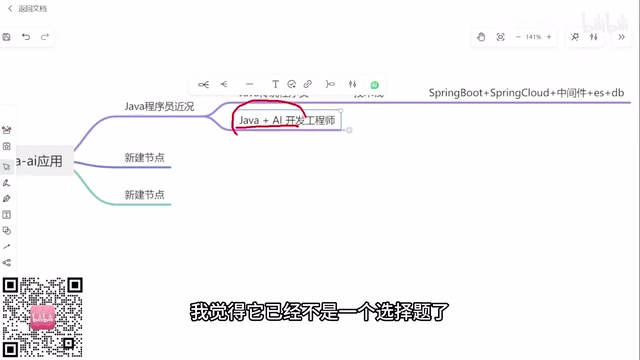
This "involution" trend means that large model skills are changing from a differentiating advantage to a basic threshold. The instructor stated bluntly that for Java programmers, turning to the AI large model direction is "no longer a multiple-choice question, but a must-do question." If a resume lacks relevant projects, it is likely to be eliminated at the initial screening stage.
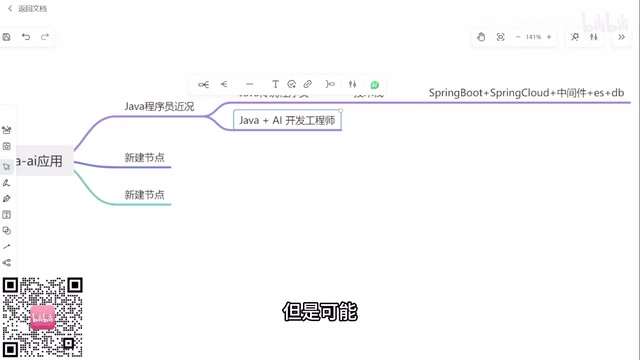
Feasibility of the Transition: The Unique Advantages of Java Programmers
Although it sounds stressful, the instructor believes that expanding AI capabilities is actually relatively simple for Java programmers. The core reason is that large model application development does not require training models from scratch; rather, it involves integrating large model capabilities into existing business systems. The engineering thinking, microservice architecture experience, and system design capabilities that Java developers already possess are precisely the important foundation for building AI applications. By simply layering frameworks such as Spring AI or LangChain4j onto the original tech stack and understanding concepts such as streaming output, memory caching, prompt engineering, vector databases, RAG, MCP, and Tool Calling, one can quickly get started.
The instructor suggests that if one can invest the time of four gym sessions per week into learning, one to two months is enough to accumulate large model project experience that can be written into a resume.
Prompt engineering is the practice of designing and optimizing input instructions to guide large models to produce desired outputs. For Java developers, prompt engineering is not "mysticism" but an engineerable skill: through methods such as templated prompts, few-shot examples, and structured output constraints (such as JSON Schema), the non-deterministic output of large models can be transformed into a format that business systems can reliably consume. Both Spring AI and LangChain4j provide prompt templates and output parsers, helping developers manage and test prompts as code assets.
Memory caching refers to the ability to maintain context in a dialogue system. Large models themselves are stateless, and each request must carry historical dialogue. A simple implementation can concatenate historical messages into the prompt, but this is limited by the context window length; better solutions include sliding windows, summary memory, and vectorized long-term memory. Java developers can use existing caching facilities such as Redis to store session history and combine them with the memory modules of frameworks to achieve coherence in multi-turn dialogues, which is crucial for scenarios such as intelligent customer service and personal assistants.
Building the First Java AI Program: Learning Path and Core Concepts
The course starts with the "first Java AI application" and designs a step-by-step route for beginners. Although the original text does not expand on specific coding steps, the knowledge framework it outlines is highly valuable for beginners:
Core Tools and Frameworks
- Spring AI: An AI integration framework under the Spring ecosystem, providing unified model invocation interfaces, prompt templates, output parsing, and other functions. It is suitable for developers familiar with Spring to quickly connect to large models.
- LangChain4j: The Java version of LangChain, supporting chained calls, memory management, tool integration, and RAG implementation, with relatively high community activity.
- Ollama: A convenient tool for locally deploying large models. The instructor mentioned that experience with Ollama deployment can be a resume highlight.
LangChain4j is a Java port of LangChain, designed specifically for the JVM ecosystem, aiming to seamlessly integrate large model capabilities into Java applications. It provides modular components such as declarative AI services (e.g., defining prompts and responses through interfaces), dialogue memory management, Tool Calling, and retrieval-augmented generation (RAG), and supports multiple model providers (OpenAI, Hugging Face, local Ollama, etc.). Compared with Spring AI, LangChain4j focuses more on chain orchestration and flexible extension, with active community iteration, making it suitable for projects that require deep customization of AI workflows.
Ollama is an open-source local large model running tool that supports one-click download and running of mainstream open-source models such as Llama, Mistral, and Gemma, and provides a concise REST API. For Java developers, Ollama can serve as a low-cost, privacy-safe development and testing environment, allowing quick verification of AI functions without relying on cloud APIs. In production environments, private models can also be deployed through Ollama to meet data compliance requirements.
Key Concepts That Must Be Understood
- Streaming output: Large models return results character by character to improve user experience, requiring handling of asynchronous data streams.
- Memory caching: Maintaining dialogue context so that the model remembers historical interactions.
- Prompt engineering: Designing effective instructions to guide model output.
- Vector database: Storing text embedding vectors to support semantic retrieval.
- RAG (Retrieval-Augmented Generation): Combining external knowledge bases to improve answer accuracy.
- MCP (Model Context Protocol): Standardizing the interaction between models and external tools.
- Tool Calling: Allowing models to call external functions or APIs to complete complex tasks.
These concepts form the basic skeleton of large model application development and are also high-frequency examination points in interviews.
Vector databases are database systems specifically designed for storing and retrieving high-dimensional vectors (i.e., numerical representations of data such as text and images). In large model applications, text is first converted into vectors through embedding models and then stored in vector databases; when a user asks a question, the system vectorizes the question and performs similarity search in the database to quickly find document fragments with the closest semantics. Common vector databases include Milvus, Pinecone, Chroma, and Redis (vector extension). It is the core infrastructure for implementing semantic search, recommendation systems, and RAG.
RAG (Retrieval-Augmented Generation) is a technical paradigm that combines external knowledge bases with large models. Its process is: first vectorize the user's question, retrieve relevant document fragments from the vector database, then concatenate the retrieval results as context into the prompt, guiding the large model to generate more accurate and traceable answers. RAG effectively alleviates the problems of large model hallucinations and outdated knowledge, and does not require fine-tuning the model, making it the mainstream solution for scenarios such as enterprise knowledge Q&A and intelligent customer service.
MCP (Model Context Protocol) is an open protocol proposed by Anthropic, aimed at standardizing the interaction between large models and external tools and data sources. It defines how models discover and call tools and obtain contextual resources, similar to a "USB interface for AI applications." Through MCP, developers can integrate tools once for reuse by different models and clients, reducing the cost of multi-model adaptation. The Java ecosystem already has MCP client/server implementations, making it easy to expose enterprise systems as AI-callable tools.
Tool Calling allows large models to dynamically call external functions or APIs during conversations. Developers predefine the descriptions and parameter structures of tools, and the model decides whether to call them and what parameters to pass based on user intent; the execution results are then returned to the model to generate the final reply. This mechanism enables AI to complete complex tasks such as real-time queries, database operations, and sending emails, and is a key capability for building intelligent agents.
How to Integrate AI Capabilities into Resumes and Projects
The instructor emphasizes that learning outcomes must ultimately be reflected in the resume. Specific strategies include: embedding large model functions into existing Java business projects, such as intelligent customer service, document Q&A, and code-assisted generation; demonstrating practical experience in calling large models using Spring AI or LangChain4j; and describing implementation details of mechanisms such as streaming output, memory caching, and RAG. The course mentions that its Java direction has accumulated nearly 20 projects, and students can select two of them and combine them with large model technology for transformation, thereby packaging a competitive "Java + AI" developer resume.
The rationality of this approach lies in the fact that what enterprises need is not AI algorithm experts, but engineering talent who can implement large model capabilities into business systems. Java developers' understanding of business logic and system architecture is precisely the key to achieving this goal.
Conclusion: Action Is More Important Than Anxiety
In the face of technological change, anxiety is an instinctive reaction, but action is the cure. The path for Java programmers to transition to the AI large model direction is clear and the threshold is controllable; the key is to start accumulating practical experience as early as possible. Starting from building the first Java AI program, gradually mastering frameworks and core concepts, and then integrating them into resume projects—this path has been proven feasible. As the instructor said, change is the only constant—only by actively embracing change can one maintain an advantage in competition.
One-line Summary
Java programmers need to transition to AI large model development, master frameworks such as Spring AI and core concepts, and quickly accumulate project experience.
Paragraph Summary
The article points out that Java job recruitment increasingly requires large model experience, and AI skills are changing from a bonus to a standard requirement. Java programmers have engineering advantages in transitioning and can layer frameworks such as Spring AI and LangChain4j onto their original tech stack, while understanding core concepts such as streaming output, memory caching, prompt engineering, vector databases, RAG, MCP, and Tool Calling. The instructor suggests investing one to two months in systematic learning and accumulating resume experience by embedding large model functions into existing Java projects, thereby enhancing job competitiveness. The article emphasizes that action is more important than anxiety, and the transition path is clear with a controllable threshold.
Related articles

9 AI Subscription Plans Compared: The Real Cost Per 100M Tokens Revealed
Bilibili creator tests 9 AI subscription plans from Volcano, Alibaba, Tencent, Baidu, Zhipu, Xiaomi, MiniMax and more, converting them all to real cost per 100M tokens, breaking down fixed-quota vs. three-tier coefficient billing and how caching, time-of-day discounts, and window limits affect actual quota.

Vibe Coding for Beginners: Expressing Intent Instead of Handwriting Code
What is Vibe Coding? A 137-episode Bilibili course defines it: the core is expressing intent, not writing code. This article analyzes Vibe Coding's productivity logic, target audience, and entry expectations to help beginners decide if it's worth learning.

LangChain Beginner's Guide: An Agent Development Roadmap from LangGraph to Deep Agents
Clarify the encapsulation relationship among LangChain, LangGraph, and Deep Agents, and master the learning path and selection logic for agent development frameworks—suitable for beginners in large model development.