GitHub Daily · August 19: The AI Agent "Memory" Revolution and the Open-Source Hardware Wave

AI Agent memory infrastructure, open-source phased array radar, and Web3-AI fusion define today's GitHub trends.
ByteDance's Volcano Engine project OpenViking tops GitHub Trending as a 'self-evolving context database' for AI Agents, signaling the infrastructure race has shifted to the memory layer. Open-source phased array radar PLFM_RADAR surges with a remarkable 1:4.3 fork-to-star ratio, showing open-source hardware is going hardcore. GenLayer's boilerplate leads daily growth at 543 new stars, reflecting the emerging Web3-AI convergence track.
GitHub Daily · August 19: The AI Agent "Memory" Revolution and the Open-Source Hardware Wave
Today's GitHub Trending presents a fascinating combination: on one side, AI Agent infrastructure continues to heat up, with ByteDance's Volcano Engine project OpenViking dominating the charts as a "self-evolving context database"; on the other side, open-source hardware projects are making a surprising surge—a low-cost phased array radar system has quietly climbed into the top ranks. Add to that GenLayer's developer scaffold from the Web3 space seeing remarkable growth, and today's trending list reads like a microcosm reflecting three main threads of the 2026 open-source world: the standardization race for the Agent memory layer, the democratization wave of open-source hardware, and the convergence exploration of Web3 and AI.
Let's break them down one by one.
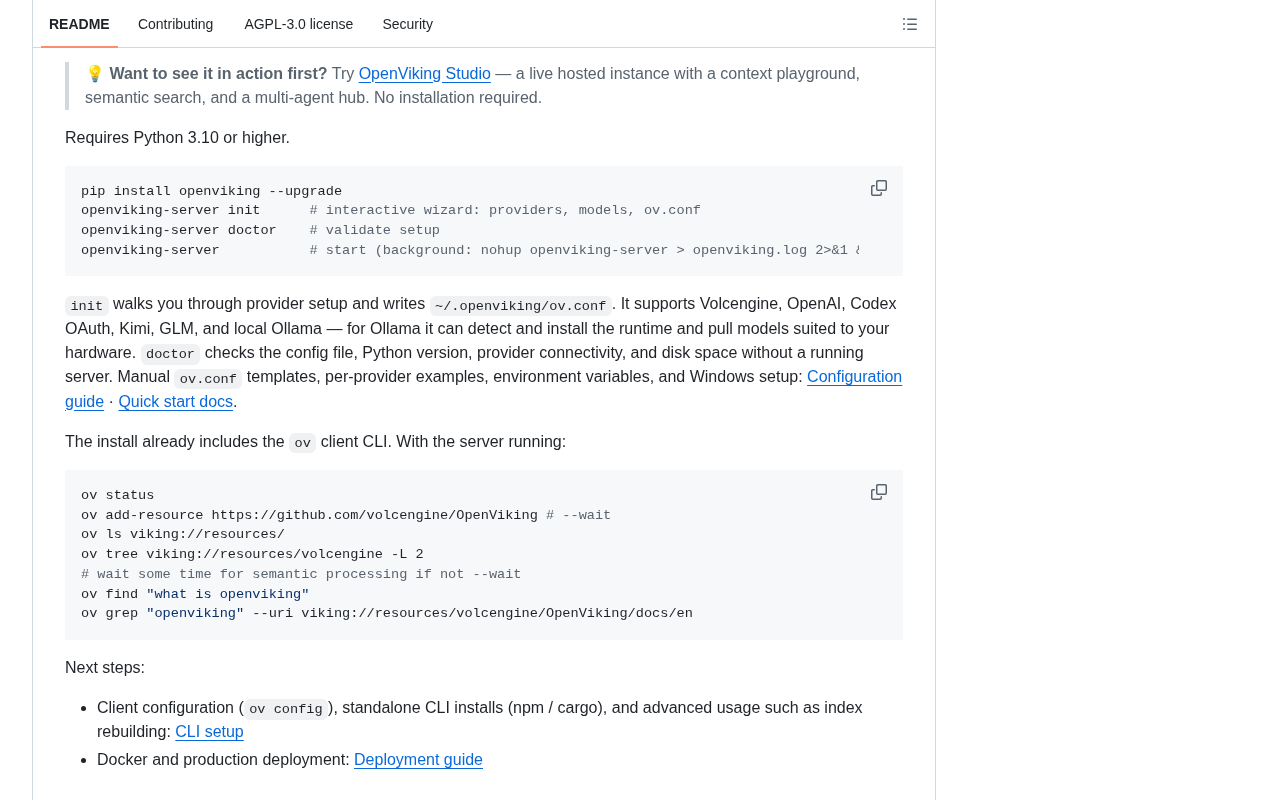
OpenViking: Giving AI Agents an "Evolving Brain"
Project Positioning: volcengine/OpenViking is a "self-evolving context database" designed for AI Agents, unifying Agent memory, knowledge retrieval (Knowledge RAG), and skills into a single system.
What problem does it solve? Over the past two years, every developer building Agents has hit the same wall: Agent "memory" is fragmented. Conversation history goes into one vector store, business knowledge uses a separate RAG pipeline, and the tool-calling experience the Agent has learned is stored elsewhere. This fragmentation gives Agents "goldfish memory"—what they learned in one session is forgotten by the next, with zero continuity across conversations. OpenViking's ambition is to completely unify these three components, providing a unified context foundation. More critically, it emphasizes "self-evolving"—the database isn't passive storage but continuously organizes, distills, and updates its own knowledge structure as the Agent interacts.
Core Features: The most noteworthy aspect is the "Memory + RAG + Skills" trinity abstraction. Instead of having developers manually assemble memory pipelines, it manages the short-term conversations, long-term knowledge, and reusable skills generated during Agent operation as a single continuum. For teams building long-lifecycle, multi-session Agents, this is a design that can significantly reduce engineering complexity.
Use Cases: Imagine an enterprise-grade customer service Agent that needs to remember each customer's historical preferences (Memory), retrieve the latest product documentation (RAG), and reuse operational workflows from past problem-solving (Skills)—OpenViking is built exactly for this type of scenario. It's equally applicable to personal assistants, coding Agents, automated operations, and any scenario that "needs to accumulate experience over time."
Tech Stack: Python, aligning with the mainstream choice in the AI ecosystem, with low integration costs for frameworks like LangChain and LlamaIndex. It's backed by Volcano Engine, meaning it has big-company engineering resources and production-ready scenarios behind it—a key reason it's been able to rapidly accumulate stars.
Data Analysis: 29,010 stars, with 239 new stars in a single day, and 2,284 forks. The fork-to-star ratio is approximately 1:12, indicating it's not just being "bookmarked and watched"—a significant proportion of developers are actually pulling it down to modify and integrate. This is a healthy signal for infrastructure-class projects. For a project with such a vertical positioning, nearly 30,000 stars represents phenomenal recognition.
PLFM_RADAR: Bringing Military-Grade Radar into the Garage
Project Positioning: NawfalMotii79/PLFM_RADAR is an open-source, low-cost 10.5 GHz PLFM (Pulsed Linear Frequency Modulated) phased array radar system.
What problem does it solve? Phased array radar has long been an "elite technology" in the military and aerospace domains, with astronomical costs and closed technical documentation keeping ordinary engineers, students, and hobbyists at bay. The most disruptive aspect of this project lies in the combination of "low-cost" and "open-source"—it turns previously inaccessible phased array technology into an open-source hardware solution that anyone motivated enough can replicate. This fills an extremely hardcore gap in the open-source hardware space: it's not another RGB light strip or keyboard, but a genuinely high-frequency RF system.
Core Features: The 10.5 GHz operating frequency combined with PLFM modulation and phased array design means it has electronic beam scanning capability—changing the detection direction without physically rotating the antenna. This is a core capability for moving target detection, velocity measurement, imaging, and other applications. Being open-source means complete schematics, PCB designs, and firmware are all available, offering tremendous educational value.
Use Cases: University-level radar and signal processing education, amateur radio enthusiast experiments, drone obstacle avoidance research, and even independent researchers' imaging experiments. It transforms "phased array radar" from a textbook term into something you can solder on your desk.
Tech Stack: The repository is labeled as PLSQL (this is most likely a GitHub language detection misclassification—RF hardware projects often contain large data tables and scripts that easily get miscategorized). The real value lies in the hardware design files and signal processing code.
Data Analysis: 24,142 stars, with 204 new stars in a single day, and 5,565 forks. Note the remarkable fork ratio—approximately 1:4.3, far higher than the vast majority of software projects! This is a typical characteristic in open-source hardware: everyone who actually wants to build the radar must fork the repository to adapt it to their own components and PCB manufacturer. Such a high fork rate strongly indicates this is a project "being extensively practiced hands-on" rather than merely riding topic hype.
GenLayer Boilerplate: Paving the Way for "Smart Contracts + AI"
Project Positioning: genlayerlabs/genlayer-project-boilerplate is the official project scaffold for the GenLayer platform, helping developers quickly bootstrap applications based on GenLayer.
What problem does it solve? GenLayer represents a new direction in the Web3 space—"smart contracts" no longer just execute deterministic logic but can call large language models and incorporate non-deterministic AI judgments. The programming paradigm of this new type of blockchain is unfamiliar to developers, and setting up an environment from scratch has a high barrier. The boilerplate packages best practices, directory structure, and dependency configurations together, letting developers "clone and go," focusing their attention on business logic.
Core Features: As an official scaffold, its value isn't in complex functionality but in being a "standard starting point." It defines what projects in this new ecosystem should look like, serving in some sense as the front door to the GenLayer developer experience.
Use Cases: Any developer wanting to experiment with building "AI-native smart contracts"—such as decentralized applications that automatically arbitrate based on natural language agreements, AI oracles, intelligent arbitration systems, and more.
Tech Stack: TypeScript, the standard language for Web3 frontends and toolchains, very friendly for developers familiar with modern frontend and the Node ecosystem.
Data Analysis: 15,703 stars, but with a single-day increase of 543—the fastest daily growth rate on today's trending list! This kind of explosive growth usually indicates a concentrated wave of community activity behind it: possibly an incentive program, hackathon, or airdrop expectations. The relatively low 791 forks contrasting with high stars suggests that currently more people are "watching and waiting," and the actual developer hands-on rate still needs time to prove out. This is a common pattern for Web3 projects—hype leads, delivery follows.
Today's Trend Observations: The Intersection of Three Main Threads
Looking at these three projects together reveals several deep signals about the 2026 open-source world.
First, Agent infrastructure has entered the "memory layer" race. In 2025, everyone was competing on Agent frameworks and orchestration (whose workflow is more flexible). By 2026, the battlefield has descended to the more fundamental level of "memory and context management." OpenViking's rise to the top shows that when model capabilities (GPT-5, Claude Fable 5) are no longer the bottleneck, what truly determines the upper limit of Agent capability is whether it can continuously accumulate and recall experience. Whoever defines the Agent memory standard controls the gateway to the next-generation Agent ecosystem.
Second, open-source hardware is going "hardcore." PLFM_RADAR hitting the trending charts is a landmark event—open-source hardware is no longer satisfied with consumer-grade toys and is advancing into high-barrier domains like RF and radar. Behind this is the global maturation of the engineering community, along with the proliferation of low-cost PCB manufacturing and open-source EDA toolchains. The "democratization" of hardware is replicating from software into the physical world.
Third, Web3 is searching for its convergence point with AI. The "AI-native blockchain" that GenLayer represents is an attempt to merge two hot narratives. While its sustainability remains to be observed, it reflects the Web3 community actively blazing trails for new paradigms like "smart contracts calling AI."
Notably, the three projects come from a big tech company (Volcano Engine), an independent developer (the radar author), and a startup (GenLayer Labs) respectively. This diverse power structure is the best embodiment of open-source ecosystem vitality.
Today's Must-See TOP 3
🥇 First Place: OpenViking — If you're building any form of AI Agent, this unified memory layer is almost a must-see project. It represents the latest evolutionary direction of Agent infrastructure, with big-company backing ensuring high deployment reliability.
🥈 Second Place: PLFM_RADAR — A gift for all hardware geeks and signal processing learners. Turning military-grade phased array radar into a low-cost open-source solution is itself a victory of engineering spirit, with irreplaceable educational and experimental value.
🥉 Third Place: GenLayer Boilerplate — Suited for early movers watching the Web3-AI convergence direction. While the ecosystem is still in its early stages, the 543 daily star growth rate is worth continuous tracking—it may signal the beginning of a new track.
Looking Ahead: Today's trending list is like a prism, refracting the multi-threaded progress of the 2026 open-source world—AI Agents deepening into foundational memory infrastructure, open-source hardware breaking through into hardcore domains, and Web3 seeking new narratives through its collision with AI. Regardless of which field you're in, all three projects are worth spending time to study in depth. See you tomorrow.
Related articles

Hands-On with Claude Opus 5: Why It's Become My Go-To Coding Model
Based on developer Theo's hands-on testing, a deep analysis of Claude Opus 5's cost-efficiency, distillation tech, coding capabilities, and model selection advice.

How to Draw CNN Neural Network Architecture Diagrams? A Complete Guide to Tools and Methods
A systematic guide to drawing professional CNN architecture diagrams using mainstream tools like NN-SVG, PlotNeuralNet, Netron, and torchviz for papers and projects.

The AI Watermark Detection Challenge: Why You Almost Can't Spot Watermarks in LLM Output
Explore LLM text watermarking through an interactive Hacker News challenge. Learn how modern watermarks work, why humans can't detect them, and what this means for AI content governance.