The AI Watermark Detection Challenge: Why You Almost Can't Spot Watermarks in LLM Output

An interactive challenge reveals why AI text watermarks are virtually invisible to humans.
A Hacker News interactive project challenges users to identify watermarked LLM outputs, revealing that modern text watermarking—embedded through statistical manipulation of token sampling probabilities—is virtually undetectable by humans. The article explores how techniques like Kirchenbauer's green/red list scheme and Google's SynthID-Text work, the stealth-vs-robustness dilemma, and why watermarking must complement other tools like C2PA for effective AI content governance.
A Seemingly Simple Challenge with Hidden Depths
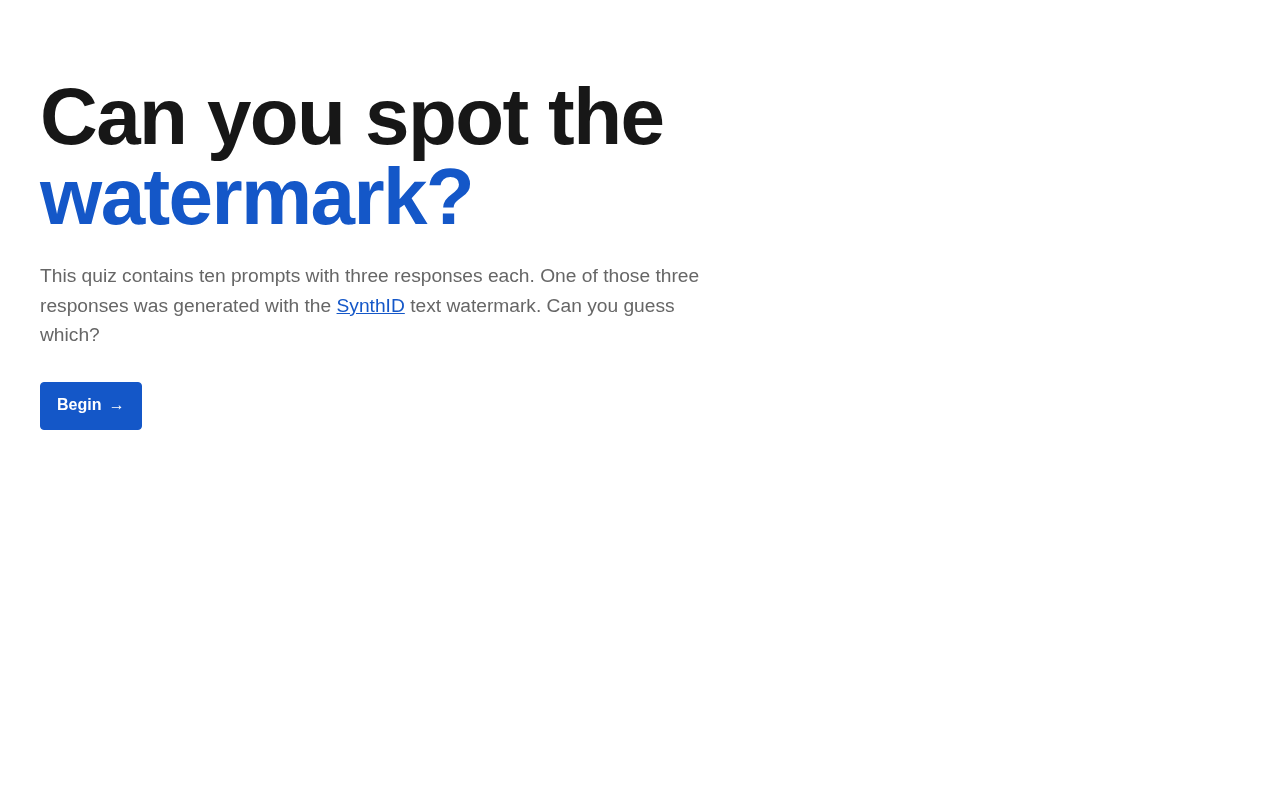
Recently, a thought-provoking interactive project appeared on Hacker News — "Guess which of these LLM outputs is watermarked." Through an intuitive challenge, the project lets users experience firsthand just how stealthy and difficult to detect modern AI watermarking technology really is.
The core gameplay is straightforward: the system presents multiple passages of text generated by a large language model (LLM), some of which have invisible statistical watermarks embedded in them. Users must rely on their eyes and intuition to determine which passage has been "marked." Yet it's precisely this seemingly simple task that exposes a critical fact — modern text watermarking technology is virtually imperceptible to humans.
How LLM Text Watermarking Works
A Signature Hidden in Probability Distributions
Unlike image watermarking, the technical challenge of text watermarking lies in the fact that text is a discrete, information-dense medium. Current mainstream LLM text watermarking approaches (such as Google DeepMind's SynthID-Text and the widely discussed scheme by Kirchenbauer et al.) don't simply insert special characters into the text. Instead, they embed statistical signals by manipulating the token sampling probability distribution during generation.
To understand this, you first need to know how large language models generate text. LLMs essentially perform word-by-word prediction. At each step, the model computes a probability distribution over all possible tokens in its vocabulary, then samples from this distribution to select the next token. For example, after the phrase "The weather today is very," the model might assign 30% probability to "nice," 25% to "hot," and so on. Sampling strategies (parameters like temperature, top-k, top-p, etc.) affect the degree of randomness in the final selection. Watermarking technology exploits exactly this controllability in the sampling process — subtly adjusting the probability distribution to embed a traceable statistical signal without significantly degrading output quality.
Specifically, when generating each token, the watermarking algorithm uses a hash of the preceding context to pseudo-randomly partition the vocabulary into a "green list" and a "red list," then slightly boosts the probability of green-list tokens being selected. The impact on any individual word is negligible, but across an entire passage, it creates a statistical pattern that algorithms can detect but human eyes cannot.
The classic implementation of this approach comes from a 2023 paper by Kirchenbauer et al. at the University of Maryland, titled A Watermark for Large Language Models — a landmark work in the field. The core idea is: when generating the t-th token, the algorithm uses the (t-1)-th token (or the preceding few tokens) as a seed for a pseudo-random number generator to pseudo-randomly partition the entire vocabulary into green and red lists. It then adds a fixed bias δ (typically between 1 and 2) to the model's original logits (unnormalized log-probabilities) for all tokens in the green list, followed by softmax normalization and sampling. Because this bias is relatively small, when the model already has high confidence in a particular token, the watermark barely changes the output; only at positions where the model is more uncertain does the green-list preference have a substantive effect.
Meanwhile, Google DeepMind's SynthID-Text, officially released in 2024, takes a more elegant approach. Unlike the Kirchenbauer scheme, SynthID-Text uses a Tournament sampling strategy that embeds the watermark signal through "tournament-style" comparisons among multiple candidate tokens, rather than directly modifying the probability distribution. The advantage of this method is that it has less impact on output text quality and can be theoretically proven, under certain conditions, to not alter the model's original output distribution (so-called distortion-free watermarking). Google has integrated SynthID-Text into its Gemini model family, making it one of the largest-scale deployed text watermarking systems in industry.
Watermark Detection Relies on Statistical Analysis, Not Human Reading
Precisely because watermarks are embedded at the statistical level, detecting them also requires specialized algorithmic tools rather than human reading judgment. The detector determines whether a text has been watermarked by checking whether the frequency of "green list" tokens is significantly higher than what would be expected by chance. This explains why most people "can't guess correctly" in this Hacker News challenge — because the watermark was designed from the outset to be completely invisible while preserving text quality.
Why AI Text Watermarking Matters So Much
Addressing the Flood of AI-Generated Content
With the widespread adoption of models like ChatGPT, Gemini, and Claude, AI-generated text has permeated every domain from news and education to social media. How to distinguish human-created content from machine-generated content has become an urgent societal issue. Text watermarking is regarded as one of the key technical approaches to solving this problem, helping with:
- Academic integrity: Identifying AI-ghostwritten content in student assignments or papers
- Information provenance: Tracing disinformation and AI-generated propaganda
- Platform governance: Helping content platforms flag and manage AI-generated content
- Model accountability: Providing AI companies with verifiable content attribution
The Dilemma Between Stealth and Robustness
However, this challenge project also indirectly reveals a core contradiction in watermarking technology. On one hand, watermarks must be sufficiently stealthy — they cannot degrade text quality or be easily detected. On the other hand, watermarks must be sufficiently robust — able to withstand paraphrasing, translation, partial deletion, and other attacks.
Research has shown that when users heavily paraphrase watermarked text or use another model to rephrase it, the watermark signal is often significantly weakened or even completely destroyed. This means that while watermarking is effective in "honest user" scenarios, it remains fragile against adversaries who deliberately try to circumvent it.
Watermark robustness is one of the most active research directions in academia today. Between 2023 and 2024, multiple studies demonstrated that simple paraphrasing attacks (such as using GPT-4 to perform synonym substitution on watermarked text) can reduce watermark detection rates from nearly 100% to near random-guessing levels while preserving semantic meaning. More sophisticated attacks like back-translation (translating text into another language and then back) and expression diversification (restating the same content in multiple ways) are equally effective. To address these challenges, researchers have proposed semantic watermarking (embedding signals based on textual meaning rather than surface-level vocabulary), multi-layer watermarking (embedding simultaneously at syntactic, semantic, and discourse levels), and other novel approaches — but the practicality and scalability of these schemes are still being validated.
Insights from This Challenge
The Limits of Human Perception
The most valuable aspect of this interactive project is that it uses gamification to help the public intuitively understand: AI watermarks aren't meant for human eyes — they're meant for algorithms. Whether or not a text is watermarked, the average reader's experience is virtually identical. This is both a sign of watermarking technology's success (it doesn't affect readability) and a reminder that we cannot rely on human judgment to identify AI content.
Watermarking Is No Silver Bullet for AI Content Governance
Although community discussion of this project was modest (only 4 upvotes and 1 comment), it touches on a deep issue in AI governance. The industry needs to clearly recognize that watermarking is just one tool in the AI content provenance toolbox, not the ultimate solution. It needs to work in concert with other approaches — such as content metadata standards (C2PA), AI content detection models, and platform policies — to build a trustworthy AI content ecosystem.
C2PA (Coalition for Content Provenance and Authenticity) is a technical standards alliance co-founded by tech and media giants including Adobe, Microsoft, Intel, and the BBC, aimed at establishing a system for verifying the provenance and authenticity of digital content. The C2PA standard embeds cryptographically signed "Content Credentials" in file metadata, recording how content was created, its editing history, and the degree of AI involvement. Unlike text watermarking, C2PA is an external labeling mechanism that relies on file format and platform support rather than being embedded in the content itself. The two are complementary: watermarking works for scenarios where plain text needs to remain detectable after being distributed across various channels, while C2PA is better suited for tracking provenance throughout the complete file chain of custody. Organically combining these technical approaches to establish a multi-layered, complementary content authentication system is the viable path forward for addressing the flood of AI-generated content.
Conclusion
This small challenge of "guess which passage is watermarked" encapsulates the current state and dilemmas of AI watermarking technology: it has achieved a high degree of stealth technically, but still faces multiple challenges in robustness, standardization, and widespread adoption in real-world applications.
For everyday users, this project serves as a vivid educational experience; for practitioners, it's a mirror reflecting just how far we still have to go on the road to AI content governance. As machine-generated content becomes increasingly indistinguishable from human-created work, building trustworthy, verifiable technical standards will become an inescapable challenge for the entire industry.
Related articles

Workbuddy for Absolute Beginners: How a Desktop AI Agent Fits Into Real Workflows
A beginner's guide to the Workbuddy desktop AI agent: installation, claiming credits, file management, and building automated workflows—compared with CodeX for fit and cost, helping professionals shift from AI question-askers to AI managers.

OpenAI's New Agent Stack: Computer Use, Decisions API, and Ultra-Fast Workflows
OpenAI Dev Day unveiled a new agent stack: Computer Use outperforms humans, Decisions API delivers ultra-low-latency classification via Luna, Agents API opens the same Computer Use capabilities, and GPT-6.1 Sol costs only one-seventh of Astra. Core updates, benchmark data, and developer insights.

Liang Wenfeng Open-Sources DeepInfo Inference Framework, Takes On U.S. Ban
DeepSeek open-sources its DeepInfo inference framework after its models, featuring GPU/CPU cross-pipelining, small-model prediction with large-model verification, and full Huawei Ascend and NVIDIA chip support—facing the U.S. federal ban head-on. This article analyzes its significance for AI deployment and open-source strategy.