GitHub Daily · August 5: AI Agents Enter the 'Production Engineering' Era

GitHub Trending signals AI Agents entering the production engineering era with key infrastructure projects.
Today's GitHub Trending reveals AI Agents transitioning from demos to production systems. Key projects include loopx (+585 stars, state management for long-running Agent teams), TencentDB-Agent-Memory (local long-term memory), firecrawl/pdf-inspector (+1,769, Rust-based PDF processing), and Uber's ADR (enterprise Agent security). Together with agent-skills and superpowers for reusable skill systems, these projects form a complete 'production starter pack' for AI Agents.
GitHub Daily · August 5: AI Agents Enter the 'Production Engineering' Era
If AI Agents spent the past two years stuck in the "good enough if it runs" demo stage, today's GitHub Trending list sends a clear new signal: Agents are graduating from toys to production systems. From loop state kernels and local long-term memory to enterprise-grade security and "skill libraries" for coding Agents, nearly every trending project today answers the same question — How do we make AI Agents run reliably in production environments?
Meanwhile, classic engineering infrastructure (system-design-primer, Next.js, Tailwind CSS) still holds strong positions, proving that solid system design and frontend fundamentals never go out of style — even amid the AI wave. Let's take a deep dive into today's most noteworthy projects.
huangruiteng/loopx: A "State Kernel" for Long-Running Agent Teams
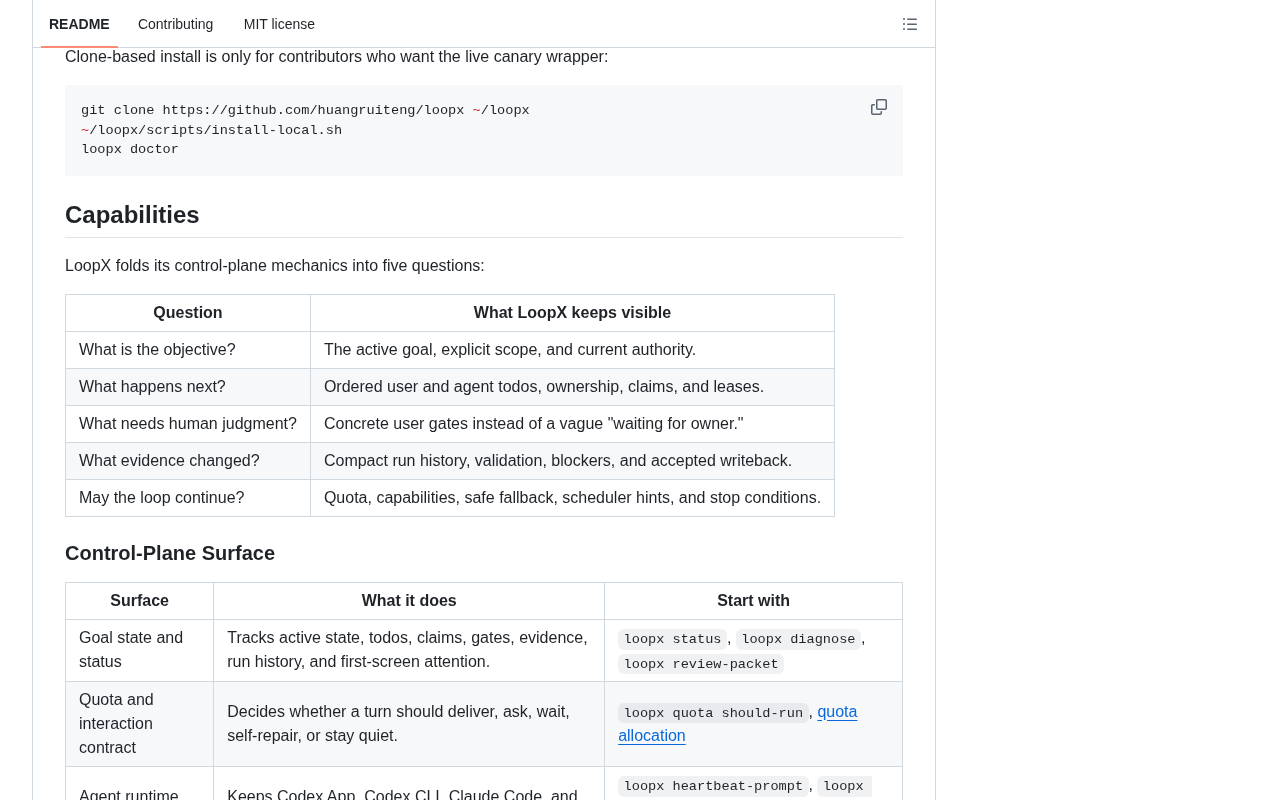
Project positioning: A lightweight "loop engineering" state kernel designed specifically for long-running AI Agent teams.
Problem it solves: Most Agent frameworks today excel at "single tasks," but the moment tasks need to span multiple days, sessions, or require multi-Agent collaboration, fatal weaknesses emerge — lost goals, forgotten context, duplicate task execution, and unverifiable handoffs. loopx targets exactly this gap: it abstracts the Agent's "loop" itself into a persistable, auditable state machine.
Core features: The most impressive design elements include durable goals (Agents remember what they're doing after restarts), quota-aware auto-wake (preventing idle spinning when API quotas are exhausted), executable todos, evidence logs (every step is traceable), and verifiable handoffs. Crucially, it's "agent-loop agnostic" — compatible with mainstream coding Agents like Codex and Claude Code without being locked into any single ecosystem.
Use cases: Imagine a team of multiple Claude Code instances that needs to run continuously for a week to refactor a large codebase. Who remembers the overall goal? Who ensures tasks handed from Agent A to Agent B aren't missed? loopx serves as that "orchestration brain."
Tech stack: Python — the mainstream choice in AI engineering.
Stars/Forks analysis: 1,720 stars, but +585 today — an explosive growth rate. The single-day increase accounts for one-third of total stars, and it landed directly at the top of the chart. This indicates it precisely hits current Agent engineering pain points — a classic "rising star" project worth continuous tracking.
TencentCloud/TencentDB-Agent-Memory: Fully Local Long-Term Memory for Agents
Project positioning: Provides fully localized long-term memory capabilities for AI Agents through a four-tier progressive pipeline with zero external API dependencies.
Problem it solves: Agent "memory" has always been an industry challenge. Many memory solutions on the market rely on external vector databases or cloud APIs, introducing privacy, cost, and latency concerns. The killer feature of this Tencent Cloud project is zero external API dependencies — everything runs locally.
Core features: The 4-tier progressive pipeline is its core architecture, meaning memories aren't dumped wholesale into a vector store but instead settle in layers and are progressively refined — closer to how human memory is organized. This is extremely attractive for enterprises focused on data sovereignty and privacy-sensitive scenarios.
Use cases: Building AI assistants in heavily regulated industries like finance and healthcare where data cannot leave local infrastructure; individual developers who want to add "memory" to Agents in offline environments.
Tech stack: TypeScript — easy to integrate into the Node.js ecosystem and frontend Agent applications.
Stars/Forks analysis: 8,105 stars, +134 today. As a project from a major tech company, it has deep accumulation and sustained growth, representing cloud vendors accelerating their Agent infrastructure investments.
donnemartin/system-design-primer: The System Design Bible with 360K Stars
Project positioning: Teaches you how to design large-scale systems, doubling as system design interview prep (with Anki flashcards).
Problem it solves: No matter how AI evolves, backend engineers ultimately face the eternal challenges of distributed systems, caching, load balancing, and data sharding. This repository organizes massive system design knowledge in a structured way — a "lifeline" for countless engineers preparing for interviews.
Core features: From foundational concepts to real-world case studies (like designing Twitter or a URL shortener), plus companion Anki cards for memory reinforcement — forming a complete learning loop.
Use cases: Candidates preparing for big tech interviews; mid-level engineers looking to systematically fill gaps in their architecture knowledge.
Tech stack: Primarily Python, but essentially a knowledge base.
Stars/Forks analysis: 360,246 stars — the absolute king of the charts, still gaining +138 today. This "evergreen" sustained growth proves that in the AI era, solid system design skills are actually becoming scarcer and more valuable.
firecrawl/pdf-inspector: Redefining PDF Processing with Rust
Project positioning: A fast Rust library for PDF inspection, classification, and text extraction that intelligently distinguishes between scanned and text-based PDFs.
Problem it solves: In today's explosion of RAG (Retrieval-Augmented Generation) and document AI, PDF parsing is an unavoidable first step. But PDF formats are extremely complex — scanned documents need OCR, text documents can be extracted directly, and mixing the two leads to inefficiency or errors. pdf-inspector's "intelligent routing" design solves exactly this pain point: first determine the PDF type, then decide which processing path to take.
Core features: Intelligent scanned vs. text-based detection provides "routing decisions" for downstream processing, avoiding unnecessary OCR on text PDFs. The Rust implementation delivers extreme performance.
Use cases: Any team building document processing pipelines, knowledge bases, or RAG systems — especially scenarios requiring batch processing of massive PDF volumes.
Tech stack: Rust — continuing the recent trend of "rewriting data processing infrastructure in Rust."
Stars/Forks analysis: 6,664 stars, surging +1,769 today — one of the fastest-growing projects of the day. firecrawl already has a strong reputation in the crawling/data scraping space, and this new library captures massive demand for high-performance document processing.
esengine/DeepSeek-Reasonix: A Terminal Coding Agent Built Natively for DeepSeek
Project positioning: A DeepSeek-native terminal AI coding Agent designed around "prefix-cache stability" for long-term persistent operation.
Problem it solves: Most coding Agents are tied to the OpenAI or Anthropic ecosystem, while DeepSeek is winning over more developers with its powerful reasoning and low cost. Reasonix fills the gap of a "DeepSeek-native Agent."
Core features: "Prefix-cache stability" is the core highlight — stable prefix caching significantly reduces inference costs and improves response speed during long-running sessions. The "leave it running" design philosophy echoes today's chart-topper loopx, both emphasizing long-term persistent capability.
Use cases: Individual developers and small teams who prefer DeepSeek models and prioritize cost-effectiveness can have an "always-on" programming assistant in their terminal.
Tech stack: Go — naturally suited for building high-performance, long-running CLI tools.
Stars/Forks analysis: 28,704 stars, +274 today, showing steady growth that reflects the continued expansion of the DeepSeek ecosystem.
addyosmani/agent-skills & obra/superpowers: The Agent "Skills" Arms Race
These two projects are especially interesting viewed together, as they represent two directions of the same trend.
addyosmani/agent-skills (76,522 stars, +1,114 today) is led by renowned Google engineer Addy Osmani, positioned as "production-grade engineering skills for AI coding Agents." It's not another framework but a set of reusable "skill modules" — giving Agents capabilities that truly conform to engineering standards, such as proper code review, test writing, and refactoring patterns. Written in JavaScript for easy integration into existing frontend/Node toolchains.
obra/superpowers (244,525 stars, +897 today) is an "agentic skills framework + software development methodology" written in Shell. With 244K stars, it's a heavyweight project in the Agent methodology space. It emphasizes a complete set of "proven" development methodologies, distilling Agent capabilities into reusable "superpowers."
Shared trend: Both point in the same direction — Agents are no longer about "just give it a prompt and call it done." They need a structured, reusable, verifiable skill system. Together with loopx's state kernel and ADR's security protections, they form the complete puzzle of "Agent production engineering."
uber/ADR: Enterprise-Grade Agent Security from Uber
Project positioning: Protects enterprise AI Agents through observability, security benchmarking, and threat detection — already deployed internally at Uber.
Problem it solves: When Agents enter production and gain real permissions (calling APIs, modifying databases, executing code), security becomes the number one risk. Who's monitoring Agent behavior? How do you detect threats like prompt injection? ADR is that "safety net."
Core features: Observability, security benchmarking, and threat detection form a trinity — and it's already deployed in Uber's actual production environment — an endorsement of extremely high value.
Use cases: Any mid-to-large enterprise deploying Agents in production needs a similar security and compliance layer.
Tech stack: Python.
Stars/Forks analysis: Only 503 stars, but +140 today — a just-starting project with fierce growth momentum. Big tech open source + real production validation means it could very well become the de facto standard for enterprise Agent security.
Other Noteworthy Evergreen Projects
roboflow/supervision (48,751 stars) continues to provide reusable tools for computer vision — the Swiss Army knife for CV engineers. vercel/next.js (140,560 stars) and tailwindlabs/tailwindcss (96,245 stars) hold steady on the charts as the frontend power duo, proving that beyond the AI hype, web development infrastructure remains a daily essential for developers. lyogavin/airllm (23,131 stars, +242 today) continues to lower hardware barriers for large model inference with its extreme optimization of "running 70B models on 4GB GPUs," making large-parameter models accessible to individual developers.
Today's Trend Summary: The Agent "Production Starter Pack"
Connecting today's chart entries reveals a clear technical landscape — AI Agents are filling in all the infrastructure needed to enter production environments:
- State management (loopx): Agents that remember, run long, and hand off reliably
- Long-term memory (TencentDB-Agent-Memory): Agents with localized, privacy-safe "brains"
- Skill systems (agent-skills, superpowers): Agents with engineering-grade reusable capabilities
- Security protection (uber/ADR): Agents that don't go rogue when given real permissions
These four puzzle pieces collectively declare: Agents have left the "demo era" and entered the "production engineering era." Whoever standardizes this infrastructure first may well define the development paradigm for next-generation AI applications.
Today's Must-Watch TOP 3
- huangruiteng/loopx — Surged +585 stars in a single day to claim the top spot, precisely hitting the state management pain point for long-running Agent teams. A critical piece of the Agent engineering puzzle — highly recommended to follow.
- firecrawl/pdf-inspector — Today's growth champion (+1,769). A high-performance PDF intelligent routing library built in Rust — practically a must-have for teams working on RAG/document AI.
- uber/ADR — An enterprise-grade Agent security framework validated in real production at a major tech company. Despite only 503 stars, its fierce growth trajectory suggests it could become a future standard — worth getting ahead of the curve.
Looking ahead, as the four cornerstones of state, memory, skills, and security gradually mature, there's good reason to believe: the second half of 2026 will see an explosion of truly reliable, scalably deployable production-grade Agent applications. Today's trending chart may well be the prelude to that transformation.
Related articles

Apple Accuses Former Employees of Taking Confidential Data to OpenAI: The AI Talent War Escalates
Apple accuses former employees of taking trade secrets to OpenAI, spotlighting the escalating AI talent war and intellectual property challenges in the tech industry.

Dashi Metrics: A Real-Time Visualization Tool That Maps Revenue Data onto a 3D Globe
Dashi Metrics maps revenue and visitor data onto an interactive 3D globe in real-time, giving SaaS teams and indie founders intuitive geographic visualization of their global business.

Adform Hacked: Why You Should Be Using an Ad Blocker Right Now
Ad tech giant Adform was hacked, exposing security risks in online advertising. Learn why ad platforms are targets, how ad blockers protect against malvertising, and get practical tips on uBlock Origin and Pi-hole.