#AI Agent production
2253 related articles

·2 min
HyperProbe: How a Read-Only AI Agent Is Revolutionizing Production Debugging
HyperProbe is a YC S26 AI debugging agent that performs read-only debugging in production, helping engineers quickly identify root causes. Analysis of its design philosophy and market positioning.
Read more →

·3 min
GitHub Daily · August 5: AI Agents Enter the 'Production Engineering' Era
GitHub Trending Aug 5: AI Agents shift from demos to production with new projects for state management, long-term memory, skill systems, and security.
Read more →

·3 min
MCP Session Analytics: Building Production-Grade Observability and Evaluation for AI Agents
How to build product analytics and evaluation capabilities for AI Agents at the MCP protocol layer, covering session-level tracing, tool call observability, and quality Evals.
Read more →

·3 min
Orca-Bench: Evaluating Whether AI Agents Can Handle Production Oncall Duties
Orca-Bench is a benchmark for evaluating AI agents' operational capabilities, testing LLMs on fault diagnosis, multi-tool orchestration, and risk decisions in simulated Oncall scenarios.
Read more →

·2 min
Prefactor: Production-Grade Monitoring and Quality Assurance Tool for Real-Time AI Agent Evaluation
Prefactor is a production-grade monitoring tool for real-time AI Agent evaluation, using live scoring, quality drift detection, and performance visualization to solve the core problem of Agents passing offline tests but failing in production.
Read more →

·2 min
Prefactor: Production-Grade Monitoring and Quality Assurance Tool for Real-Time AI Agent Evaluation
Prefactor is a production-grade monitoring tool for real-time AI Agent evaluation, using real-time scoring, quality drift detection, and performance visualization to solve the core pain point of Agents passing offline tests but failing in production.
Read more →
·4 min
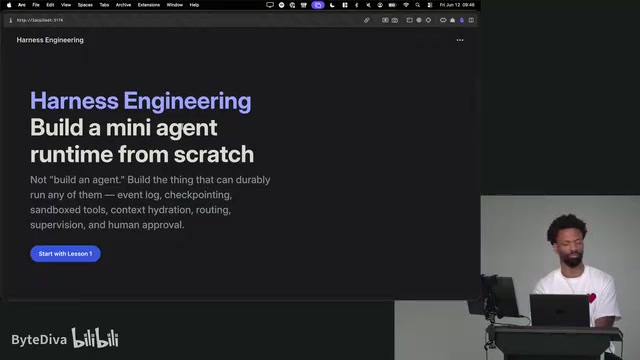
Harness Engineering: The Core Infrastructure for Taking AI Agents from Demo to Production
Deep dive into Harness Engineering: why AI Agents need memory management, durable execution, guardrails & approvals to go from demo to production.
Read more →

·4 min
Harness Engineering: The Core Infrastructure for Taking AI Agents from Demo to Production
Deep dive into Harness Engineering: why AI Agents need memory management, durable execution, guardrails & approvals to reach production. Based on Scott Moss's workshop.
Read more →

·5 min
The Five Stages of AI Agent Architecture Evolution: The Real Path from Model Calls to Production Runtime
Deep dive into the five evolution stages of AI Agent architecture: model calls, tool calls, workflows, Agent loops, and production runtime. Learn the responsibility boundaries and design principles.
Read more →

·4 min
AI Agent Development in Practice: A Complete Path from Zero to Production
A systematic guide to AI Agent development covering core modules, framework selection, tool calling, data preparation, and production deployment to help developers build production-ready Agent applications.
Read more →

·5 min
Complete Breakdown of Core Competencies for AI Agent Engineers: From Demo to Production-Grade Systems
Deep breakdown of 4 core AI Agent engineer competencies: business decomposition, multi-Agent architecture, quantitative evaluation, and engineering delivery—bridging the gap from Demo to production.
Read more →

·3 min
AI Agent Development Landscape: From Architecture Design to Production Deployment
A systematic overview of the AI Agent tech stack: RAG retrieval, Agent planning, MCP protocol, AI Gateway, and observability — helping developers build production-grade AI systems.
Read more →

·2 min
Dependency Drift in Production AI Agents: Detection, Response, and Building Resilient Systems
AI Agents in production face systemic dependency drift risks — model updates silently change outputs and silent failures are hard to detect. Learn detection strategies, hidden costs, and engineering practices.
Read more →

·3 min
AI Agent Production Guide: Four Orchestration Patterns That Actually Work
Most AI agents never make it past the demo stage. This guide covers four production-grade agent patterns—workflow orchestration, policy-constrained execution, anomaly handling, and load routing—to help teams build reliable agent systems.
Read more →
·2 min
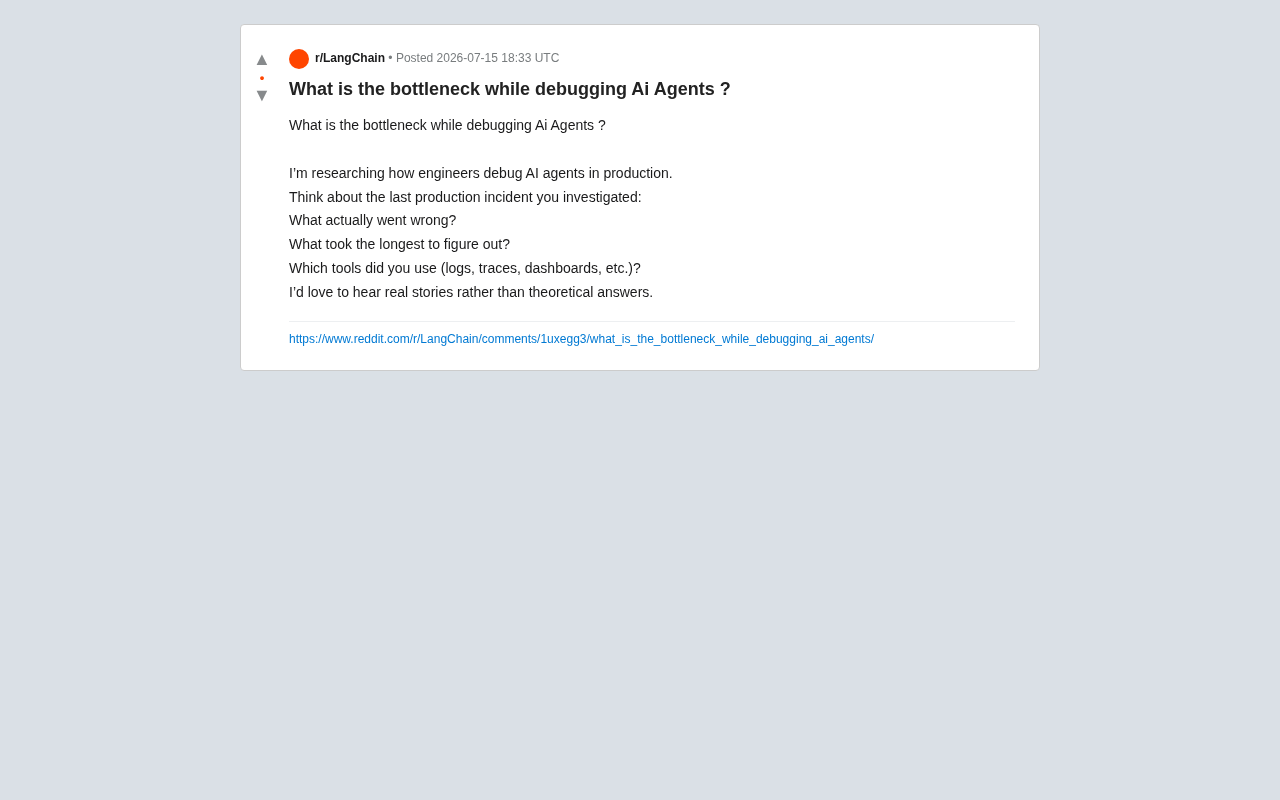
AI Agent Debugging Bottlenecks: A Practical Guide to Production Observability
Explore core AI Agent debugging challenges in production: non-determinism, multi-step error propagation, and observability gaps — with practical guidance on LangSmith and tracing tools.
Read more →

·2 min
AI Agent Development Roadmap: A Four-Stage Guide from Zero to Production
A four-stage AI Agent development roadmap: from core theory and ReAct paradigm to multi-agent collaboration and production deployment. Covers DeepSeek, Coze, Dify, and more.
Read more →

·4 min
LangChain + LangGraph Full-Stack in Practice: A Production-Ready Guide to Six Core Modules and Agent Deployment
A systematic breakdown of LangChain's six core modules (Models/Prompts/Chains/Memory/RAG/Agent) and LangGraph's state graph, persistence, and HITL — with production deployment tips.
Read more →
Production-Grade LangGraph Template: A…
·2 min
Production-Grade LangGraph Template: A Practical Guide to Engineering AI Agents for Production
A deep dive into production-grade LangGraph templates covering state management, observability, error handling, and containerized deployment to bridge the gap from demo to production.
Read more →

·3 min
Enterprise AI Agent Learning Roadmap: A Complete Guide from Beginner to Production
A structured AI Agent learning roadmap covering 4 stages: foundations, core frameworks, scenario practice, and advanced product thinking. Master LangChain, tool calling, memory, and more.
Read more →

·2 min
Skill + Agent in Action: A Complete AI Workflow for Home Furnishing Ad Video Production
Use Skill + Agent to complete a full home furnishings ad workflow — from asset sourcing and character consistency to video storyboarding and final compositing — all within one canvas.
Read more →