GitHub Daily · November 21: Compliance and Editing — AI Implementation Starts Sweating the Details
GitHub Daily Nov 21: compliance handbook gains 377 stars, narrow-scenario agents rise, autoclip covers full short-video pipeline.
Today's GitHub Trending shows AI implementation entering the details phase. app-store-compliance surged 377 stars by structuring 117 real rejection cases into a handbook with an AI agent skill; AFFiNE at 75K stars keeps growing; autoclip offers one-click long-to-short video editing across Douyin, Xiaohongshu, TikTok, Reels, and YouTube Shorts.
Today's Overview: The Leaderboard Says the Same Thing — AI Implementation Has Entered the Details Phase
Today's GitHub Trending sends a clear signal. There's no earth-shattering foundational model project on the list. Instead, several very down-to-earth tools are surging upward.
An app store compliance handbook, a CI/CD reliability agent, a desktop tool that auto-clips short videos, and AFFiNE at seventy-five thousand stars. Look at what these projects have in common — they're all solving specific pain points in specific scenarios.
Put plainly, competition in AI and the application layer has shifted from the model capability battles of the past couple of years to engineering details. Whoever can smooth out the tedious links — compliance, release, editing — gets the users.
Let's go through them one by one.
mjmirza/app-store-compliance: Turning App Store Rejection Pitfalls into a Handbook
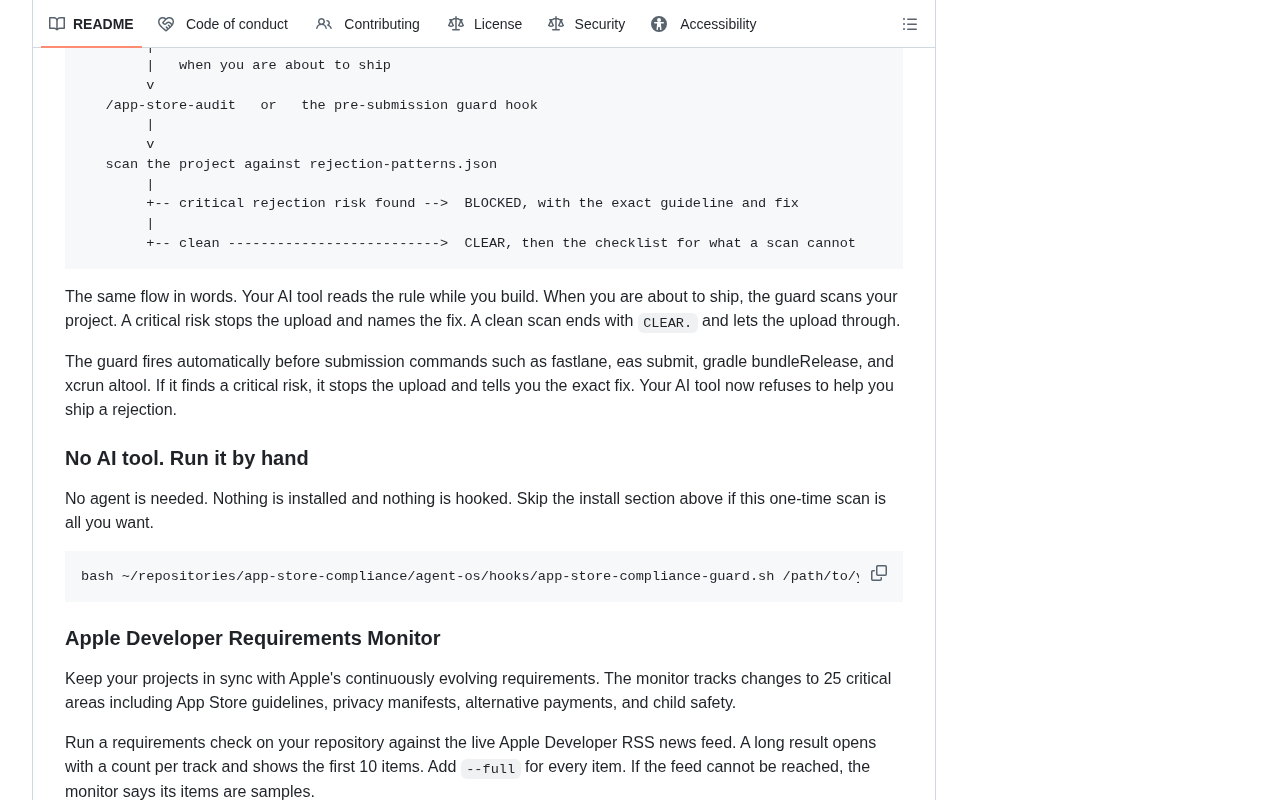
Project positioning: A compliance pitfall-avoidance handbook for app store submissions, plus a pre-submission check guard tool.
Problem solved: App store rejections have always been a hidden cost for developers. App Store and Google Play review rules are fragmented and change often. After a rejection, many teams can only dig through forum posts from others and try things one by one.
This project organizes that process into something structured. It records 117 real rejection cases with corresponding fixes. That's not a small number — it basically covers the common review landmines.
Core features: It's not just a case collection. The project also includes privacy manifest and Data safety checks, and tracks 95 regulatory deadlines involving the EU AI Act, DSA, COPPA, and age-related regulations.
More importantly, it provides a skill for AI coding agents. Think about it — many people now use Claude Code or Cursor to write code. If this skill can be plugged in, the agent can avoid known submission issues while generating code. That's a clever approach.
Use cases: Independent developers and small teams need this most. Especially those building apps for overseas markets — grappling with European and American compliance requirements on your own is too costly. With this handbook as a baseline, you can at least avoid a few pitfalls.
Tech stack: Primarily Shell. That makes sense — compliance checks are inherently script-and-checklist-driven work and don't need a heavy framework.
Stars analysis: Over 2,300 stars, up 377 today. For a Shell project, that daily growth rate is quite aggressive. It shows this pain point has been suppressed for a long time and people jumped on it as soon as it was released. It feels like someone finally turned everyone's collective complaints into a product.
Tracer-Cloud/opensre: An Open-Source Agent for CI/CD Reliability
Project positioning: An open-source agent specifically focused on CI/CD pipeline reliability.
Problem solved: CI/CD issues are a persistent headache for engineering teams. Pipelines break, or builds are flaky, and troubleshooting is exhausting. These problems often aren't logic errors in code but edge factors like environment, dependencies, and timing.
The traditional approach is manually reading logs. opensre's idea is to let an agent take over this work. It watches the pipeline and helps locate instability factors.
Core features: Its positioning is very focused — it only does CI/CD reliability. This kind of single-point agent is more likely to actually work than a general-purpose agent that claims to do everything. Because the scenario boundary is clear and the evaluation criterion is unambiguous: is the pipeline stable or not.
Use cases: Medium-to-large engineering teams. Many pipelines, high failure costs. Small teams may not need it yet, but once team size grows, this need emerges.
Tech stack: Python. This is also the mainstream choice for current agent projects — mature ecosystem, easy integration with various CI systems.
Stars analysis: Over 13,000 stars, but only up 38 today. This data is interesting. It shows the base is already large — it's a project that has been established over time, not one that just got popular today. A daily gain of 38 is normal fluctuation. So don't be misled by today's number when looking at this project — its scale has been there for a while.
AFFiNE: A 75,000-Star Domestic Knowledge Base, Still Steadily Growing
Project positioning: A next-generation knowledge base that combines planning, organizing, and creating. The official description is direct — more than Notion and Miro.
Problem solved: People use Notion for notes and Miro for diagrams today — documents and canvases are fragmented. What AFFiNE wants to do is put documents and whiteboards in the same space.
Core features: Privacy-first, open source, customizable. Put those words together and it's very attractive to teams that care about data ownership. Its out-of-the-box experience is also well done, which is one reason it has accumulated so many stars.
Use cases: Knowledge management, project planning, team collaboration. Especially for teams that want to escape SaaS lock-in without sacrificing experience.
Tech stack: TypeScript. Front-end experience and real-time collaboration both rely on this ecosystem. For developers building collaboration products, its front-end architecture is worth studying.
Stars analysis: Over 75,000 stars, up 182 today. Still gaining 182 a day at this scale shows it continues to attract new users. An open-source collaboration tool reaching this magnitude is no small feat.
Ghost-Downloader-3: Taking the Downloader to the Extreme
Project positioning: An all-purpose downloader, officially self-described as the culmination of downloaders.
Problem solved: In the download tool space, established products either have outdated interfaces or scattered features. Users want a tool that is multi-threaded, has a modern interface, and supports various protocols.
Core features: Its selling point is completeness. It gathers common download needs into one out-of-the-box product. The benefit is users don't have to switch between multiple tools.
Use cases: Both regular users and developers use it. Downloading large files, batch resources, mirroring content — these are everyday scenarios.
Tech stack: Python. This choice ensures cross-platform capability and extensibility. However, building a desktop downloader in Python takes effort in performance tuning — that's also its technical highlight.
Stars analysis: Over 13,000 stars, up 341 today. This daily gain is impressive in the old downloader race. It shows that classic needs paired with a modern experience still have a market.
autoclip: One Link, One-Click Video Production
Project positioning: An open-source AI video editing desktop tool that automatically cuts long videos into short clips.
Problem solved: For long-form content like podcasts, interviews, and courses, publishing to short-video platforms involves enormous editing work. Cutting one by one manually is time-consuming and labor-intensive. autoclip targets exactly this pain point.
Core features: Its workflow is complete. From cutting short clips out of long videos, generating subtitles, to creating covers and publishing copy — all in one step. And it adapts to mainstream platforms like Douyin, Xiaohongshu, TikTok, Reels, and YouTube Shorts. Think about it — the most annoying thing for content teams is format adaptation, and this handles it directly.
Use cases: Self-media teams, knowledge-payment practitioners, course creators. Especially creators managing multiple platforms alone — this tool can save a lot of repetitive work.
Tech stack: Python. The ecosystem for video processing and AI editing is most mature in Python, so choosing it is natural.
Stars analysis: Over 11,000 stars, up 126 today. A content creation tool with this growth rate shows that demand for short-video secondary creation is really strong. This赛道 is hot right now.
Today's Trends: Agents Start Doing Narrow Work, Tools Start Filling Gaps
Looking at today's projects together, two trends are worth mentioning.
First, agents no longer pursue all-purpose capability but dig into narrow scenarios. opensre only does CI/CD reliability; the skill in the compliance project only does submission avoidance. These narrow-and-deep agents are easier to validate and more likely to be genuinely adopted than general-purpose agents.
Second, open-source tools are filling gaps in compliance and process. Previously open-source projects competed on features; now they compete on whether they can be released smoothly and listed compliantly. This shows users have matured — they want not just usability but peace of mind.
Today's Must-See TOP 3
First, AFFiNE. With 75,000 stars, developers working on collaboration and knowledge management should study its architecture.
Second, mjmirza/app-store-compliance. Up 377 today, pinpointing the pain point. For those building mobile apps for overseas markets, this handbook can directly save real money.
Third, autoclip. Content creation tools are timely. If you're doing short-video secondary creation, this tool's complete pipeline is worth trying.
Outlook
Going forward, I expect more narrow-scenario agents and compliance tools to appear on the leaderboard. Model capabilities are still improving, but users' money and attention will increasingly go to tools that solve specific problems. For engineers, that's a good signal.
Related articles
Perplexity Mac App Gets Major Upgrade: Retention Rising, Exclusive Support for Hybrid and Local Models
Perplexity's Mac app sees major improvements with rising user retention, and is the only AI app supporting both frontier and local models (hybrid and fully local). This article analyzes its highlights and industry significance.

Harbinger: Electrifying the Trillion-Dollar Economic Artery with Electric Trucks
Harbinger closes a $240M Series D, secures a $300M FedEx order and a U.S. military defense contract. How is this electric truck startup driving electrification across commercial and defense sectors?
Perplexity Computer May Switch Default Model: Gemini Neon Reportedly Beats Opus 5.5
Perplexity Computer is rumored to recommend Gemini Neon and may switch its default model, reportedly outperforming Opus 5.5 with decisions based on retention data. This article unpacks the product logic, changes in model selection criteria, and open questions behind the news.