Perplexity Mac App Gets Major Upgrade: Retention Rising, Exclusive Support for Hybrid and Local Models
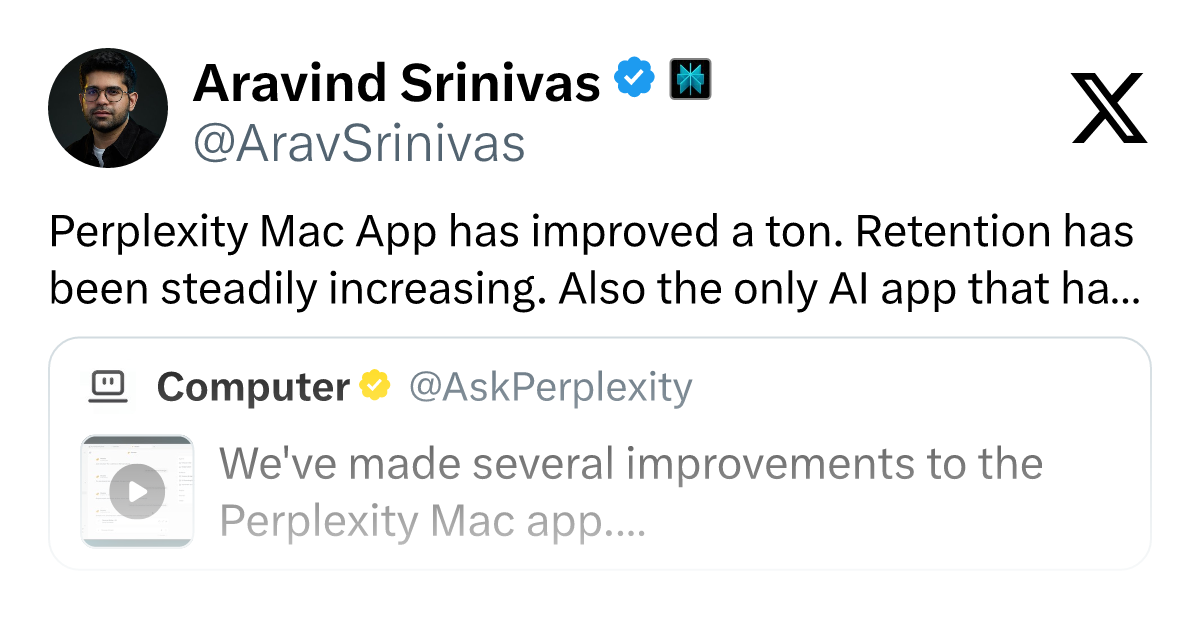
Perplexity's Mac app is greatly improved, retention is rising, and it exclusively supports hybrid use of frontier and local models.
An official Perplexity tweet revealed that its Mac desktop app has recently been greatly improved, with user retention growing steadily, and called it the only AI app that supports both frontier cloud models and local models (including hybrid mode and fully local mode). The article argues that native desktop apps outperform the web version in interaction smoothness, system integration, and stability, making them an important battleground for AI assistants; support for local models caters to privacy, latency, and offline availability needs, while hybrid inference can flexibly schedule between local and cloud. This move reflects two major trends in AI applications: diversification of model choices and the rise of privacy computing. Because the tweet did not disclose specific retention data or feature details, whether this advantage can translate into broad user growth remains to be seen, but it may prompt other AI apps to follow suit and make model flexibility a new dimension of desktop competition.
Perplexity's Mac desktop app has recently received significant improvements, with user retention continuing to rise, and it has become the only AI app that supports trying both frontier models and local models (hybrid mode and fully local mode). This development comes from an official tweet, revealing Perplexity's strategic positioning on desktop and in model flexibility.
App Experience Greatly Improved, Retention Growing Steadily
According to a message posted by Perplexity on Twitter, its Mac app has been "improved a ton," and user retention has been growing steadily. Although the tweet did not disclose specific retention figures or improvement details, the statement indicates that the team's continued investment in the desktop product is gaining user recognition.
Desktop apps have always been an important battleground for AI assistants. Compared with the web version, native apps can provide smoother interaction, deeper system integration, and more stable performance. Perplexity has clearly put effort into optimizing the Mac experience, which has driven the increase in user stickiness.
Exclusive Feature: Support for Both Frontier and Local Models
More notably, the Perplexity Mac app is described as "the only AI app that supports trying frontier models and local models (hybrid and fully local)." This means users can flexibly switch within the same app between frontier large models in the cloud and models running locally, and may even enable hybrid inference—with some tasks processed locally and some completed in the cloud.
This feature is highly attractive to users who care about privacy, latency, or offline availability. Local models can prevent data from leaving the device and reduce network dependence, while frontier models can ensure answer quality. Perplexity's integration of both into one app is indeed rare in the current AI assistant market.
Frontier models usually refer to large language models with parameter sizes ranging from tens of billions to hundreds of billions or more, deployed in the cloud (such as flagship versions of GPT-4, Claude, Gemini, etc.). They rely on large-scale GPU cluster inference, offer high answer quality, but come with network latency, usage-based billing, and the need to upload data to the service provider. Local models are small-parameter models that run on the user's device after quantization and compression (commonly at the 7B–70B level, and after 4-bit quantization can fit into consumer-grade VRAM), driven by inference frameworks such as llama.cpp, Ollama, and MLX. Their advantages are that data does not leave the device, they can be used offline, and there is no invocation cost; the tradeoff is that their knowledge breadth and reasoning ability are weaker than frontier models.
Hybrid mode generally refers to router-style scheduling: the app decides whether to send a request to the local model or the cloud model based on query complexity, privacy sensitivity, or user settings, and may also perform rough local screening first before handing off to the cloud for precise processing. The key difficulty of this architecture lies in the decision strategy and the consistency of context between local and cloud.
Industry Significance: Model Flexibility and Privacy Computing
Perplexity's move reflects two trends in AI application development: first, diversification of model choices, as users are no longer satisfied with a single model and want to choose the most suitable model for the scenario; second, the rise of privacy and local computing, as more and more users care about data sovereignty.
You may not have noticed that Perplexity is not the only company exploring local models, but integrating them with frontier models into a desktop app and making this a core selling point currently appears unique. If this feature works well, it may prompt other AI apps to follow suit, creating a new dimension of competition.
Data sovereignty means that data subjects have control over where their data is stored, how it is processed, and the scope of its flow. In the AI assistant scenario, sending prompts and context to the cloud means this content passes through the service provider's servers and may be used for log retention, abuse detection, or even (under some terms) model training. Local models keep the entire inference process on the device, making it easier to meet compliance requirements such as GDPR and enterprise intranet data-not-leaving-domain policies, which is also a core reason why users in finance, healthcare, legal, and other industries prefer local deployment.
Privacy computing is a broader technical category, including federated learning, differential privacy, trusted execution environments (TEE), and homomorphic encryption; local inference is one of its most direct forms—no transmission means no leakage. It should be noted that local models can only guarantee data residency during the inference stage, and the app's own networking behavior (such as account sync and telemetry) remains part of the privacy boundary.
Outlook: Desktop Competition Intensifies
With improvements to the Perplexity Mac app and rising retention, competition among desktop AI assistants will become more intense. Users expect more powerful features, more flexible model options, and better privacy protection. Perplexity has already taken an important step; what remains to be seen is whether it can turn this advantage into broader user growth.
For developers and tech enthusiasts, the Perplexity Mac app's hybrid model support is worth trying, especially in scenarios that need to balance performance and privacy.
(Note: This article is based on information from Perplexity's official tweet; specific feature details and retention data were not disclosed in the tweet.)
Related articles
Gemini 4 Neon Hands-On: Half the Price vs. Opus 5.5 — Which Is Better?
Based on hands-on developer tests and third-party benchmarks, we analyze the real gap between Gemini 4 Neon and Claude Opus 5.5: intelligence index, coding ability, cost per task, and use cases — revealing the truth behind the 'half price' claim.
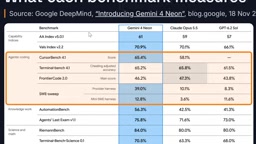
Gemini 4 Neon Benchmarks Fully Explained: Head-to-Head with Opus and ChatGPT 6.2
A detailed breakdown of the Gemini 4 Neon official benchmark tables: slightly ahead of Opus and ChatGPT 6.2 overall, trailing by 0.5 on terminal tasks, with a clear long-context advantage and wins on cost and speed.

The Gemini 4 Neon Coding Test Mystery: 39% vs. 12.8% — Tool Differences or Model Capability?
Gemini 4 Neon scores 39% and 12.8% on SWE-bench, narrowing its gap with GPT-6.2 Sol from 30.7 to 1.2 points. We analyze how agent tools affect coding benchmark scores and offer controlled testing advice.