GitHub Game Off 2026 Theme Announced: SHIFT

GitHub's 14th Game Off announces theme SHIFT, open to interpretation, encouraging open-source game completion in one month.
GitHub's annual game development challenge Game Off returns for its 14th edition, announcing the 2026 theme as SHIFT. The word has multiple meanings—physical movement, perspective shifts, or distortion of reality's rules—and GitHub encourages free interpretation. The article notes broad themes are Game Off's style, with developers typically breaking them into core mechanics; SHIFT suits state switching, perspective rotation, and timeline jumps. As an open-source game jam, it requires a playable version with public code within one month. The article also offers mechanics design directions and preparation advice.
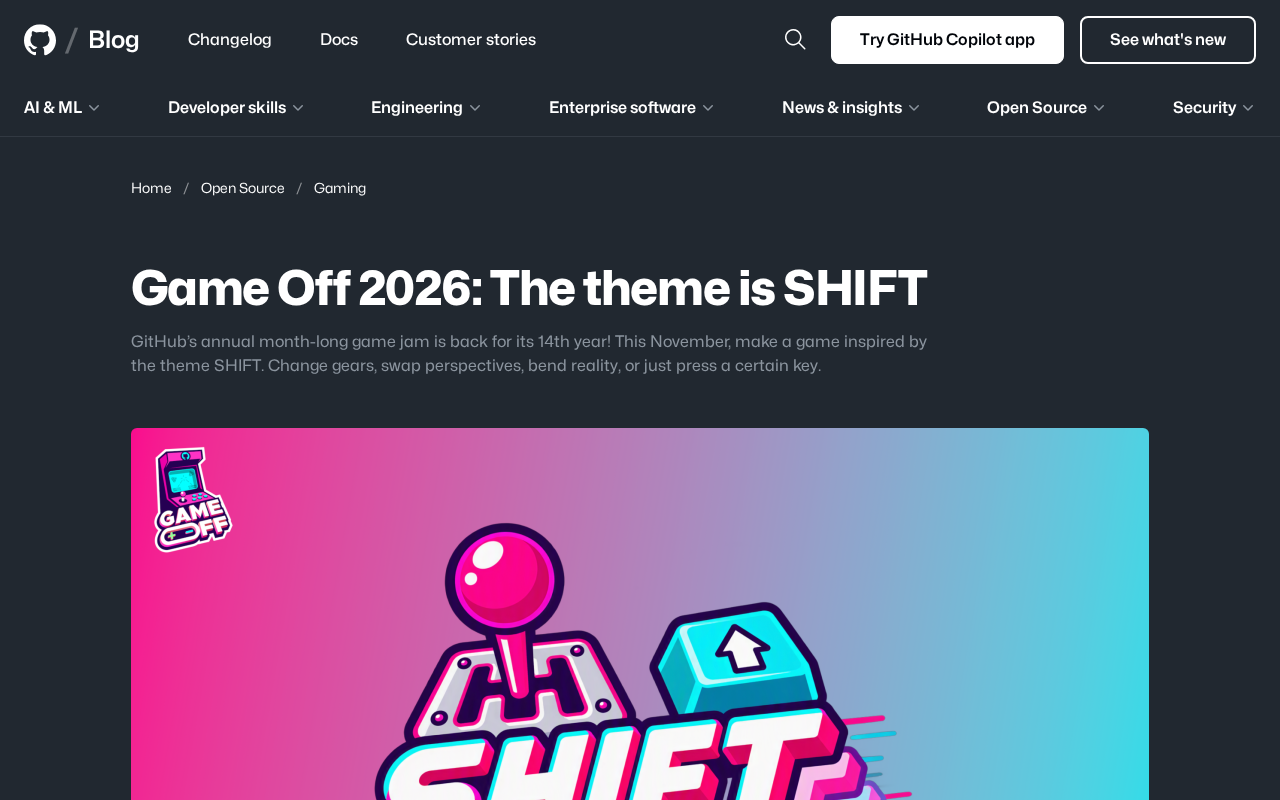
GitHub's annual month-long game development challenge Game Off is back, now in its 14th year. The official blog has officially announced this year's creative theme: SHIFT. For those familiar with the indie game development community, this signals that a new round of creative sprinting is about to kick off in November.
Creative Space Sparked by a Single Verb
The word SHIFT itself carries strong ambiguity. It can refer to physical movement—changing position, switching gears; it can also mean a cognitive shift—exchanging perspectives, transforming approaches; and it can even mean surreal distortion—bending the rules of reality. GitHub's prompt in the announcement is quite open: change gears, switch perspectives, distort reality, or simply press a particular key.
This broad thematic setting is Game Off's consistent style. The more abstract the theme, the more creative directions participants can project onto it. Looking at past entries, developers tend to break the theme down into core mechanics rather than staying at the literal level. SHIFT is naturally suited to combining with gameplay like state switching, perspective rotation, and timeline jumps, which may give rise to a batch of works centered on "change" as their core loop.
The Community Significance of Game Off
Game Off is hosted by GitHub and positioned as an open-source game development marathon. It does not restrict engines or tech stacks; participants complete the entire process from conception to a playable version within one month, hosting their code on GitHub. Now in its 14th edition, this event has accumulated a stable group of participants and a library of works, becoming a window into the open-source game ecosystem.
Unlike commercial game jams, Game Off's outputs are open-source by default, giving it a stronger educational and collaborative character. Participants aren't just making games—they're also making their engineering decision-making process public. For developers looking to build a portfolio and practice a complete project workflow, this is a low-barrier entry point.
The Difference Between Game Jams and Open-Source Game Jams
A game jam is a time-limited game development event where participants typically create a playable prototype from scratch around a given theme within 48 hours to several weeks. Commercial game jams (such as Ludum Dare and Global Game Jam) usually leave output ownership with the authors, and code isn't necessarily public. Game Off, as an open-source game jam, requires participants to host their code in public repositories, typically under open-source licenses. This difference has two consequences: first, works can be learned from, replicated, or further developed by others, forming ongoing educational resources; second, participants' engineering process (commit history, issue discussions, README documentation) itself becomes evaluable portfolio material. For recruiters or collaborators, a public repository provides more information about a developer's habits than a demo video.
How to Design Around SHIFT
From a mechanics design perspective, SHIFT can be implemented in several common but effective directions. State switching is the most direct interpretation: a character transforms between two forms, each with different abilities, and level design revolves around timing the switch. Perspective switching is better suited to puzzle or narrative works, where players discover hidden paths or information by changing their viewing angle.
Another approach is to understand SHIFT as a displacement at the rules level—such as changing gravity direction, adjusting time flow speed, or restructuring map layouts through player actions. These designs place higher demands on prototype validation; within a one-month cycle, you need to confirm early whether the core loop holds up. The line in GitHub's announcement—"or simply press a particular key"—also hints that the theme can be interpreted very lightly, without carrying a heavy narrative burden.
Core Loop and Prototype Validation
The core loop refers to the minimal sequence of actions players repeatedly perform in a game, such as "observe—switch form—pass obstacle—receive feedback." Whether a game jam entry can be completed within the deadline largely depends on whether the core loop is small enough and can be made to work on day one. Prototype validation in this context means quickly building an interactive version with the roughest placeholder assets, confirming whether the act of "switching" itself is fun, and then deciding whether to invest in art and level design. A common approach is to first build a grey-box scene with only mechanics and input feedback; if testers can't understand the core loop within 3 minutes, you need to shrink or redesign rather than continue stacking content.
Preparation Advice Before Participating
There's still some time before November, and interested participants can do a few things first. Determine your tech stack and toolchain to avoid running into pitfalls during the development month. Prepare a reusable project template with build, export, and version control workflows already working. Follow past Game Off repositories on GitHub to see how previous works were organized and what submission conventions were used.
The most important thing is to control scope. A one-month cycle sounds long, but for a complete project including art, sound effects, levels, and polish, time is always tight. Choosing a core mechanic around SHIFT that is small enough and clear enough makes it easier to produce a playable finished product than stacking features.
Tech Stack and Project Templates
Tech stack refers to the combination of engines, languages, and tools used to develop a game, such as Godot + GDScript, Unity + C#, or web-based Phaser + JavaScript. Game Off doesn't restrict tech stacks, but different choices have different suitability for a one-month cycle: lightweight engines start fast and have short export pipelines, making them suitable for small-scale mechanic works; heavy engines are feature-complete but have high setup costs. A project template is a starter repository pre-configured with build, export, version control, and directory structure; participants can fork or clone it before the event begins, focusing limited time on gameplay. Common organization patterns in past Game Off repositories on GitHub include organizing by theme subdirectories and using GitHub Actions to automatically build web versions—these can be reused directly.
Final Thoughts
The theme for Game Off 2026 is now clear; what comes next is developers' own interpretation and execution. SHIFT provides a sufficiently broad entry point—you can make a minimalist mechanic piece or attempt more complex system design. Whichever direction you choose, the open-source and public collaboration nature gives the process itself additional value.
One-line Summary
GitHub's 14th Game Off announces the theme SHIFT, open to interpretation, encouraging open-source game completion within one month.
Paragraph Summary
GitHub's annual game development challenge Game Off returns for its 14th edition, with the official 2026 theme announced as SHIFT. The word carries multiple meanings—physical movement, perspective shifts, or distortion of reality's rules—and GitHub encourages participants to interpret it freely. The article notes that broad themes are Game Off's consistent style, with developers typically breaking them down into core mechanics rather than literal interpretations; SHIFT is naturally suited to gameplay like state switching, perspective rotation, and timeline jumps. Positioned as an open-source game jam, Game Off places no restrictions on engines or tech stacks, requiring a playable version completed within one month with public code, offering both portfolio-building and educational value. The article also offers implementation directions from a mechanics design perspective—state switching, perspective switching, rule displacement—and suggests participants determine their tech stack early, prepare project templates, reuse past repositories' organization patterns, and strictly control project scope to ensure a playable finished product on time.
Related articles

Deleted Reddit Post Sparks Debate Over AI Content Moderation
A Reddit post removed with only a 'Removed by Reddit' notice highlights AI content moderation's transparency gaps, misjudgment risks, and appeal challenges for platforms and creators.

DSH + Ollama Local LLM Deployment in Practice: Free Chat with Da Fei Yu
Bilibili creator tests DSH + Ollama local LLM deployment end to end: Ollama install, Xunlei-accelerated downloads, ModelScope GGUF model import, DSH custom API address setup, and a comparison of Qwen 3.5 4B, 8B, Gemma, and other models on 8GB VRAM, with advice on choosing local deployment vs. API calls.

Tested: A $899 Mac Mini vs. a $200/Month AI Subscription
Real-world test of whether an M4 Mac mini can replace a $200 AI subscription: 16GB can't fit large models, and both speed and quality fall short—but privacy, no caps, and near-zero running costs make it an ideal host for an always-on agent. Includes buying advice per configuration and money-saving strategies.