GitHub HydraFusion: How Multi-Model Orchestration Approaches Frontier Quality While Cutting Costs
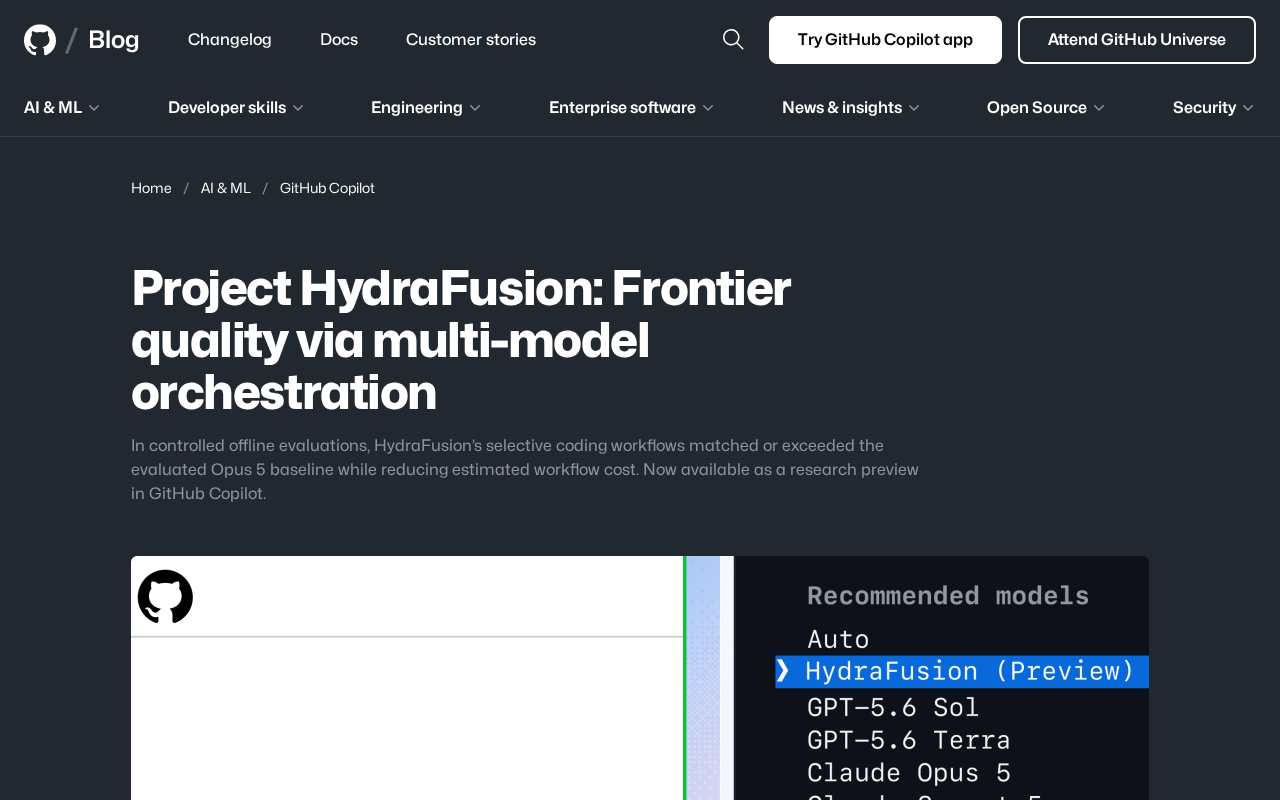
GitHub HydraFusion uses multi-model orchestration to match frontier model quality at lower cost.
GitHub's Project HydraFusion introduces a multi-model orchestration approach to AI coding assistance. Instead of relying on a single frontier model, it intelligently routes tasks to different models based on complexity — using lightweight models for simple tasks and stronger ones for complex reasoning. In controlled evaluations, it matched or exceeded the Opus 5 baseline while reducing costs, signaling a shift from "model dominance" to "model collaboration" in AI programming tools.
Is the Single-Model Era Coming to an End?
Over the past two years, the competition among AI coding assistants has revolved almost entirely around the "single strongest model" — whoever has the more powerful foundation model delivers a better code completion and generation experience. However, GitHub's newly announced Project HydraFusion charts a fundamentally different path: instead of betting on any one frontier model, it uses multi-model orchestration to organically combine the capabilities of multiple models, maintaining quality while significantly reducing costs.
Multi-model orchestration is a system architecture pattern whose core idea draws from distributed computing and microservices: decompose a single massive task into multiple subtasks, have each handled by the most suitable component, then aggregate the results. In the LLM space, this concept's rise is closely tied to the popularity of Mixture of Experts (MoE) architectures during 2023–2024 — MoE implements a similar routing mechanism within a single model, while multi-model orchestration elevates this logic to the system level, letting different complete models serve as different "experts." This architecture must address several core technical challenges: task classification accuracy, context-passing consistency between models, latency control, and conflict resolution during result fusion.
According to GitHub's official blog, HydraFusion has gone live in GitHub Copilot as a research preview, allowing developers to experience its "selective coding workflows."
What Is HydraFusion's Multi-Model Orchestration
From "One Brain" to "A Collaborative Team"
HydraFusion's core idea is to break down programming tasks and dynamically assign them to different models. As the "Hydra" (the multi-headed serpent) in its name suggests, the system doesn't rely on a single "brain" — instead, multiple models work in concert, each handling the subtasks it excels at, with an orchestration layer performing the fusion.
The logic behind this design is straightforward: different models perform differently across different types of coding tasks. Some excel at complex logical reasoning, others are more efficient at boilerplate code generation, and still others are more precise with specific programming languages or frameworks. Through intelligent routing and orchestration, the system can invoke the most suitable model at each step, rather than having one expensive large model "do everything."
Intelligent routing is the critical hub of multi-model orchestration. Its technical implementation typically includes a lightweight classifier or router model that, upon receiving a user request, quickly analyzes the task's feature dimensions — programming language, code complexity, context length, whether deep reasoning is involved, etc. — and then dispatches the request to the most appropriate downstream model. The quality of routing decisions directly determines the system's performance ceiling. Common routing strategies in the industry include rule-based static routing, machine-learning-based dynamic routing, and confidence-based cascading routing — where a small model attempts the task first, and if confidence is insufficient, it escalates to a larger model. HydraFusion's specific routing mechanism hasn't been fully disclosed, but given its description of "selective coding," cascading routing is very likely one of its core components.
What Selective Coding Workflows Bring to the Table
GitHub has placed special emphasis on the concept of "selective coding workflows." It means the system selectively decides how much compute to invest and which models to invoke based on the actual complexity of the task:
- Simple tasks: No need to deploy the most expensive frontier model — a lightweight model can handle them quickly
- Complex scenarios: Stronger reasoning capabilities are dispatched to ensure generation quality isn't compromised
This "allocate on demand" mechanism is the key to HydraFusion's cost advantage. From a technical economics perspective, in real-world coding assistance scenarios, a large proportion of requests are relatively simple code completions — variable naming, function signatures, applying common patterns, and so on. If all of these are routed to the most expensive frontier model, the marginal benefit falls far short of the marginal cost. The essence of selective coding workflows is finding the Pareto optimal solution between quality and cost.
Performance: Matching or Even Surpassing the Opus 5 Baseline
According to GitHub's disclosed evaluation data, in controlled offline evaluations, HydraFusion's selective coding workflow "matched or exceeded" the Opus 5 baseline in quality while reducing estimated workflow costs.
Opus 5 here refers to a high-end reasoning model version in Anthropic's Claude series. Claude Opus has long been regarded as one of the top baselines for code generation and complex reasoning tasks, with strong performance on mainstream programming benchmarks like SWE-bench. GitHub's choice of Opus 5 as the comparison baseline signals that HydraFusion isn't aiming to compare against mid-to-low-tier models — it's directly benchmarking against one of the strongest monolithic models on the market today. This also reflects the evolution of evaluation standards in AI programming — from early simple code completion accuracy metrics to today's end-to-end evaluation systems covering complex software engineering tasks.
This conclusion is worth noting because it challenges a deeply entrenched assumption in the industry: higher quality necessarily comes with higher per-call costs. If multi-model orchestration can compress costs while maintaining frontier quality, the implications for enterprise-scale deployment are significant — for teams handling massive volumes of code requests daily, cost efficiency is often just as important as quality.
Of course, a sober perspective is also needed: these results come from "controlled offline evaluations," which still differ from the complex scenarios of real production environments. Controlled offline evaluation is a standard methodology in AI system assessment, typically using pre-prepared test sets and scoring model outputs quantitatively under fixed conditions. The strength of this approach lies in its reproducibility and controlled variables, but its limitations are also clear: in real development environments, developer context is dynamically changing, codebase scale and complexity vary enormously, and engineering factors like network latency and concurrent requests significantly affect the experience. Historically, many AI systems that performed excellently in offline evaluations experienced varying degrees of performance degradation after deployment — this is also an important reason why GitHub has positioned HydraFusion as a "research preview" rather than a formal release. The core goal of the research preview phase is precisely to collect feedback from real developers and verify whether this orchestration mechanism can reliably reproduce lab results in actual workflows.
Why Multi-Model Orchestration Is Becoming a Major Trend
Rebalancing Cost and Quality
As inference costs for frontier models remain stubbornly high, more and more vendors are thinking about "how to solve problems with smarter architecture rather than bigger models." HydraFusion represents exactly this direction — using engineering-level intelligent routing combined with model capability composition as leverage to improve overall system performance.
The economic context behind this trend cannot be ignored. Taking GPT-4-class frontier models as an example, their inference costs are typically 10–50x that of mid-sized models. For a product like GitHub Copilot with tens of millions of users processing billions of requests daily, even saving a few cents per request in inference costs adds up to hundreds of millions of dollars in annual spending differences. Multi-model orchestration is essentially "fine-grained management of compute resources," and its business logic is entirely consistent with the approach of optimizing costs through auto-scaling and resource scheduling in the cloud computing space.
The Orchestration Layer Is Becoming the New Competitive High Ground
As foundation model capabilities gradually converge, true differentiation may no longer come from the models themselves but from "how these models are orchestrated." The orchestration layer encompasses several key stages:
- Task decomposition: Breaking complex programming requirements into independently processable subtasks
- Model routing: Selecting the most suitable model based on subtask characteristics
- Result fusion: Integrating outputs from multiple models into a coherent final result
- Quality verification: Ensuring the fused output meets expected standards
The result fusion stage deserves particular attention for its technical difficulty. When multiple models separately handle different aspects of the same code — for example, one model handling algorithm logic while another handles error handling and edge cases — ensuring the final merged code is semantically consistent, stylistically uniform, and logically conflict-free is a challenge the industry has not yet fully solved. This involves the intersection of multiple technical domains including code semantic understanding, dependency analysis, and automated testing.
As a platform sitting on massive amounts of real code data and developer behavior, GitHub has a natural advantage in building the orchestration layer. GitHub has over 100 million developers and hundreds of millions of code repositories; this vast code data enables precise classification and difficulty assessment of programming tasks. Moreover, the billions of daily code suggestion requests processed by GitHub Copilot provide rich user behavior feedback — which suggestions are accepted, which are rejected, and in what scenarios developers are most productive. These signals can all be used to continuously optimize routing strategies. Deep understanding of repository structure, dependency relationships, and programming language distributions also provides a solid foundation for context-aware task decomposition.
Real Impact on the Developer Ecosystem
For everyday developers, the biggest benefit of multi-model orchestration is that it's "invisible" — you don't need to care which models are being called behind the scenes; you just get better, faster, and cheaper results. This ability to make underlying complexity transparent to end users often determines whether an AI programming tool can truly achieve large-scale adoption.
From a broader developer tooling ecosystem perspective, HydraFusion's multi-model orchestration architecture may also bring another far-reaching impact: reducing dependence on any single model vendor. In the current AI programming tools market, deep coupling between products and their underlying models means that if a model provider adjusts pricing, changes APIs, or experiences service outages, the entire product is affected. A multi-model architecture naturally supports hot-swapping models and load balancing, which not only improves system resilience and reliability but also gives platform operators stronger bargaining power and supply chain flexibility.
Final Thoughts: An Experiment in "Composition"
Project HydraFusion is still in the research preview stage, and its long-term effectiveness still needs time and real-world validation. But the signal it sends is quite clear: the next breakthrough in AI programming may no longer come from simply stacking ever-stronger models, but from how to orchestrate, fuse, and coordinate existing capabilities.
This line of thinking is not new to the field of AI. Throughout the history of computer science, the principle of "composition over monolith" has been validated repeatedly — from Unix's pipe philosophy to microservices architecture, from ensemble learning to today's multi-model orchestration, combining specialized components through clever architecture often produces system performance that exceeds any single component. HydraFusion can be seen as the latest practice of this engineering philosophy in the age of large models.
For developers and technical teams following the evolution of AI programming tools, HydraFusion is a project worth tracking closely — it may herald the arrival of a new era where "model collaboration" replaces "model dominance."
Related articles

Amphibious Transforming Drone: Beyond 100x Power Savings, What Are the Real Needs?
Is the amphibious transforming drone just a gimmick? Starting from the 100x power difference of the M4 Morphobot, explore real application scenarios and thesis topic ideas, analyzing boundary conditions where pure drones and pure ground robots both fail.

Warhound Raises $200 Million: Genetically Engineered "War Dogs" Paired with Anduril Gear
Warhound raises $200M, backed by Ben Lamm and Palmer Luckey, to genetically engineer dogs for military and law enforcement use and equip them with Anduril gear. This article analyzes its technology direction, funding logic, and ethical controversy.

Claude API Comes to Google Cloud: IAM Integration and SDK Access Guide
Anthropic hosts the full Claude API on Google Cloud with IAM-controlled permissions and unified billing. This guide covers the Vertex AI and Anthropic-hosted entry points, IAM role configuration, and SDK access.