GitHub Project 'GIF Factory' Nears 2K Stars: One Sentence Lets AI Batch-Create 12 Animated Stickers

GitHub's near-2K-star open-source GIF Factory batch-generates animated stickers and posters from one sentence.
The article introduces 'GIF Factory,' a Chinese open-source GitHub project under the MIT license with over 1,900 stars. Its core usage is simple: send the repo address to Codex, say 'help me install GIF Factory,' then describe what you want. It includes three example categories: stickers (batch-generate multiple expressions from one character image), transition cards (two images switching back and forth), and animated posters and signatures.
One-Sentence Command, Batch-Generated Animated Stickers
Recently I came across an interesting share on Bilibili: there's a Chinese open-source project on GitHub called "GIF Factory" that has already gained over 1,900 stars and is released under the MIT license. Its core usage is incredibly simple — send the repository address to Codex, say "help me install GIF Factory," and once it's installed, just say "what you want to make" and the agent will do it.
According to Bilibili creator Funko, the author has included three categories of ready-made examples in the repository, covering most high-frequency animated image needs in daily life.
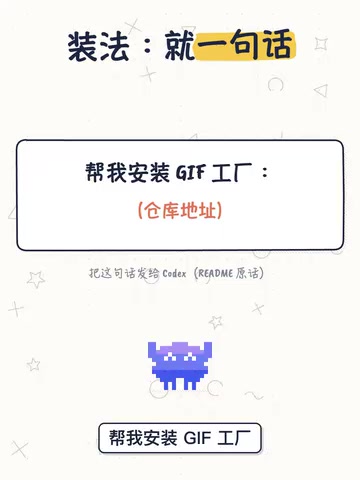
Codex is an AI coding agent launched by OpenAI (originally released as a CLI tool, later integrated into ChatGPT). It can read files, execute commands, install dependencies, and modify code in a local environment. Unlike chatbots that can only converse, Codex has the ability to "get things done": when a user sends it a GitHub repository address along with an installation instruction, it automatically clones the repository, reads the README, installs the required dependencies as described, and completes configuration. This is exactly the prerequisite that allows GIF Factory to be installed with a single sentence — the agent replaces the traditional terminal operations that would otherwise need to be executed manually one by one. Tools with similar capabilities include Claude Code, Cursor Agent, and others, which together represent a new interaction paradigm of "driving the development environment with natural language."
Three Types of Animated Images, from Stickers to Posters
Stickers: Generate Multiple Different Expressions from a Single Character Image
The first category is stickers, with styles including pixel art, illustration, pets, and more. The repository directly includes 244 ready-made examples. You can provide a character image and say "make 12, each with a different expression," and it will batch-generate based on that character. For those who want to make a set of stickers with their own catchphrases for a colleague group chat, this is far more reliable than hunting for images everywhere.
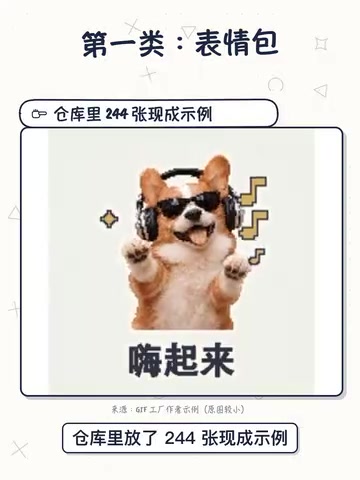
"Provide a character image, batch-generate multiple different expressions" typically relies on two types of technology: first, image generation models (such as the Stable Diffusion series) combined with character consistency control, using methods like IP-Adapter, LoRA, or reference-image conditioning to keep the same character's appearance stable across different expressions; second, expression driving or image-to-image editing, which changes facial features and demeanor according to text descriptions. During batch generation, the tool breaks down "12 images, each with a different expression" into multiple sets of prompts or parameter combinations, then renders each one and composites them into a GIF. Understanding this helps set reasonable expectations: the stronger the character consistency, the slower the generation tends to be; the greater the differences between expressions, the more likely manual selection will be needed.
Transition Cards: Switching Back and Forth Between Two Images
The second category is transition cards. You provide two images, and the card switches back and forth between the two looks. The examples the Bilibili creator gave are everyday vs. transformation and two color schemes of a product, suitable for lightweight comparison displays or fun animations.
Transition cards are essentially the simplest two-frame looping animation: two images of the same size are played alternately, with easing or brief pauses controlling the rhythm to create the visual effect of "switching back and forth." Common implementations include inserting transition frames between the two frames, using cross-fades, or simply hard-cutting to create a sense of contrast. Because the barrier to entry is low, it is often used in scenarios that need to emphasize differences, such as "everyday/transformation" and "product color comparison." Note that the closer the two images are in composition, subject position, and canvas ratio, the less jarring the switch will be, and the more natural it will look.
Animated Posters and Animated Signatures
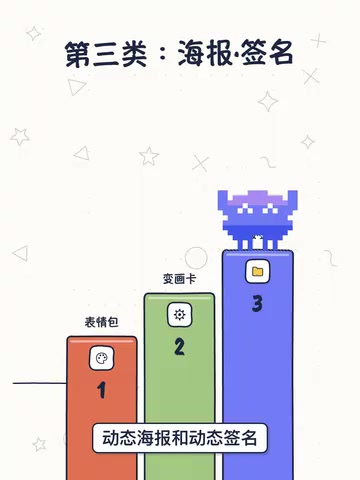
The third category is animated posters and animated signatures. In posters, the character and large text change together; signatures write out the name stroke by stroke. These are suitable for personal branding or event promotion scenarios.
A Word of Caution Before Use: Tools Are Prepared by Function
The author states clearly in the README which tools are needed at runtime, and they are prepared separately by function. In other words, the environments required for making stickers and for making animated posters may differ — it's not simply a matter of installing once and being done.
The Bilibili creator's advice is practical: make a small sample first, and only batch-produce once it looks right. This both verifies the result and avoids wasting time after batch generation only to find the style is off.
The MIT license is the most common type of permissive open-source license. It allows users to freely use, copy, modify, merge, publish, distribute, sublicense, and sell the software, provided the original author's copyright and license notices are retained. For commercial users, this means the project can be integrated into their own products or external services without disclosing their own source code, and without the original author providing any warranty. By contrast, GPL-type licenses require derivative works to be open-sourced as well, and AGPL further covers network service scenarios. So "MIT license" is a substantive advantage here: it lowers the legal barrier to secondary development and commercial use.
Why It's Worth Paying Attention To
This project pushes the barrier to "AI-generated animated images" down to nearly zero: no need to know video editing software, no need to write code, and no need to memorize complex prompts — just clearly state what you want in natural language. Over 1,900 stars and an MIT license mean it has already received a certain amount of community validation and can be freely used commercially and modified.
For content creators, community operators, and indie developers, this is a practical tool that can directly eliminate the steps of searching for images and outsourcing design. The batch sticker scenario especially stands out: making a专属 set of stickers using your own or your team's character image will have far greater reach and recognizability than generic stickers.
Of course, it's not fully automatic magic — preparing the runtime environment and testing samples both take some time to get the hang of. Treat it as a tool that needs tuning rather than a one-click image button, and your expectations will be more reasonable.
One-line Summary
GitHub open-source project GIF Factory, nearing 2,000 stars, batch-generates animated stickers and posters with a single command.
Paragraph Summary
The article introduces "GIF Factory," a Chinese open-source project on GitHub under the MIT license with over 1,900 stars. Its core usage is extremely simple: send the repository address to Codex and say "help me install GIF Factory," then describe what you want to make, and the agent will execute it. The project includes three categories of ready-made examples: stickers (provide a single character image to batch-generate multiple different expressions; the repository contains 244 ready-made examples), transition cards (two images switching back and forth), and animated posters and animated signatures. The author reminds users that runtime tools are prepared separately by function and recommends making a small sample to verify the effect before batch generation. The article argues that the project lowers the barrier to AI-generated animated images to nearly zero, making it suitable for content creators, community operators, and indie developers to save time on finding images and outsourcing design, though it still requires time to prepare the environment and tune.
Related articles

Baseten Releases Bison-1 and Groundhog-1, Topping the Decision Model Leaderboard
Baseten releases open-weight decision models bison-1 and groundhog-1 built on Gemma 4; bison-1 scores 76 on the AA Decision Index v2.1 to top the leaderboard. Both support 128k context and image input—here we analyze their capability combination, benchmark significance, and selection advice for developers.

Cline CLI v3.0.75 Released: Yolo Mode Now Default for One-Shot Runs
Cline CLI v3.0.75: one-shot runs now default to yolo mode, --timeout and Ctrl+C can interrupt the first round, read_files is no longer truncated to 8k chars, plus reasoning parameter fixes and 94 new providers.

Cline Desktop v0.0.50 Update: Model Catalog Overhaul and Reasoning Control Fixes
Cline Desktop v0.0.50 fixes Reflection Beam 400 errors, misdelivered reasoning parameters, and stuck compaction; read_files no longer truncates to 8k characters; adds 94 providers and changes 67 default models.