GitHub Trending Project AI-Coding: One-Stop Hub for Claude Code, Codex, and Cursor Free Credits
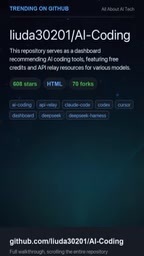
GitHub project AI-Coding aggregates proxy sites and free credits for Claude Code, Codex, and Cursor, trending with 608 stars.
A GitHub project called liuda30201/AI-Coding has hit the trending charts with 608 stars. Built in HTML and positioned as a "one-stop AI coding access portal," it aggregates proxy sites, free credits, signup perks, check-in events, and user reviews for Claude Code, Codex, and Cursor. The page includes recommended rankings, site announcements, auto-updates, detailed reviews, usage tips, and important notices, plus a real-time dashboard and Python data tools to present channel status in a data-driven way. The article notes that such projects are popular because AI coding tools have high paid barriers and scattered free credits, but third-party proxy channels carry stability, data security, and compliance risks that developers should carefully assess.
One Hub Solves AI Coding Tool Access Headaches
AI coding assistants are changing the way developers work, but tools like Claude Code, Codex, and Cursor each come with their own access barriers, quota limits, and signup processes that leave many developers frustrated. According to the YouTube channel "All About AI Tech," a GitHub project called liuda30201/AI-Coding recently hit the trending charts. Positioned as a "one-stop AI coding access portal," it has already earned 608 stars.
The project is built in HTML, and its core idea is straightforward: aggregate scattered free-credit information, signup perks, check-in events, and user reviews onto a single page to lower the barrier for developers seeking AI coding resources.
What Does It Aggregate?
According to the video, AI-Coding aggregates information on proxy sites and free credits for Claude Code, Codex, and Cursor. Specifically, it includes the following modules:
- Recommended site rankings: Ranks and recommends various proxy and access channels
- Site announcements: Posts the latest updates from each channel
- Auto-updates: Keeps information current
- Detailed reviews: Offers commentary on the user experience of each channel
- Usage recommendations: Helps developers choose the right option
- Important notices and file maintenance: Makes it easy for users to quickly locate key information

In essence, this structure is an information navigation site. It doesn't provide AI coding capabilities itself—it helps developers answer "where to use it, how to use it for free, and which channel is reliable."
What is a proxy site for AI coding tools?
In the context of tools like Claude Code, Codex, and Cursor, a "proxy site" typically refers to a third-party API proxy service. Since some AI coding tools require overseas accounts, credit cards, or have regional restrictions, developers may face hurdles when subscribing directly to official services. Proxy sites purchase official API quotas in bulk or share them, then distribute them to users at lower prices or as free credits, thereby lowering the barrier to entry. These services generally provide API-compatible interfaces—users simply replace the API endpoint and key in their tools with the information provided by the proxy site. However, proxy sites are not officially authorized, and their stability, data privacy, and compliance are all uncertain; they may also become unavailable at any time due to changes in official policy.
Why Are Projects Like This Popular?
The paid barriers for AI coding tools are not low. Claude Code, Codex, and Cursor each have their own pricing systems, and free credits are often scattered across different channels with time limits—ordinary developers find it hard to keep track consistently. AI-Coding attempts to centralize fragmented information through community maintenance.
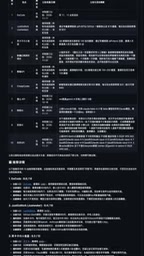
According to the project description, it also offers a real-time dashboard and Python data tools, indicating that the maintainers want to present channel availability and quota changes in a data-driven way rather than just a static list of links. For developers on a budget who still want to experience cutting-edge AI coding capabilities, this kind of aggregation site does solve a real problem.
How Claude Code, Codex, and Cursor Differ in Positioning
Although all three serve coding scenarios, their product forms and access methods differ. Claude Code is Anthropic's command-line AI coding assistant, deeply integrated into terminal workflows and reliant on the Claude model API. Codex was originally OpenAI's series of code generation models, later evolving into the technology behind GitHub Copilot, and now also refers to OpenAI's code agent product. Cursor is an AI-native editor built on a fork of VS Code, with multiple built-in models to choose from. The three have different payment systems, free quotas, and registration requirements, and official free credits often come with time and usage limits—exactly the information fragmentation that aggregation projects try to solve.
Risks to Watch Out For
Projects that aggregate proxy sites inherently carry uncertainty. The stability, data security, and compliance of proxy channels are hard to guarantee, and developers using Claude Code or Codex through third-party channels should carefully assess the security of their code and data. The project itself includes an "Important Notices" section, which indirectly suggests that channel status may change frequently.
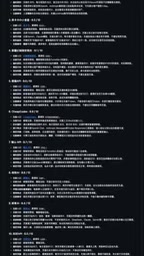
Additionally, the project is implemented in HTML with a low technical barrier, and its long-term maintenance quality depends on community contributions. 608 stars indicates a certain level of attention, but it is still far from being a mature tool.
Typical Security Risks of Using Third-Party Proxy Channels
When using AI coding tools through unofficial proxy sites, code and data pass through third-party servers and may be recorded, leaked, or misused. Developers should avoid processing sensitive code, keys, trade secrets, or user data through proxy channels. Moreover, proxy sites may violate official terms of service, leading to account bans or sudden service interruptions; some proxy sites may also carry out attacks by tampering with responses or injecting malicious code. On the compliance side, using unauthorized channels in enterprise environments may violate internal security policies or data protection regulations. It is advisable to prioritize official free credits or legitimate subscriptions; if third-party channels must be used, limit the input of sensitive information and maintain local backups.
Is It Worth Following?
If you're looking for free ways to use Claude Code, Codex, and Cursor, or want to see genuine reviews of various proxy sites, AI-Coding is worth bookmarking. But while treating it as a way to score freebies, don't forget to stay cautious about third-party channels. At the end of the day, the core competitiveness of AI coding lies in development skills themselves—tools are just aids.
Related articles

Anthropic Goes Public: AI Bubble or Buying Opportunity?
Anthropic lists on Nasdaq, opening about a third above its IPO price. We break down the $81.3B raise, $1.5T offering valuation, and $2T market valuation, plus Claude's growth and $567M quarterly operating loss.

Why the FBI's AI Hacker Warning Hinges on a Single Word from Microsoft
FBI says AI tool Artex attacked 2,250+ organizations, but the citation trail leads to Microsoft's wording of "attempted sign-ins." The gap between attempts and breaches reveals the attack's true scale.

Fable 5.2 Powers the Creation of Getsumen Express: A Browser-Based Lunar and Martian Exploration Game
A developer used Fable 5.2 to build Getsumen Express, a browser game where players explore the Moon and Mars, scan real landmarks, shoot aliens, and ride an interstellar train. Built on Three.js and WebGPU for about $730, it showcases AI-assisted development.