GitHub Tweet Leaks Next-Gen Model Codename Odango, EAP Program Surfaces

GitHub tweet video leaks undisclosed codename Odango, community speculates it corresponds to an EAP for a next-generation model, but there is no official response.
A video posted by GitHub's official X account featured the previously undisclosed codename "Odango," which Reddit users interpreted as the name of an Early Access Program (EAP) and speculated corresponds to an upcoming new model. The news spread quickly through the developer community, with discussion focusing on whether Odango means a code completion upgrade, the introduction of multimodal capabilities, or a new enterprise-facing model. However, the information source is singular, GitHub has neither used wording such as "model" or "EAP" nor made any official statement, and defining it as a "next-generation model" carries a risk of over-interpretation. The article advises developers to follow official blogs and Changelogs, view codename leaks rationally, and avoid relying on fragmented interpretations on social media.
A tweet from GitHub's official account on X accidentally leaked a codename called "Odango," which likely points to an unannounced new model. The name appeared in a video attached to the tweet and quickly sparked discussion on Reddit and other communities.
What Is Odango? Breaking Down the Leak
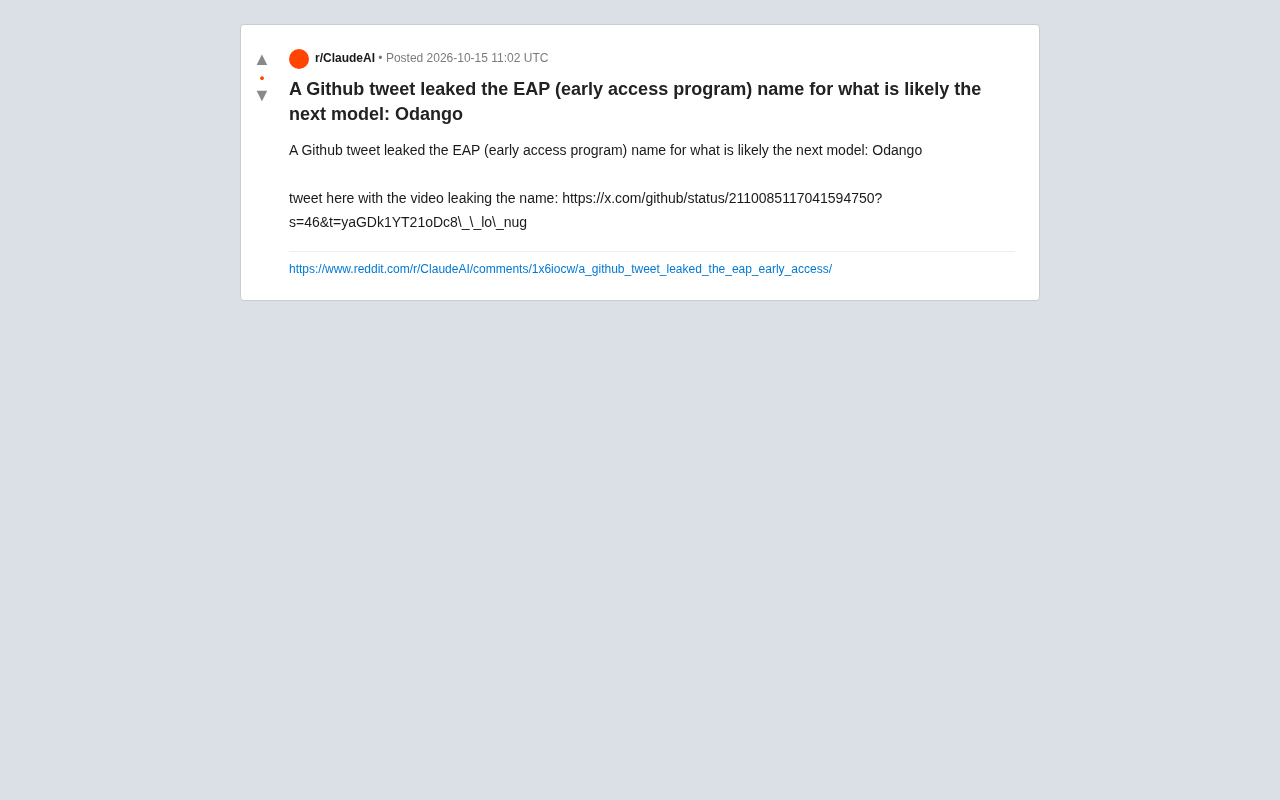
According to a Reddit user's discovery, GitHub's official account on X posted a video in which the name "Odango" appeared. The poster interpreted it as the codename for an EAP (Early Access Program), believing it most likely corresponds to the next model about to be released.
In the developer tools space, EAP typically refers to a phased program that opens a product to select users for testing before its official launch. GitHub has previously run similar early access mechanisms on product lines such as Copilot, so the exposure of this codename is seen by outsiders as a signal of the next round of product updates.
So far, GitHub has not made any official statement about Odango. The tweet itself did not include a detailed product description or feature list — the information is limited to a codename and the context in which it appeared.
Why a Codename Is Worth Paying Attention To
On its own, the word "Odango" doesn't reveal much technical detail. But given GitHub's recent product cadence, there are several reasons why the leak of this codename has drawn attention.
As the world's largest code hosting platform, GitHub's model-related moves often directly affect the daily workflows of a large number of developers. Whether it's a switch in the underlying model for Copilot or the launch of new code generation capabilities, news tends to spread quickly through the developer community.
The EAP naming suggests this may not be a minor version iteration. Early access programs are typically used to carry important features that need real user feedback to refine, rather than routine bug fixes or interface tweaks.
Judging from community reactions, discussion on Reddit about the tweet centers on guessing what specific capabilities Odango corresponds to — whether it's an upgrade to code completion, the introduction of multimodal support, or a new model aimed at enterprise scenarios. None of these guesses currently have official backing.
The relationship between GitHub Copilot and its underlying models: GitHub Copilot is an AI programming assistant launched by GitHub. Its code completion, chat Q&A, and other capabilities are not provided by models developed in-house by GitHub, but rely on underlying large language models from partners such as OpenAI. At its 2021 debut, it used OpenAI Codex, and since then it has switched foundations multiple times as models like GPT-3.5 and GPT-4 have iterated. Precisely because the model layer is provided externally, every "heart transplant" at GitHub requires re-tuning prompts, context windows, and latency performance — which is why its model movements are so keenly tracked by developers.
How EAP (Early Access Program) typically works: Early access programs are a common release strategy in the SaaS and developer tools industry, usually kicking off 3-6 months before a product's official GA (General Availability). Participants often need to sign NDAs or join a waitlist, and their feedback directly influences feature decisions. For vendors, an EAP can both validate stability with a small-scale real traffic sample and build up case studies and reputation in advance. Microsoft, Google Cloud, and AWS have all used this mechanism when launching new AI services, so a codename tied to an EAP usually means the project has entered a testable delivery stage rather than a pure concept stage.
The Limits of Cross-Verifying Multi-Source Information
The source of this leak is relatively singular. The core evidence comes from a segment of video in GitHub's official tweet and a Reddit user's interpretation. As of now, no other independent source has cross-verified this codename.
GitHub's official tweet itself did not use wording such as "model" or "EAP" — those labels were added by the community during the process of spreading the news. This means Odango's actual reference could be broader than the community guesses, or more specific; it cannot be confirmed from existing information.
In the absence of official confirmation, directly equating Odango with a "next-generation model" carries a risk of over-interpretation. A more cautious judgment is: GitHub did indeed use a previously undisclosed codename in a tweet, and the product form corresponding to that codename remains unclear.
Common naming logic for tech company product codenames: Codenames are typically used for internal project initiation and cross-team communication, to avoid locking in a product positioning before the official name is finalized. Common naming styles include place names, fruits, constellations, anime characters, and so on, and they often have no direct correspondence to product features. For example, Google once named Android versions after desserts, and Microsoft used cities and mountain ranges to codename Windows. This means that from the single word "Odango" (which means "dumpling" in Japanese), it is very difficult to infer its technical attributes. Cases of codenames being over-interpreted during the leak stage and the final product being renamed or cut are common in the industry, which is one reason community discussion needs to stay measured.
Practical Impact on Developers
If Odango is ultimately confirmed to be related to model capabilities, what developers care about most is usually a few practical questions: whether existing APIs are compatible, whether pricing changes, and whether the calling method needs adjustment.
Referring to GitHub's past update cadence on Copilot, early access programs usually open first to some paid users or enterprise customers, then gradually expand. If Odango follows a similar path, there may be some delay before ordinary developers perceive the change.
Before official information is released, developers are advised to follow GitHub's official blog and Changelog page rather than relying on fragmented interpretations on social media. Codename leaks are not uncommon in the tech industry, but there are often significant variables between a codename and a formal product — some products corresponding to codenames are ultimately canceled or renamed.
Summary
The exposure of Odango is more of a signal than an answer. It shows that GitHub is brewing something new, but exactly what it is, when it will arrive, and what it means for developers are all still open questions. Until the official side breaks its silence, staying attentive without over-interpreting is the more rational attitude.
One-line Summary
A GitHub tweet video leaked the undisclosed codename Odango, and the community speculates it corresponds to an EAP for a next-generation model, but there has been no official response.
Paragraph Summary
A video posted by GitHub's official X account featured the previously undisclosed codename "Odango," which Reddit users interpreted as the name of an Early Access Program (EAP) and speculated corresponds to an upcoming new model. The news spread quickly through the developer community, with discussion focusing on whether Odango means a code completion upgrade, the introduction of multimodal capabilities, or a new enterprise-facing model. However, the information source is singular, GitHub has neither used wording such as "model" or "EAP" nor made any official statement, and defining it as a "next-generation model" carries a risk of over-interpretation. The article advises developers to follow official blogs and Changelogs, view codename leaks rationally, and avoid relying on fragmented interpretations on social media.
Related articles

FunOS Lightweight Linux Review: JWM Window Manager and Blazing-Fast Installation
FunOS is a lightweight Ubuntu LTS-based Linux distro using the JWM window manager, removing Snap for blazing-fast installation. This article details its installation flow, preinstalled software, resource usage, and the Rust toolchain controversy, assessing whether it suits older hardware.

Trained Two ML Models but Forgot the Accuracy: AI Practice Lessons Behind a Self-Deprecating Post
A developer jokes about training sentiment and 59-language classifiers but forgetting accuracy and losing datasets. We analyze why personal AI projects flop and why model documentation matters.

CodeSmith Injection Defense: Constitution, Sanitization, and Approval Gates
A deep dive into CodeSmith's six-layer prompt injection defense: constitutional hierarchy, Unicode sanitization, permission ratchets, semantic command analysis, network boundaries, and output forgery prevention.