GitHub-Viral REA Hands-On: AI Reverse Engineers Any Software—Are Developer Moats Dead?

Open-source REA lets AI agents reverse engineer closed-source software via Ghidra/IDA Pro, erasing the reverse-engineering barrier and reshaping how we think about software moats.
REA is an open-source MCP server plus CLI tool that plugs into AI agents like Claude Code and Cursor, wrapping Ghidra and IDA Pro so AI can autonomously analyze native binaries, APKs, firmware, and other closed-source software. It doesn't output original source code but provides evidence-chained pseudocode, assembly, and call paths, with each finding tagged by source and confidence. In testing, REA located verification logic among 242 anonymous functions and generated an unlock-code generator the original app never had, demonstrating "understanding logic rather than copying code." The article notes that the high barrier to reverse engineering was an invisible moat for the software industry; REA eliminates that friction, making client-side code no longer a protective asset and shifting real moats to data, users, cloud security, and product taste. It also warns about legal boundaries, prompt injection risks without sandbox isolation, and breaking changes from rapid iteration.
An open-source project surged nearly 8,000 GitHub stars in a single day, enabling AI coding assistants to "see through" software without source code—not by copying code directly, but by understanding the logic and regenerating it. This project, called REA, is upending an unwritten rule the software industry has relied on for decades.
What REA Is: Not a Decompiler, but an "AI Reverse Engineer"
According to Bilibili creator Rob Shocks (with 20 years of software development and product management experience), REA stands for Reverse Engineer Anything. It is essentially an MCP server plus a CLI tool that can plug into any MCP-compatible AI agent such as Claude Code, Cursor, or Codex. Its goal is straightforward: when you see a feature in an app you'd like to implement in your own product, you can have an AI agent investigate how that feature works—even if you don't have the app's source code.
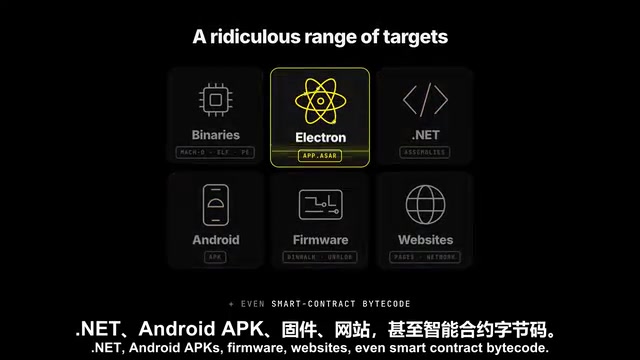
Its coverage far exceeds what many assume to be just Electron apps. Rob emphasizes that REA targets native binaries on Mac, Windows, and Linux, as well as .NET programs, Android APKs, firmware, websites, and even smart contract bytecode. These constitute the vast majority of everyday desktop software.
One common misconception needs clearing up: REA does not "give you back" the original source code—once compiled, the original code no longer exists, and no tool can recover it. What it outputs is pseudocode, assembly, module maps, call paths, and network activity logs, with evidence attached to every finding explaining why the AI concluded the code was built that way. Each conclusion is also tagged with its source, model confidence, and the parts it couldn't figure out. This kind of evidence-chained reverse analysis used to require significant money and time.
MCP (Model Context Protocol) is an open protocol proposed by Anthropic to standardize interactions between AI models and external tools and data sources. MCP servers expose various tools (such as file systems, databases, APIs) as functions callable by models, and AI agents discover and invoke these tools through MCP clients. This allows AI agents to dynamically extend their capabilities without writing separate integration code for each tool. As an MCP server, REA registers its reverse-engineering toolset (such as opening binaries, finding strings, tracing calls) as MCP tools, so any MCP-compatible AI agent (like Claude Code or Cursor) can use these capabilities directly, completing complex reverse-engineering tasks within a conversation.
Technical Architecture: Standing on the Shoulders of Ghidra and IDA Pro
REA itself is not some revolutionary decompilation technology. Its cleverness lies in encapsulation. Under the hood, it calls mature tools that reverse engineers have used for years—the free and open-source Ghidra (from the NSA) and the commercial standard IDA Pro. In other words, these reverse-engineering capabilities have always existed; they just came with an extremely steep learning curve and high cost of use.
What REA does is wrap these tools into dozens of plain-text tool interfaces exposed to AI agents: open a binary, find strings, trace function callers... letting the agent figure out and understand the code structure step by step on its own. Installation is also quite simple—a single npx rea-agent setup command. It shows what it will modify, backs up configurations, adds the MCP server and skill instructions, and asks for confirmation before touching critical configs.
Rob personally ran a fair test in the video: he wrote a "vault" app with unlock-code verification, compiled it the way a real release would be—stripping all function names and enabling optimizations. Then he had REA, connected to Ghidra, analyze it. The result: out of 242 anonymous functions, the agent located the key verification function within a few calls and ultimately generated a set of valid unlock codes. More notably, REA didn't copy the original code—it understood the logic and wrote a code generator that the original app didn't even have.
Ghidra is a disassembly and decompilation framework open-sourced by the U.S. National Security Agency (NSA) in 2019, supporting multiple processor architectures and executable formats. It can convert binary machine code into readable C-like pseudocode and provides capabilities such as function call graphs, cross-references, and script extensions. Ghidra is completely free, has an active community ecosystem, and is a top choice for academic research and security analysis.
IDA Pro is the long-standing standard in commercial reverse engineering, known for its powerful interactive disassembly, debugging, and plugin system. Its free version, IDA Free, has limited functionality, while the full version is expensive. IDA Pro is widely used in complex binary analysis and malware research, but its learning curve is steep and requires deep understanding of assembly language and operating system internals.
By wrapping these two types of tools into AI-callable text interfaces, REA essentially adds a natural-language interaction layer on top of mature reverse-engineering capabilities, allowing users without specialized reverse-engineering skills to complete analysis with the help of AI agents.
What's Really Changed: The Barrier to Reverse Engineering Has Vanished
Rob makes a key observation: the software industry has long enjoyed an unspoken protection—reverse engineering has always been feasible, but it's slow, requires specialized skills, and is expensive, so almost no one bothered. That "friction" itself was the moat. REA's significance is that it essentially eliminates that friction.
To those worried about "planes falling out of the sky"-style security disasters, Rob is skeptical: breaking into a system still involves many hurdles, and REA is not a one-click hack. But for anyone shipping client-side software—desktop apps, browser extensions, games, mobile apps, large front-end JS bundles—you should assume by default that anyone's AI agent can figure out how it works. He predicts some interesting GTA 6 mods in the coming months.
This isn't a disaster; it's a correction. Code was never the real barrier for most teams. The real moats are in data, users, cloud security, delivery speed, product taste, and the parts that run on your own servers where others can't peek. Conversely, REA is also a great self-audit tool: you can throw apps from your machine at it and ask exactly what this thing does and where it sends data. There are no shortage of cases where 3D printers and coffee machines were caught secretly transmitting data back.
Prompt injection attacks are security threats in which attackers embed malicious instructions in input data to trick AI models into performing unintended actions. In REA's use case, the binary being analyzed may contain carefully crafted strings or metadata; when the AI agent reads this content, it may be misled into dangerous operations (such as leaking sensitive information or modifying system configurations). Because REA runs with user privileges and has no sandbox isolation, the prompt injection risk is particularly acute. Mitigation measures include: keeping the AI agent's approval prompts enabled, only analyzing binaries from trusted sources, and running analysis tasks in isolated environments.
Three Things You Must Know Before Using It
Rob repeatedly emphasizes risks in the video, and these three points deserve serious attention from anyone wanting to try it:
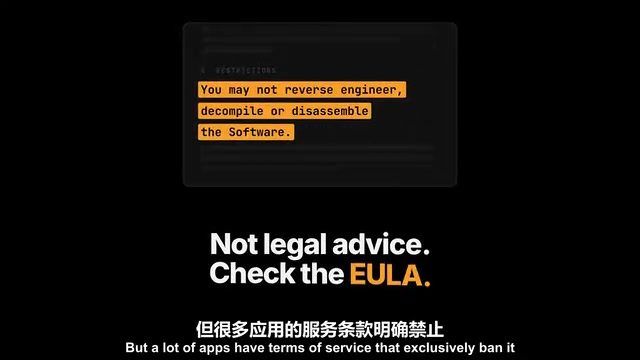
Legal boundaries. Reverse engineering for interoperability is protected in most jurisdictions, but many apps' terms of service explicitly prohibit reverse engineering. Cracking DRM or encryption is another legal issue entirely. Safe use cases are: your own apps, open-source binaries, security challenges, and authorized test targets. REA's own disclaimer also states: the responsibility is yours.
This is not a sandbox. REA runs with your privileges and performs runtime capture. Don't run binaries you casually downloaded from forums. Always keep the AI agent's approval prompts enabled and know what it's doing at all times—you never know what kind of prompt injection attack is hiding in a binary.
The project iterates extremely fast. The repository is evolving rapidly, and breaking changes are the norm. If you use it, you'll need to keep updating.
Engineer's Perspective: How to Use It, and How Not To
Rob's advice is pragmatic: it's suitable for learning how excellent desktop apps handle engineering problems like offline scenarios and local storage. But you shouldn't directly clone competitors—it carries legal risk and misses the point. The right approach is to understand the ideas and then build something better. After all, it's hard to beat the original vendor on marketing; the core of competition now is distribution.
He ends the video with a question: if you could use REA on just one feature of one app, what would you choose?
The core of this discussion isn't really about the tool itself. When evidence-chained AI reverse analysis becomes as easy as installing an npm package, the software industry needs to reconsider one question: what are you really selling—the compiled binary, or the capabilities behind it that others can't copy?
Related articles

Software Factory in Practice: Building an Evaluable Self-Evolving Development Pipeline with Codex and Claude Code
Deconstructing a Codex and Claude Code software factory: control/data plane separation, foreman prompts for consistency, automatic triggers, and data-driven evaluation.

WorkBuddy Full Guide: How an AI Coworker Takes Over Workplace Automation
What is WorkBuddy? This article analyzes the core capabilities of this full-scenario AI agent: autonomous execution with deliverable results, local file processing, multi-agent parallelism, and workplace automation workflows, helping you judge its essential difference from ordinary AI chat tools.

The Truth About AI Agents: A Hundred Lines of Code + an LLM, Deconstructing the Agent's Underlying Logic
AI agents aren't a new AI species—just a language model plus tools, a loop, and a goal. Here's the underlying logic: how 100 lines of Python hit a 75% fix rate, why the harness beats the model, and Gartner's "agent washing."