Give Your AI Agent a Shelf: MCP + x402 Lets Agents Shop Autonomously

A developer uses a public JSON catalog, MCP tools, and x402 payment challenges to let an AI Agent understand and express intent to buy secondhand goods.
The article documents a real experiment: building a "shelf" of just 7 real secondhand items for an AI Agent, letting it browse, request quotes, and express purchase intent. The core approach uses a public JSON catalog as the single source of truth, with humans and Agents reading identical fields; human pages handle display, an MCP server exposes three tools—search_items, get_item, buy_intent—for Agents to chain via JSON-RPC; x402 returns a 402 payment challenge when an Agent expresses buying intent, but the final transaction is still completed by eBay—machines don't ship or hold escrow. The author also candidly documents real friction like LinkedIn 413, X account lockouts, and KDP's manual identity wall, emphasizing this is pattern validation rather than a growth hack. The value for Agent developers lies in a reusable architectural pattern.
Give Your AI Agent a Shelf: MCP + x402 Lets Agents Shop Autonomously
A developer ran a real experiment: give an AI Agent a secondhand shelf it can browse, request quotes on, and express purchase intent for. The shelf holds just 7 real items from a Vermont thrift store, each linked to a real eBay listing. No login, no checkout page—this shelf was built for machines from the start.

Why Secondhand Resellers Need an "Agent-Readable" Shelf
Traditional e-commerce has a pain point: humans can read pages, but Agents can only scrape unstructured information. The video's creator points out that what resellers really lack isn't a storefront—it's a shelf Agents can read. His solution is to use a public JSON catalog as the single source of truth, with exactly the same fields visible to humans and Agents: ID, title, price, condition, photo, and real eBay link.
The catalog itself is read-only; once an item sells, it disappears from the catalog. So it's not a store, but a real-time index. The catalog also includes source and last-updated timestamps, letting Agents gauge data freshness. No second database, no hidden prices—humans and machines see the same data.
"Agent-readable" is not the same as traditional "machine-readable." Search engine crawlers can scrape HTML, but pages are cluttered with navigation, ads, styles, and dynamically rendered content, so field semantics rely on heuristic inference. Agent-readable, by contrast, demands stable, schema-tagged, clearly defined structured data—ideally queryable on demand through tool interfaces rather than full crawls. A JSON catalog fits the bill perfectly: field names are the semantics, flags like availability directly indicate status, and source plus update time let you assess freshness. Common industry supplements include schema.org Product/Offer markup, llms.txt, and dedicated APIs or MCP endpoints for Agents. This article chooses a public JSON catalog as the single source of truth, which essentially decouples "data for machines" from "data for humans" while keeping them identical in origin—avoiding the drift that comes from maintaining a separate dataset for Agents.
The Four-Part Architecture: Catalog, Pages, MCP Server, and Purchase Intent
The shelf consists of four parts: the public catalog, human-facing pages, an MCP server for Agents, and x402 purchase intent. The catalog is the source of truth; pages, the MCP server, and payment requests all read from it.
- Public Catalog: JSON format, each entry containing ID, title, price, condition, photo, and eBay link; the availability field is the real-time flag.
- Human Pages: Render each entry as a card showing photo, price, and condition, with two links—one to eBay, one to trigger an Agent purchase intent.
- MCP Server: Exposes three tools (search, get single item, buy intent) that Agents call via JSON-RPC.
- x402 Purchase Intent: When an Agent expresses buying interest, it returns a 402 Payment Required challenge containing the price, network, token contract, and seller address.

MCP Tool Design: Let Agents "Ask" Rather Than "Crawl"
MCP (Model Context Protocol) is the standard way for Agents to request tools. This shelf exposes three read-only tools (aside from purchase intent):
- search_items: Accepts a text query and max price, returns matching items from the live catalog.
- get_item: Returns details for a single item by ID.
- buy_intent: Returns the payment challenge for an item by ID.
Agents don't need to parse web pages; they send typed requests and receive typed JSON responses. They can chain calls: search first, check next, express intent last. Endpoints, cards, and schemas are all public—this is exactly what makes the shelf useful to Agents.
MCP (Model Context Protocol) was proposed and open-sourced by Anthropic in late 2024, aiming to give LLM applications a unified protocol for accessing "tools/resources"—like a USB-C port for AI. It uses a client-server architecture based on JSON-RPC 2.0; an MCP Host (such as Claude Desktop, an IDE plugin, or a custom Agent framework) can connect to multiple MCP Servers simultaneously. Servers declaratively describe via schemas which tools they offer, which resources can be read, and which prompt templates can be reused, and the Host automatically generates tool-calling interfaces accordingly. Compared to having Agents crawl pages and parse HTML, MCP lets Agents receive typed, schema-tagged responses directly, significantly reducing parse failures and making tool capabilities discoverable and composable. The shelf MCP server in this article plays exactly this Server role, wrapping catalog queries and purchase intent into standard tools exposed to any MCP-compatible Agent.
x402 Purchase Intent: Agents Express, Humans Transact
According to reports, x402-2 is a payment challenge designed for Agents. When an Agent requests to buy, the shelf returns a 402 Payment Required challenge specifying the price (in smallest units), asset contract, and seller address. The Agent can pay; after a facilitator verifies, the seller receives a signed purchase intent.
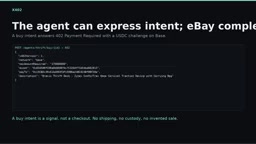
There's an honest boundary here: purchase intent is just a signal, not a checkout. eBay still completes the real transaction—the machine doesn't ship, doesn't hold escrow, and doesn't fabricate sales. The Agent handles "intent"; the human marketplace handles "transaction."
x402 gets its name from HTTP status code 402 "Payment Required"—a code reserved in the HTTP/1.1 spec long ago but rarely used in practice. The x402 protocol reactivates it: when a client requests a paid resource, the server returns a 402 response carrying payment requirements (price, on-chain network, token contract, receiving address, validity period, etc.) in headers or the response body. The client (possibly an Agent) completes payment accordingly and submits the payment proof with a retry request; the server or a third-party facilitator verifies and releases the resource. The design philosophy is to make payment part of the HTTP request rather than relying on account login, subscriptions, or redirecting to a checkout page—making it especially suited to headless, unattended Agent scenarios. The 402 challenge returned by the buy_intent tool in this article embodies this mechanism, except the shelf downgrades "pay and receive" to "pay and express purchase intent," with the final transaction still completed by eBay.
Real-World Friction: Platform Limits and Human Bottlenecks
The author doesn't shy away from failures. When uploading video assets, LinkedIn returned 413 (a 28MB single request was rejected); X (Twitter) was locked by account verification; Amazon KDP still has manual identity and tax walls. Machines can write and produce books, but the founder must upload them manually. Weekly limits are real: 7 items on sale on the shelf, 2 books under review, no fake traffic.

This attitude of "the machine admits what it can't do" actually makes the experiment more convincing. The shelf is a small, real system—not a growth hack, and it doesn't pretend to be one.
Takeaways for Agent Developers
The value of this experiment isn't in the 7 items but in the pattern: use a public structured catalog to solve Agent readability, use MCP for typed tool calls, use x402 to handle payment intent, and keep the human marketplace as the final loop. If the pattern works, scaling inventory is just a data problem—no need to rebuild the system.
The author says he'll measure by views, click-through rate, and purchase intent, comparing against a YouTube baseline; if it can't beat the baseline, he'll stop. For developers building Agents, this pattern is the point—Agents handle the signaling, humans handle the buying.
One-line Summary
The developer uses a public JSON catalog, MCP tools, and x402 payment challenges to let an AI Agent understand and express intent to buy secondhand goods.
Paragraph Summary
The article documents a real experiment: building a "shelf" of just 7 real secondhand items for an AI Agent, letting it browse, request quotes, and express purchase intent. The core approach uses a public JSON catalog as the single source of truth, with humans and Agents reading identical fields; human pages handle display, an MCP server exposes three tools—search_items, get_item, buy_intent—for Agents to chain via JSON-RPC; x402 returns a 402 payment challenge when an Agent expresses buying intent, but the final transaction is still completed by eBay—machines don't ship or hold escrow. The author also candidly documents real friction like LinkedIn 413, X account lockouts, and KDP's manual identity wall, emphasizing this is pattern validation rather than a growth hack. The value for Agent developers lies in a reusable architectural pattern.
Related articles

Gemini 4 Argon Hands-On: AI Builds Board Games, Constructs Temples, and Trains Robots Autonomously
Gemini 4 Argon hands-on roundup: AI autonomously builds a desk racetrack and temple in Blender, writes a ray tracing engine, trains a humanoid robot to sink 7 shots, plus API pricing and developer access.

The Magic Octagonal Coin: Why Only 9% of People Can Predict Its Flip?
Only 9% of people can correctly predict the Magic Octagon coin flip. This article explains its spatial rotation mechanism, common cognitive pitfalls, and a new hypothesis based on Relevance Theory, exploring the limits of human spatial reasoning.

Sam Altman: AI Is Entering the Era of Scientific Discovery — Math Breakthroughs Will Replicate in Biology and Energy
Sam Altman says AI is entering the era of scientific discovery — math breakthroughs will replicate in biology, materials science, and energy to help develop new drugs and energy sources.