Gladys Assistant 5: A Privacy-First, Self-Hosted Smart Home Platform — No YAML Required

Gladys Assistant 5 is a local-first, open-source smart home hub with no YAML and full offline support.
Gladys Assistant 5 is a free, open-source self-hosted smart home platform deployable on a Raspberry Pi or mini PC, keeping all data entirely on-premises with no third-party cloud involvement. Automations continue running even when the internet is down, delivering appliance-like reliability. The platform supports Zigbee, Z-Wave, and the next-gen Matter standard, along with 90+ community integrations. Its standout differentiator is a fully graphical, phone-first dashboard that eliminates YAML entirely — balancing data sovereignty with ease of use for privacy-conscious users who want to escape cloud lock-in.
Gladys Assistant 5: Keep Your Smart Home Data Firmly in Your Own Hands
Privacy and data control have always been central concerns in the smart home space. Most consumer smart home ecosystems rely on cloud services, meaning your household data passes through the manufacturer's servers — and if the internet goes down or the service shuts down, your entire setup could grind to a halt. The open-source, self-hosted solution Gladys Assistant was built to address exactly these pain points. Its latest version, Gladys Assistant 5, recently appeared on Product Hunt, earning 73 upvotes and landing at #15 on the day's leaderboard.
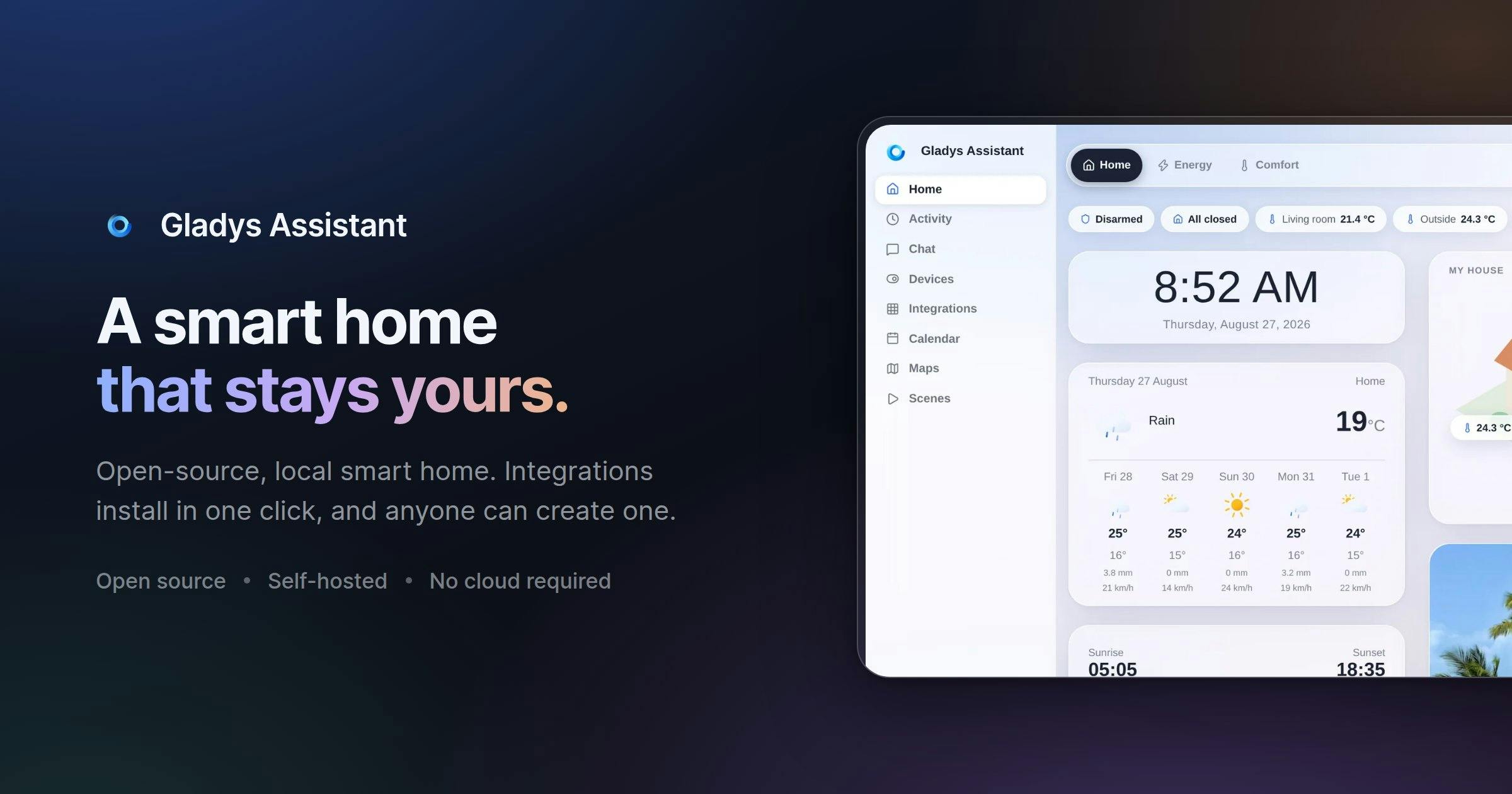
An Open-Source Smart Home Hub That Runs on Your Own Hardware
Gladys Assistant is a free, open-source smart home platform whose core value proposition is running entirely on the user's own hardware — whether that's a mini PC or a Raspberry Pi. This local-first architecture means all your home device data stays on-premises, with no need to upload anything to a third-party cloud.
For privacy-conscious users, this is a critical differentiator. When the status data from your door locks, cameras, and thermostats is stored on hardware you control, the risks of data breaches and third-party analysis are significantly reduced. The project is led by developer Pierre-Gilles, hosted on GitHub, and is a classic community-driven open-source effort.
Works Without the Internet: Local-First Reliability
Another feature Gladys emphasizes is offline availability. The official description explicitly states that the system keeps working when the internet goes down.
This is critical for the practical reliability of a smart home. Many cloud-based solutions can't even execute basic tasks — like toggling lights or triggering scenes — when the internet is unavailable, because the control logic runs on remote servers. Gladys runs its automation logic locally, so device interactions within your home network don't depend on an external connection. For users who treat their smart home as everyday infrastructure, this delivers an experience closer to a reliable home appliance.
Broad Protocol and Integration Support
In terms of device compatibility, Gladys Assistant 5 covers today's leading smart home wireless protocols:
- Zigbee: Low-power, widely used for sensors and lighting
- Z-Wave: Another major low-power smart home protocol
- Matter: The next-generation unified standard driven by an industry alliance, designed to bridge different brand ecosystems
Beyond these, the platform offers 90+ community-contributed integration plugins, covering a wide range of devices and services. This combination of standard protocol support and a rich library of community extensions gives Gladys the flexibility to handle heterogeneous device environments — which is the core competitive strength of any self-hosted smart home platform.
Matter is a smart home interoperability standard formally launched in 2022 by Apple, Google, Amazon, Samsung, and other major players through the CSA (Connectivity Standards Alliance). Built on IP networking (Wi-Fi and Thread), its goal is to allow devices from different brands to discover and control each other without relying on their own cloud services. Thread is the underlying wireless mesh network protocol for Matter, offering low power consumption and self-healing routing. It typically requires a Thread Border Router (such as an Apple HomePod mini or Google Nest Hub) to connect Thread devices to the IP network. For local-first platforms like Gladys, Matter support means being able to communicate directly with a large number of next-generation devices on the local network — without maintaining separate cloud integrations for each brand — reducing dependence on external internet connections and lowering the risk of devices becoming unusable if a brand discontinues its service.
Say Goodbye to YAML: A More User-Friendly Configuration Experience
Anyone familiar with open-source smart home platforms has probably had a love-hate relationship with YAML configuration files. Solutions like Home Assistant, particularly in their early days, relied heavily on hand-written YAML to define devices and automations — a significant barrier to entry.
One of Gladys's key selling points is that no YAML is required. It features a phone-first dashboard that lets users complete setup and daily operations entirely through a graphical interface. This design lowers the barrier for non-technical users, aiming to strike a balance between the control offered by open-source self-hosting and the ease of use found in consumer products.
YAML (Yet Another Markup Language) is a plain-text data format that uses indentation to express hierarchical relationships. It's heavily used in platforms like Home Assistant for defining device entities, automation rules, and dashboard layouts. Its strengths include version control friendliness and expressive power, but a single indentation error can cause parsing failures, and it isn't particularly intuitive for beginners. Home Assistant has been gradually shifting toward graphical configuration in recent years, but historical baggage means some advanced features still rely heavily on YAML. Gladys avoids this path entirely by design, using a graphical interface as the sole entry point. This makes configuration feel closer to a consumer app interaction model, though it may involve trade-offs in flexibility and the ability to express complex scenarios.
Positioning and Takeaways
Gladys Assistant 5 operates in a crowded field — mature open-source projects like Home Assistant and openHAB are its direct competitors. Its strategy is to differentiate with a clear set of keywords: privacy, local-first, no YAML, and phone-first. The logic is straightforward: target users who want data sovereignty without being scared off by complex configuration.
It's worth noting that Product Hunt listings primarily reflect a product's marketing positioning. Real-world stability, integration completeness, and long-term maintenance quality still need to be evaluated against your specific device environment. For users with some technical aptitude, a spare Raspberry Pi or mini PC, and a genuine concern for privacy, Gladys is worth adding to your self-hosted smart home shortlist.
Summary
Gladys Assistant 5 represents one direction in the smart home world's push toward declouding — returning control and data to the user. It's free and open-source, supports Zigbee, Z-Wave, and Matter, includes 90+ community integrations, and is built around offline availability and graphical configuration. If you're tired of cloud lock-in and YAML files, this is an open-source option worth keeping an eye on.
Related articles

Gaussian Process Bandit Optimization: Exploration Strategies and Inference Regret Guarantees
Cumulative regret guarantees in Bayesian optimization fail to reflect final recommendation quality. This article examines a new study that provides inference regret guarantees for Gaussian process bandit optimization through exploration query strategies and fill distance analysis, validated on hyperparameter optimization and control tasks.

The Most Detailed Codex Guide on Bilibili: From Installation to Real-World Practice
The most detailed Codex guide on Bilibili: from app store installation to daily work mode configuration, with a real coffee shop project demonstrating file organization, data extraction, dashboard creation, and other practical tasks. Learn to use Plan Mode and desktop pets to leverage Codex efficiently.

Appearance Compensation in Volume Rendering: Why RGB Accuracy Cannot Guarantee Density Correctness
Volume rendering research reveals that volumetric data perfectly reproducing external RGB views may still contain density errors: appearance compensation can double central density and keep external rays unchanged even when L2 error exceeds 14.52%. Density recovery depends on appearance capacity, spatial resolution, and measurement design.