Glass Page: Letting AI Agents' Work Go Through Team Review

Glass Page lets MCP agents publish output as annotatable Panes, closing the feedback loop in human-AI collaboration.
Glass Page is a Product Hunt tool (71 upvotes) that solves inefficient team review of AI agent output. Any MCP-based agent (Claude, ChatGPT, Cursor, Codex) publishes documents, images, or pages as linked Panes; teams zoom across Panes on a Canvas and start precise Threads comments. Agents read feedback and reply with new versions, with a latest link ensuring consistency. Free for 10 Panes.
AI agents can already write code, sketch prototypes, and generate documents—but how do teams efficiently review their work? Glass Page offers an elegant answer: let any MCP agent publish its output as a linked Pane, let the team zoom and browse on a Canvas and leave precise comments in Threads, and let the agent read that feedback and publish a new version. This tool, which earned 71 upvotes and ranked #12 on Product Hunt, targets precisely the weakest link in human-AI collaboration—the feedback loop.
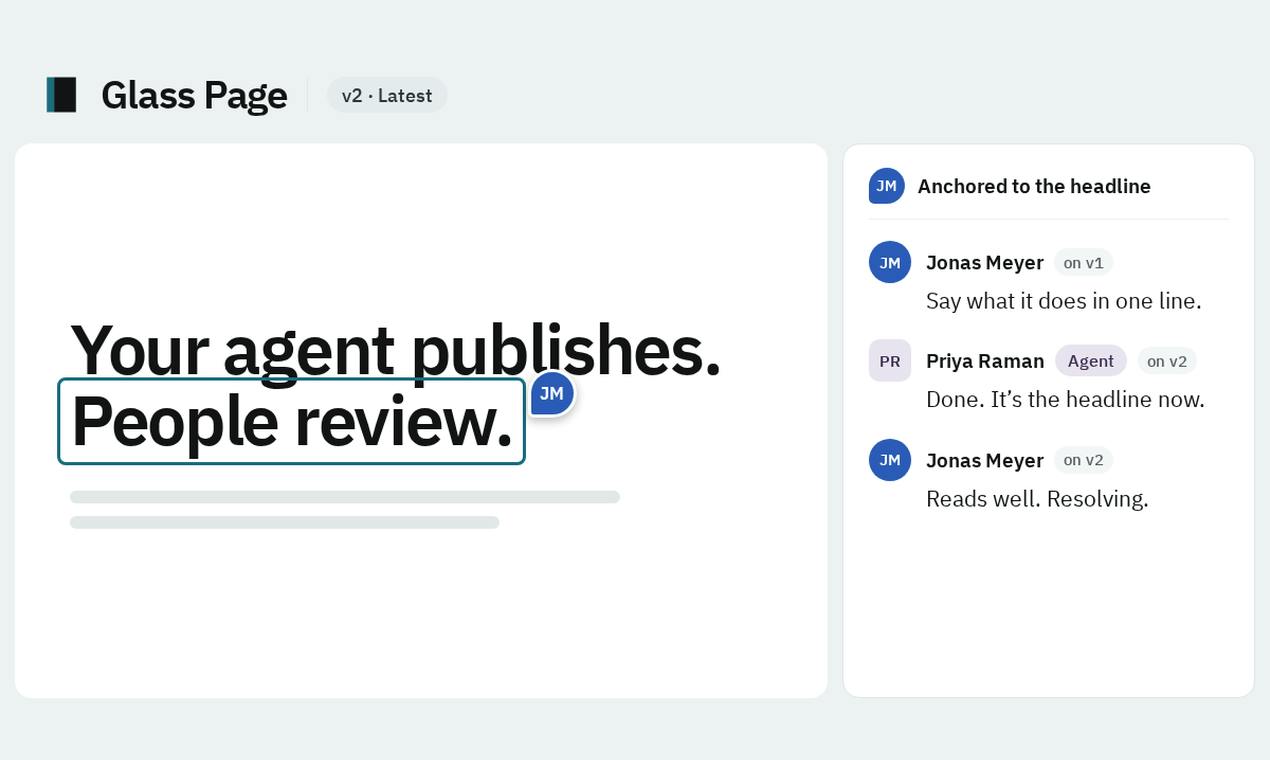
Starting from an internal collaboration pain point
Glass Page was born from a real team need. Developer Nabeel Parkar's AI agent wrote a system design document, and he wanted team members to weigh in on specific details—but existing tools either lacked the ability to anchor comments precisely or couldn't let the agent read feedback back directly. So he built Glass Page, with a core idea: turn the agent's output into a shareable, annotatable, iterable online artifact.
This starting point reveals a frequently overlooked fact—the "last mile" of AI agents isn't generation capability, it's collaboration capability. Agents can produce content quickly, but the team review, revision, and confirmation process still relies on manual handoffs, and that's where the efficiency bottleneck arises.
Three key mechanisms: Pane, Canvas, Threads
Glass Page's product structure revolves around three concepts, each corresponding to a collaboration step.
Pane is a single work unit published by an agent—it can be a document, an image, or a page. Once an agent connects via the MCP protocol, it can publish its output as a Pane and generate a link.
Canvas is the surface that hosts multiple Panes. A Canvas link lays out all related Panes in the same space, and team members can pan and zoom to browse, as naturally as reviewing a design mockup. This solves the "scattered everywhere, hard to get an overview" problem of multi-file deliverables.
Threads is the commenting mechanism. The team can start comment threads at precise locations on a Pane, rather than vaguely saying "change the third paragraph" in a chat app. The agent can read these threads, understand the feedback at specific locations, and reply with a new version. The system always keeps a "latest link," ensuring everyone sees the current version.
Together, these three mechanisms form a complete chain from publishing to review to iteration. The agent is no longer a black box that "drops off its work and leaves," but a collaborator that can continuously participate in discussion and digest feedback.
The interaction between MCP agents and Glass Page is not a simple "publish" action, but a bidirectional read-write loop. The agent submits generated documents, images, or page content to Glass Page via MCP tool calls; the latter renders them as Panes and returns a stable link. When team members leave comments in Threads, the agent can call the tools again to pull those threads, parse the text ranges or coordinate positions the comments are anchored to, and then generate a revised version and publish it as a new Pane. Through a "latest link" pointer mechanism, the system keeps old versions accessible while showing the latest content by default—preserving history while avoiding version confusion. This protocol-based tool-calling pattern means the agent doesn't need to understand Glass Page's UI details; it only needs to send and receive structured data per the MCP spec, lowering integration complexity.
Why MCP is the key fulcrum
Glass Page explicitly supports Claude, ChatGPT, Cursor, Codex, and any agent built on MCP. This positioning is worth noting. MCP (Model Context Protocol) is becoming the de facto standard for agents connecting to external tools, and Glass Page has chosen to embed itself in this ecosystem rather than binding to a single model.
This means it doesn't try to be another AI generation tool, but rather the collaboration layer between agents and teams. Agents handle production; Glass Page handles presentation, review, and version management. For teams already using Claude or Cursor, the integration cost is low, and the value lies in consolidating a previously scattered feedback process into a single traceable link.
MCP (Model Context Protocol) is an open protocol proposed by Anthropic in late 2024, intended to provide a standardized way for AI agents to connect with external tools and data sources. It uses a client-server architecture: the agent acts as the client, calling the resources, tools, and prompt templates exposed by the server through a unified JSON-RPC interface. Before MCP, every integration between every agent and every tool required custom development, and the ecosystem was severely fragmented; MCP's arrival means tool providers only need to implement a server once and it can be called by all compatible agents. Glass Page implements itself as an MCP server—once an agent connects, it can publish Panes and read comment threads, embedding itself into the workflows of mainstream agents like Claude and Cursor at very low adaptation cost. This also explains why the product emphasizes "any MCP agent" rather than a specific model—it's betting on the network effects that protocol standardization brings.
Who it fits best
Judging from its product positioning and pricing strategy, Glass Page is mainly aimed at small development teams and product design teams. The free tier supports up to 10 Panes, enough for individuals or small teams to try the core workflow. Typical scenarios include: agent-generated system design documents that need team review, AI-produced prototype pages that need collective discussion, and code generation results that need section-by-section confirmation.
Its limitations are also obvious: if a team doesn't use MCP agents, or the agent only handles scattered tasks that don't require a formal review process, Glass Page's value drops sharply. It's more like infrastructure for teams where "agents are deeply involved in creation" than a replacement for general-purpose collaboration tools.
Editorial take
Glass Page's insight is that it didn't compete on generation quality, but filled in the feedback link missing from human-AI collaboration. As agents produce more and more, "how to let teams efficiently view, review, and revise" is itself a product opportunity. However, its success depends on how fast the MCP ecosystem spreads, and whether teams are willing to migrate their review process to a new tool. The 10-Pane limit on the free tier also hints at the monetization path—moving from individual trials to team payments requires the product to go deeper on version management and permission controls.
For teams already using AI agents for real output, Glass Page offers a lightweight approach worth trying; for the broader collaboration market, it's more of a signal: collaboration tools in the agent era are shifting from "collaborating with people" to "collaborating with agents."
One-line Summary
Glass Page lets MCP agents publish their output as annotatable Panes, closing the feedback loop in human-AI collaboration.
Paragraph Summary
Glass Page is a tool that earned 71 upvotes on Product Hunt, designed to solve the problem of inefficient team review after AI agents produce output. It lets any MCP-based agent (such as Claude, ChatGPT, Cursor, Codex) publish documents, images, or pages as linked Panes; the team zooms and browses multiple Panes on a Canvas and starts Threads comment threads at precise locations. The agent can read this feedback and reply with new versions, and the system keeps the latest link to ensure version consistency. The product originated from developer Nabeel Parkar's internal collaboration pain point and positions itself as a collaboration layer between agents and teams rather than a generation tool. The free tier supports 10 Panes, suitable for small teams to try; its success depends on how fast the MCP ecosystem spreads and teams' willingness to migrate their processes.
Related articles

Prospero: A Lightweight Native AI Coding Tool Built with ImGui
Prospero is a bloat-free native AI coding tool built with ImGui, emphasizing lightweight design, high performance, and low dependencies. This article analyzes its design philosophy, technical choices, and the divergence between platformization and toolization in AI coding tools.

WebRTC Abused: New Variant of Credit Card Skimming Scripts on Shopping Sites
Security researchers found skimming scripts on popular shopping sites using WebRTC data channels to exfiltrate credit card data. This article analyzes the technical原理, differences from traditional Magecart attacks, and defense strategies for e-commerce platforms in third-party script governance and CSP policies.

Single GB10 Card Hits 101 tok/s: Inkling 2 Mini Performance Tested on vLLM
A developer shared on Hacker News running Inkling 2 Mini with vLLM on a single GB10 at 101 tok/s. This article analyzes the technical context, the significance of vLLM with small models on single cards, and caveats for interpreting tok/s metrics.