GLM-5.2 and the Media Panic: Open-Source AI Safety Controversy and Governance Dilemmas

Why the GLM-5.2 media panic reveals a deeper tension between open-source AI and safety governance.
A Reddit thread about media fearmongering over GLM-5.2 has reignited a core debate in AI: does open-source equal unsafe? This piece examines what GLM-5.2 is actually accused of, why the dual-use framing is more complex than headlines suggest, and what regulatory crackdowns on open-source model weights would mean for the AI ecosystem.
A PR Battle Over Open-Source AI
A post titled GLM-5.2 fearmongering in the press recently sparked widespread discussion on Reddit's r/LocalLLaMA community. r/LocalLLaMA is one of Reddit's most active hubs for locally-run large language models, with over 100,000 active members including AI researchers, independent developers, and tech enthusiasts. The community takes its name from Meta's open-source model released in 2023 — whose weight leak is widely seen as a turning point for the open-source AI movement, shattering the notion that frontier AI belonged exclusively to big tech. User ttkciar shared a report from tech outlet Futurism and expressed clear concern about the media's growing tendency to hype open-source AI as a threat. On the surface, this is a dispute about one specific model. In reality, it cuts to a long-standing core tension in open-source AI: the fundamental conflict between openness and safety.
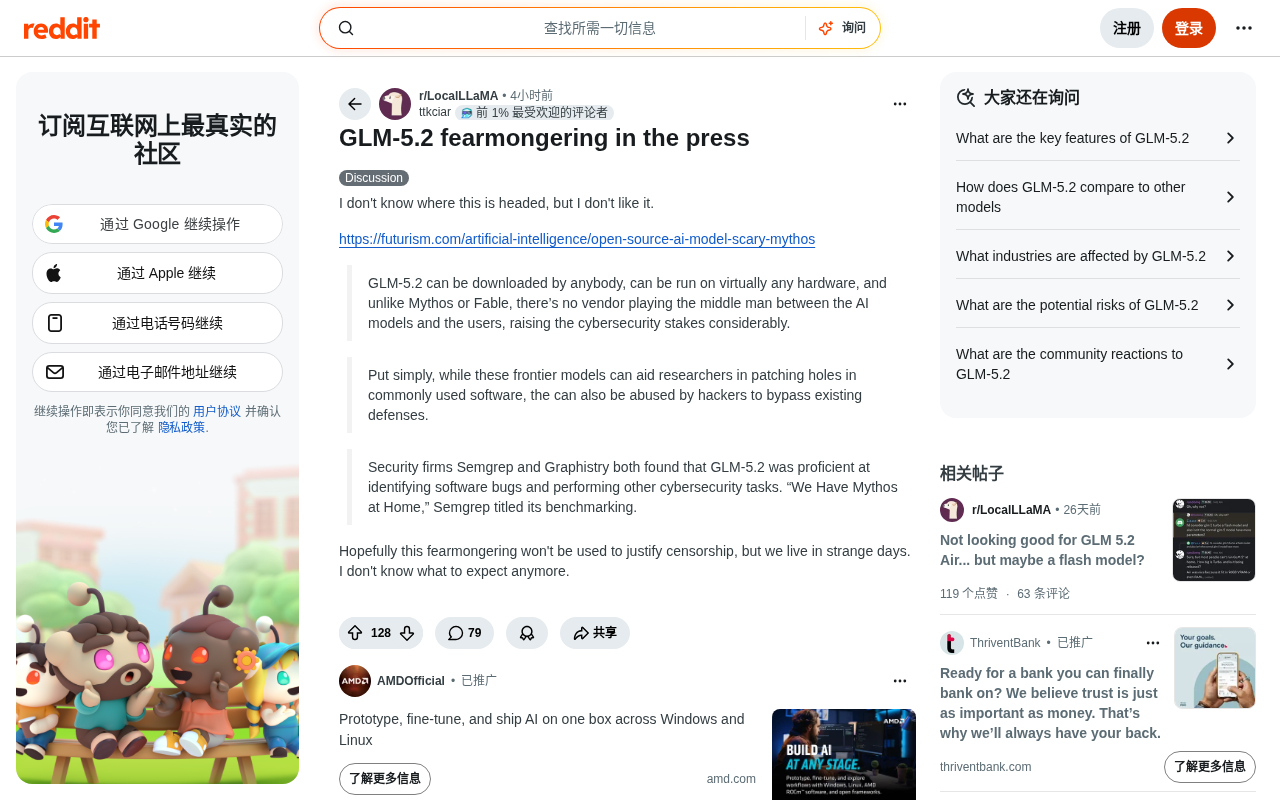
The poster's sentiment is telling — "I don't know where this is going, but I don't like it." Behind those words lies a deep anxiety within the open-source community about potential regulatory crackdowns and content censorship. In an era of rapidly advancing AI capabilities, every "safety panic" can become a concrete justification for restricting the free distribution of open-source models.
What GLM-5.2 Is Actually Being Accused Of
GLM (General Language Model) is an open-source large language model series jointly developed by Tsinghua University and Zhipu AI, known for its bilingual (Chinese-English) capabilities and open weights. Across successive versions, the GLM series has consistently improved on benchmarks for code generation, mathematical reasoning, and instruction following, and is increasingly seen as a viable open-source alternative to top-tier closed-source models. According to Futurism's report, media concerns about GLM-5.2 center on a few key points. First is its extremely low barrier to use: anyone can download the model and run it locally on nearly any consumer-grade hardware — a sharp contrast to closed-source frontier models (referred to in the report by codenames like Mythos and Fable) that require paid API access through vendors.
A Double-Edged Sword With No Middleman
The report specifically emphasizes that there is "no vendor acting as a middleman" between the user and the model. In a closed-source setup, vendors can monitor, filter, and block potentially malicious requests in real time at the API layer. Once a fully open-source model is downloaded locally, it escapes any form of external control.
From a cybersecurity perspective, this is genuinely a double-edged sword:
- Upside: Frontier open-source models can help security researchers efficiently discover and patch vulnerabilities in widely-used software, raising the overall level of defense.
- Downside: The same capabilities could be used by malicious actors to circumvent existing defenses and identify exploitable attack surfaces.
What Security Firms Found in Benchmarks
These concerns aren't pure media speculation — they're backed by empirical testing. The report cites results from security firms Semgrep and Graphistry, both of which found GLM-5.2 performed exceptionally well at identifying software flaws and executing cybersecurity tasks. Notably, Semgrep is a widely-used open-source static code analysis tool supporting 30+ programming languages, used by companies like Dropbox and Snowflake in their secure code review workflows — when a firm this deeply embedded in security tooling incorporates an AI model into its testing framework, its conclusions carry real professional weight. Semgrep even titled its test report We Have Mythos at Home, a tongue-in-cheek nod to the idea that this open-source model's capabilities are already closing in on top closed-source alternatives.
That playful title gets at the heart of the issue: when open-source models genuinely match closed-source frontier models in capability, many of the arguments historically used to justify "closed-source is safer" will need to be fundamentally reconsidered.
The Real Problem Behind the Panic Narrative
The GLM-5.2 debate is the latest iteration of a recurring theme in AI governance. Every time a powerful open-source model is released, similar "dual-use" controversies emerge.
The dual-use concept originates from regulatory practice in nuclear and biotech fields — it refers to technology or knowledge that can serve both civilian/defensive and destructive purposes. This is hardly a new debate in AI: as far back as 2018, OpenAI staged the phased release of GPT-2 weights, citing the risk of misuse from a model "too capable." That decision sparked a controversy that continues today — critics argued it was "security theater" that couldn't truly stop capable attackers while artificially creating capability barriers, ultimately serving commercial interests more than safety ones.
Democratizing Capability — and Risk
The core value of open-source AI is capability democratization — giving researchers, independent developers, and small teams access to tools on par with those available to big tech, without being subject to API pricing, access quotas, or commercial gatekeeping. But the flip side is that the same democratization applies equally to potential bad actors.
What deserves a sober assessment, though, is this: cybersecurity has always been an ecosystem where offense and defense coexist. Vulnerability-hunting tools used by security researchers can also end up in attackers' hands — this is not a problem unique to the AI era. The real question is whether defenders benefit equally from these tools. If GLM-5.2 can help attackers find vulnerabilities but also helps defenders patch them faster, its net impact may not be negative at all.
The Deeper Fear: Regulatory Crackdown
The poster's biggest worry is that "this panic narrative will be used to justify censorship." That concern is not unfounded. Policy debates over open-source AI weight releases have been intensifying: during 2023 EU AI Act negotiations, fierce debate erupted over whether to impose the same regulatory obligations on open-source models as closed-source ones — lawmakers ultimately granted open-source models some exemptions. The Biden administration's AI executive order required that training runs above certain compute thresholds be reported to the government. Think tanks like RAND have directly explored whether releases of frontier open-source models should be restricted.
If the perception that "open-source models equal uncontrollable security threats" solidifies in the public consciousness, it could generate policy pressure to limit the public release of model weights. For the open-source community, this is an existential threat: if releasing a frontier open-source model itself becomes something requiring a license — or gets banned outright — the entire foundation of the open-source AI ecosystem crumbles.
How to Think Rationally About This Controversy
Even with incomplete information (some details about GLM-5.2 in the original discussion may not reflect reality — readers should consult official sources), we can draw a few reasonable conclusions.
First, strong capability does not equal danger. A model that can identify software vulnerabilities has value that depends entirely on who uses it and how. Equating model capability with misuse risk is the most common logical trap in panic-driven narratives.
Second, closed-source is not inherently safer. The vendor middleware layer does provide some control, but it also introduces opacity, single points of failure, and commercial gatekeeping. Open-source transparency actually enables the security community to audit and study model behavior more thoroughly.
Third, regulation should target behavior, not tools. What truly warrants concern is the malicious use itself, not the existence of the tool. If we restrict openness because a tool could be misused, nearly every powerful technology would face the same fate.
The media storm around GLM-5.2 may be just a small episode in the broader open-source AI wave — but the core question it reflects, how to find a sustainable balance between open innovation and safety governance, will continue to challenge the entire industry for a long time to come. As the poster put it, "we live in strange times" — and that strangeness stems precisely from the fact that the pace of technological progress has outrun the pace at which social consensus can form.
Key Takeaways
Related articles

CSS Anchor Positioning: A New UI Positioning Approach Without JavaScript
A deep dive into CSS Anchor Positioning: from anchor-name and position-anchor to the anchor() function, position-area shorthand, position-try-fallbacks, anchor-size, and upcoming anchor queries.

New AI Chart Interaction: Continuous Follow-up Questions and Visualization in Conversation
Explore a new AI interaction method for continuously generating charts in conversation. Use the /visualize command to ask follow-up questions and visualize answers in the same chat window, improving data analysis efficiency.

Cursor Merges Into X Subscription: Paid Plans Share Unified Usage Pool, Grok Model Coding Usage Doubled
Cursor joins The X Subscription with a unified usage pool and doubled Grok coding quota. Third-party models shift to API pricing. Existing users can keep or migrate plans.