GLM-5.2 Released: Open-Source Coding Capability Approaches Closed-Source Flagships for the First Time

GLM-5.2 becomes the top open-weight coding model, nearly matching closed-source flagships.
GLM-5.2 scored 74.4 on Frontiers-WE, surpassing GPT-5.5 and nearly matching Claude Opus 4.8. Under an MIT license supporting local deployment and publicly endorsed by Vercel's CEO, it marks the first time an open-source model has truly approached closed-source flagships in long-horizon coding, challenging closed-source pricing logic.
GLM-5.2: The First Open-Source Model to Truly Rival Closed-Source Flagships in Coding
Just two days after the release of GLM-5.2, the open-source community erupted. But this time, the focus of the discussion wasn't the benchmark numbers themselves—it was that CEOs of leading tech companies were stepping forward to vouch for it. When the CEO of Vercel described an open-weight model as leaving him "almost shocked," the nature of the conversation changed.
GLM's Technical Lineage and Evolutionary Path: GLM (General Language Model) is a large language model series jointly developed by the Knowledge Engineering Group (KEG) at Tsinghua University and Zhipu AI. Its technical evolution reflects a typical engineering path taken by academically-rooted large models. Tsinghua's KEG lab has long focused on knowledge graphs, natural language understanding, and graph neural network research. This academic background gave the GLM series a design orientation different from the industry's "pure language modeling" route from the very beginning—placing greater emphasis on integrating structured knowledge and bidirectional semantic understanding.
Early GLM adopted the Autoregressive Blank Infilling training objective, a unique paradigm that fuses BERT-style bidirectional understanding with GPT-style autoregressive generation. During training, the model randomly masks text spans and then restores them token by token in an autoregressive manner, endowing it with both contextual understanding and sequence generation capabilities. Specifically, this design shuffles the masked text spans and places them at the end of the sequence, requiring the model to leverage the full bidirectional context to predict the masked content. This preserves the BERT-like model's ability to perceive global semantics while ensuring output coherence through autoregressive decoding. This differs fundamentally from the mainstream Decoder-only architecture (such as the GPT series): the latter can only model unidirectionally from left to right and cannot directly leverage right-side context during pretraining. While the Encoder-Decoder architecture supports bidirectional understanding, there is a substantial gap between its training objective and open-ended text generation, causing it to underperform pure decoder architectures in open-generation scenarios. GLM's innovation lies in attempting to reconcile this contradiction within a single framework.
As scale expanded and engineering demands deepened, the GLM series began moving toward a more standard large-scale pretraining paradigm during the GLM-4 phase, gradually introducing longer context windows, multimodal capability expansion, and dedicated reinforcement learning alignment (RLHF) processes. By GLM-5.2, the team had clearly shifted its engineering focus toward the systematic development of agentic capabilities—this involves not just improvements to the model itself, but also tool-calling protocol design, refinement of long-horizon task planning frameworks, and dedicated training data engineering for code engineering scenarios.
Coding Benchmarks: Open-Source Models Approach Closed-Source Flagships for the First Time
The official emphasis this time for GLM-5.2 is its long-horizon task capability, which is also the hard metric that best differentiates models.
Long-horizon tasks refer to a model's ability to continuously reason and complete goals in complex environments involving multiple steps, multiple files, and cross-context work. Unlike single-turn Q&A or short code completion, long-horizon coding tasks require the model to understand the structure of an entire codebase, trace dependencies across functions, and maintain a consistent execution plan across multiple tool calls.
From a technical architecture perspective, achieving long-horizon task capability depends on the coordination of several key elements: the Agent scheduling framework is responsible for decomposing complex goals into executable subtask sequences; context window management determines how much valid information the model can retain during ultra-long conversations or codebase reading without "forgetting drift"; and the Tool Use Chain is the interface layer through which the model interacts with the external environment—such as code executors, file systems, and search engines. A shortcoming in any one of these three links can cause a task to "derail" midway.
Worth explaining at a deeper mechanistic level is the role of the KV Cache (Key-Value Cache): in the Transformer architecture, each attention layer generates Key and Value vectors for every position in the input sequence, used to compute the relevance between the current position and historical positions. During autoregressive generation, if the K/V vectors for all historical tokens were recomputed at each step, the computational cost would grow quadratically with context length. The KV Cache reduces the complexity of incremental inference to linear by caching already-computed K/V vectors in memory—but this also means that long-context tasks place extremely high demands on VRAM, often becoming a bottleneck in real deployments. A model with a 128k-token context window may require dozens of times more VRAM during batch inference than a single-turn short-context task, which is why long-context capability faces significant engineering obstacles when deploying open-source models.
Worth explaining in particular is the "forgetting drift" phenomenon: when the context length exceeds the model's effective attention range, key information from early input (such as function signatures and interface conventions) gets "diluted" internally by subsequent content, causing the generated results to contradict the original task constraints. This is why context window size does not equal effective context length—a 128k-token window does not mean the model can accurately track all dependencies throughout a 128k-token codebase. From the mathematical principles of the attention mechanism, standard Softmax attention suffers from the "Attention Sink" problem over extremely long sequences: tokens closer to the end of the sequence tend to receive excessively high attention weights, while early key information is gradually marginalized. This has given rise to a series of improvement schemes such as Sliding Window Attention, RoPE extrapolation, and ALiBi, but in practical engineering applications, all of these must make trade-offs between coverage range and computational efficiency. GLM-5.2's improvements at this level are reflected in the stability of its benchmark scores rather than in peak values.
The Design Logic of the Benchmark Matrix: The SWE-bench system is currently recognized in the industry as the hardest code model evaluation framework to "game." Its anti-cheating mechanism comes from three dimensions of design. First, test samples are drawn from historical Issues in real GitHub repositories, rather than artificially constructed algorithm problems, so models cannot gain an advantage by memorizing solution patterns. Second, the scoring criterion is whether the code can pass the repository's complete original test suite—it does not accept code that "looks reasonable but doesn't run," which directly eliminates models that excel at generating "superficially correct" code. Third, SweepBench Pro builds on the original SWE-bench by further increasing the cross-file complexity and dependency chain depth of tasks, specifically stress-testing multi-step planning capability. Frontiers-WE goes even further, incorporating closed-loop engineering scenarios that require the model to autonomously discover hidden bugs, design test cases, and verify fixes—it is currently the benchmark closest to "the workload of a real junior engineer." The common feature of both determines that scores must come from genuine understanding and generation capability, not superficial text similarity.
Because of this, benchmarks like SweepBench and Frontiers-WE are regarded by the industry as "hard metrics"—they simulate the complete workflow of a real engineer solving actual bugs or developing new features in an IDE, rather than isolated algorithm problems. Being able to approach closed-source flagships on such benchmarks means the model has reached a new level of engineering maturity in agent scheduling, context management, and tool-use chains.
On the most representative Frontiers-WE benchmark, GLM-5.2 scored 74.4 points, surpassing GPT-5.5's 72.6 and narrowing the gap with Claude Opus 4.8 to less than one point. On SweepBench Pro, it overtook GPT-5.5 with 62.1 points—a result that would have been hard to imagine in the past.
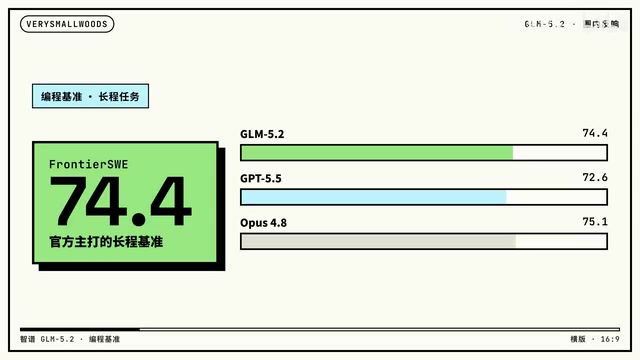
If the horizontal comparison isn't intuitive enough, the vertical comparison with its own previous generation is truly astonishing:
- Frontiers-WE: soaring from just over 30 to 74
- Deeps-WE: jumping from 18 to 46
Anatomy of the Technical Path of Open-Source Catch-Up: This generational leap of GLM-5.2 is not the result of a single technical breakthrough, but the product of multiple engineering paths advancing in tandem. Knowledge Distillation is the most direct path—by having the model learn the output probability distribution of a stronger model on the same input (rather than just learning the final answer), the "implicit reasoning paths" of a large model can be transferred to a smaller model. In code scenarios, this means learning how to decompose problems and how to plan the order of modifications, not just learning code syntax. The "Soft Labels" mechanism in knowledge distillation is particularly crucial: the complete probability distribution output by the teacher model contains subtle semantic association information between vocabulary items (for example, in a certain code context, append and extend have similar but not identical probabilities). This information is entirely lost in hard-label (One-hot) training, yet can be transferred to the student model through distillation, providing an implicit data augmentation effect.
Synthetic data engineering addresses the scarcity of high-quality training data: real "engineer bug-fixing process" data is extremely difficult to obtain at scale, but strong models can automatically generate code-fixing trajectories that include complete reasoning chains, which are then quality-filtered and used for training—this path has also been thoroughly validated in the DeepSeek-Coder and Qwen-Coder series. Reinforcement learning fine-tuning (represented by RLHF and RLAIF) provides an "outcome-oriented" optimization signal: whether code passes tests is a clear binary reward, far simpler than reward modeling for natural language conversation, which is why code scenarios were among the first domains where reinforcement learning fine-tuning produced significant results. RLAIF (replacing human feedback with AI feedback) further reduces annotation costs, making the scaling of reinforcement learning signals possible—this is especially important in engineering scenarios that require extensive code execution verification. The Mixture of Experts (MoE) architecture resolves the contradiction between scaling up parameter count and controlling inference cost—by activating only a subset of expert networks during each inference (usually determined by a lightweight router deciding which experts handle the current token), MoE can scale the model's total parameter count to several times that of a dense architecture while keeping inference latency controllable, providing the underlying support for the breadth of knowledge and depth of reasoning required for long-horizon tasks.
This magnitude of generational leap shows that the GLM team made solid engineering investments in the direction of long-horizon coding. In one sentence: it is currently the strongest open-weight model, and its long-horizon coding capability has caught up to the side of closed-source flagships.
The Real Signal: Who's Vouching for It
What really made the industry stop and take notice was not these numbers, but who's using it and who's speaking up for it.
Benchmarks can be gamed and leaderboards can be over-optimized, but when frontline product builders proactively vouch for something, the weight is completely different.

Vercel CEO Guillermo Rauch publicly stated that he was "almost shocked" by GLM-5.2's coding capabilities and flatly declared "this changes things." Shortly after, the CEO of Box also weighed in.
It's worth noting that Vercel is not just an ordinary bystander. As one of the world's most mainstream frontend deployment and developer experience platforms, Vercel is built on the Jamstack architecture philosophy. Its core products include zero-config deployment infrastructure for Next.js applications, an Edge Network, and v0—a tool it has heavily bet on in recent years that is based on large language models and can generate runnable React/Tailwind UI code directly from natural language descriptions. Jamstack (a combination of JavaScript, API, and Markup) is a modern web architecture philosophy that emphasizes frontend-backend decoupling, with static asset pre-building and CDN distribution at its core. Vercel is precisely the most important commercial vehicle for this philosophy, with its global edge network currently supporting the deployment of millions of frontend applications.
v0's technical route means Vercel must continuously evaluate the capability boundaries of various models in real code generation scenarios, rather than relying on leaderboard reports for decisions. What Rauch encounters daily is the actual performance of models in tasks like real UI component generation, multi-file code refactoring, and cross-framework adaptation, which gives his judgment strong scenario specificity. His statement immediately prompted other tech company CEOs to follow suit on X (formerly Twitter), forming a rare "practitioner word-of-mouth chain"—this kind of bottom-up evaluation is often more persuasive in the AI industry than official launch events, because it comes from real engineering decision pressure.
For a company like Vercel, which deeply integrates AI coding and code generation into its products, its CEO's evaluation is not marketing rhetoric but a judgment based on real production scenarios. The credibility of such endorsements far exceeds that of any benchmark test report.
Shortcomings and Total Cost: How to Calculate Token Consumption
Of course, GLM-5.2 has also drawn criticism—it consumes a lot of tokens.

A token is the basic unit of measurement for how large language models process text, roughly corresponding to 3/4 of an English word or 1-2 Chinese characters. Internally, text is first split into a token sequence by a Tokenizer—modern large models commonly use subword tokenization algorithms such as Byte Pair Encoding (BPE) or SentencePiece, which count high-frequency character combinations in the corpus to compress the vocabulary to a scale of tens of thousands of tokens. This allows the model to handle common vocabulary while also representing rare words and proper nouns through subword combinations, while avoiding the excessively long sequences caused by character-level tokenization. The model's inference computation, attention mechanism operations, and final output generation are all performed at token granularity. Understanding the importance of token consumption requires a key background: under the autoregressive inference mode of the Transformer architecture, each new token generated requires the model to recompute attention weights over all historical tokens (although the KV Cache mechanism can cache part of the computation). This means there is a superlinear relationship between output token count and computational overhead—the longer the output, the higher the marginal computational cost, and the more significant the latency.
Why is GLM-5.2 more "token-hungry"? This is closely related to its long-horizon task execution strategy. In agent mode, the model typically needs to output detailed reasoning steps, tool-calling instructions, intermediate result records, and self-verification logic—these "thinking processes" themselves consume a large number of output tokens. From an information theory perspective, this "explicit reasoning chain" actually externalizes the model's internal implicit computation process into readable text, similar to how humans tend to draft on paper rather than give answers directly when solving complex problems. Higher token consumption also reflects, to some extent, a more thorough unfolding of the model's reasoning, similar to the "Extended Thinking" mode of OpenAI's o1/o3 series—a trade-off of output for accuracy. The core assumption of this design philosophy is that on high-difficulty tasks, the accuracy improvement brought by "thinking more" is worth more than the cost of additional token consumption. From the research perspective of Test-time Compute, this assumption has been empirically validated on multiple hard reasoning benchmarks—with the model's parameter count fixed, allowing the model to generate longer intermediate reasoning chains often yields significantly higher final answer accuracy than versions forced to output briefly.
Under the pay-per-use API models of OpenAI, Anthropic, and others, the number of output tokens directly determines the cost—typically the unit price of output tokens is 3-5 times that of input tokens, because each output token must go through complete forward inference computation. Therefore, to complete the same task, GLM-5.2's higher output volume translates directly into a higher per-call cost. Some conclude from this that it is "inefficient," and the token consumption per single call is indeed a real issue.
But if you do the full accounting, the conclusion reverses. GLM-5.2 adopts the MIT open-source license and supports local deployment—the MIT License (Massachusetts Institute of Technology License) originated at MIT in the 1980s and is one of the least restrictive software open-source agreements. Its full text is only about 170 words, with its core clause merely requiring the retention of the copyright notice. It allows anyone to use, modify, and distribute it for free, even integrate it into commercial products, without paying licensing fees to the original copyright holder, without paying third parties per API call, and without the compliance risks of data privacy leaks. By comparison, Apache 2.0—though also common in open-source AI models—has additional requirements regarding patent grant clauses (it explicitly grants users a patent license, but this automatically terminates if the user files a patent lawsuit against the licensor); the GPL series requires derivative works to be open-sourced under the same license (i.e., the "copyleft clause"), which often raises legal concerns in commercial scenarios; and the custom license previously used by the Llama series set commercial restrictions once monthly active users exceeded 700 million, which was one of the early obstacles limiting large-scale enterprise deployment. The MIT license means enterprise legal review costs are almost zero, which is a very substantial advantage in the software procurement processes of large enterprises.
When a model is deployed locally in open-weight form, the marginal call cost is primarily composed of GPU compute and electricity, rather than per-token billing. For medium-to-large enterprises or high-frequency usage scenarios, the fixed-cost amortization effect of local deployment is extremely significant, and the overall usage cost is far lower than the API call fees of closed-source flagships. The savings here are more than enough to cover the extra tokens it consumes.
In other words, being "token-hungry" is a shortcoming from a pay-per-use perspective, but in scenarios involving self-hosted deployment and large-scale usage, from the perspective of Total Cost of Ownership (TCO), it is actually an acceptable price. TCO analysis is a standard methodology in enterprise IT procurement. Its core lies in bringing direct costs (API call fees, GPU purchase/rental fees) and indirect costs (compliance audits, data governance, engineering maintenance, loss of vendor bargaining power) into a unified framework for comparison—looking only at per-call cost while ignoring these hidden costs systematically underestimates the true expenditure of closed-source APIs. This is precisely the structural advantage of open-source models over closed-source APIs.
What It Really Changes
Putting the above points together, you can understand the true meaning of Rauch's line "this changes things."

Open weights + MIT license + coding capability that hugs the first tier—these three things have appeared on a single model at the same time for the first time.
In the past, closed-source flagship models could charge high premiums, a logic built on two premises: first, the irreplaceability of capability; and second, the channel scarcity created by deployment barriers. With the continuous evolution of open-source model series like Llama, Mistral, and DeepSeek, the second premise has been gradually dismantled; and GLM-5.2's performance approaching flagships on long-horizon coding benchmarks is beginning to challenge the first premise.
From the perspective of enterprise procurement decisions, the impact of this challenge is especially far-reaching. AI model procurement usually follows an implicit logic: when closed-source models are irreplaceable in capability, enterprises are willing to accept the incidental costs of pay-per-call, cloud data compliance review, and vendor lock-in. But once an open-source alternative crosses the psychological threshold on the "hardest" capability dimension, this logic loosens.
The hidden costs of vendor lock-in are often underestimated: in AI model procurement, the lock-in effect is not only reflected in the technical dependency of the API interface layer; deeper costs come from the Prompt Engineering IP accumulated around a specific model—these carefully tuned prompt templates are often tailored to the output style and capability boundaries of a specific model, and switching models means having to accumulate them all over again. This phenomenon is called "Asset Specificity" in economics, a core concept in transaction cost theory that explains vertical integration and long-term lock-in relationships—when an enterprise has accumulated a large amount of specialized assets to adapt to a supplier's characteristics, the real cost of switching suppliers far exceeds the surface migration fees. There are also proprietary fine-tuning datasets: when enterprises fine-tune closed-source models on private data, this data often remains on the supplier's platform per the terms of service, facing data retrieval and re-annotation costs when migrating. Finally, there is the inertia of the engineer skill stack: the engineering norms, debugging experience, and monitoring systems a team builds around a certain model API are all invisible switching costs. Open-source models under the MIT license provide a "controllable migration" path—enterprises can freely train, fine-tune, and deploy in local environments, consolidating core capabilities in their own infrastructure and avoiding the compounding of all these lock-in risks.
Enterprise decision-makers are beginning to reallocate their "premium budget"—it is no longer "you can only use closed-source," but rather "which scenarios are worth paying a premium for and which scenarios can use self-built open-source." This shift from overall dependence to scenario-based evaluation will drive the entire supply side to re-price and accelerate the diversification of AI application-layer infrastructure. Once open-source models break through the psychological threshold on the hardest-to-quantify "hard capability" dimension, enterprise procurement decisions will enter a re-evaluation cycle.
So the buzz over the past couple of days is essentially not "another benchmark news story," but rather the first time the open-source camp has truly approached the level line of closed-source flagships in the hardest-to-crack coding scenario. What it impacts is not just the leaderboard, but the pricing logic of the entire closed-source business model. The loosening of this pricing system has far-reaching implications for the commercial landscape of the entire AI application layer, and is also the deeper reason why the industry views GLM-5.2 as an industry milestone rather than an ordinary version update.
Final Thoughts
Whether GLM-5.2 is worth switching to depends on your actual scenario: if you heavily rely on AI coding and have the conditions for local deployment, then the cost advantages and capability performance it brings are indeed worth serious evaluation; if you pursue the ultimate single-task efficiency or rely on the stable service of a closed-source ecosystem, you need to weigh the token consumption issue.
But regardless, the gap between open-source and closed-source models in coding capability is narrowing at a visible pace. This is what truly deserves attention about the release of GLM-5.2.
Key Takeaways
Related articles
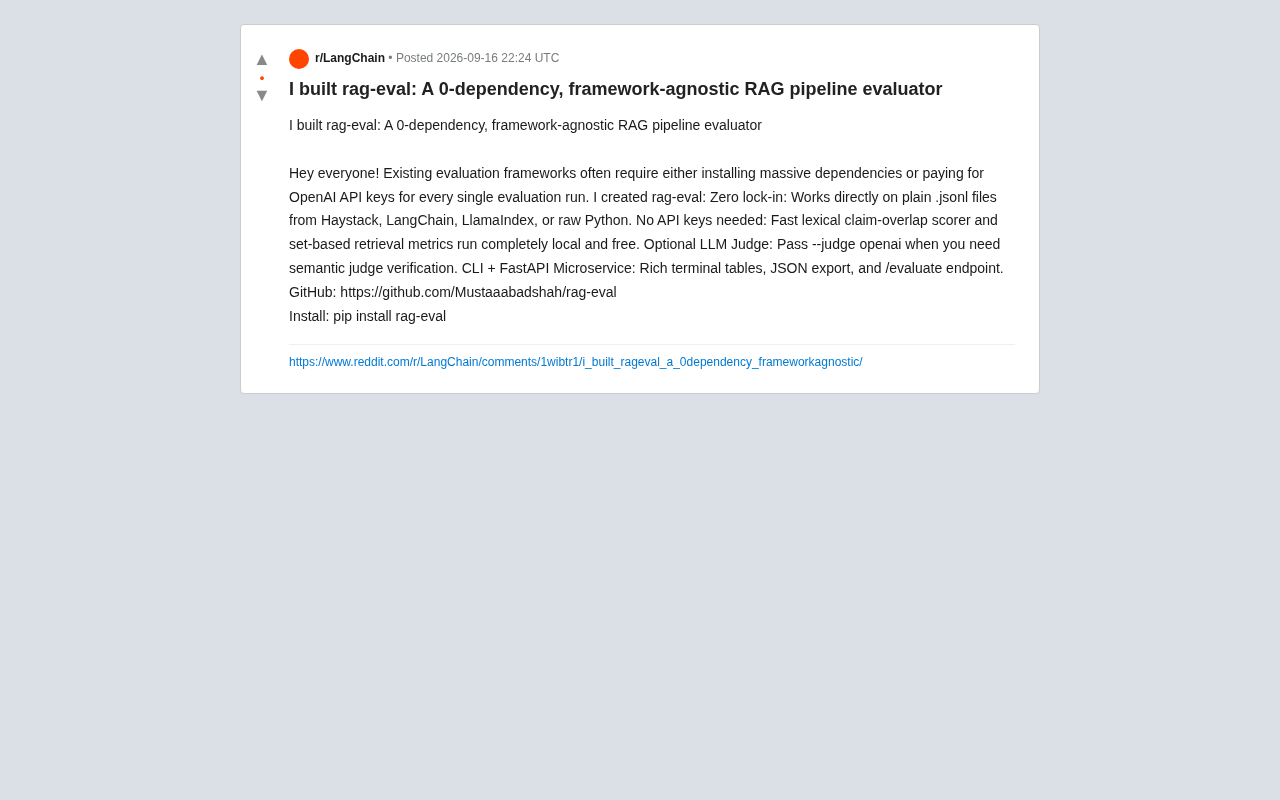
rag-eval: A Zero-Dependency, No-API-Key RAG Evaluation Tool
rag-eval is a zero-dependency, framework-agnostic open-source RAG pipeline evaluation tool. It supports free local lexical and retrieval metrics with no API keys required, and offers optional LLM Judge for semantic validation. Compatible with Haystack, LangChain, and LlamaIndex.
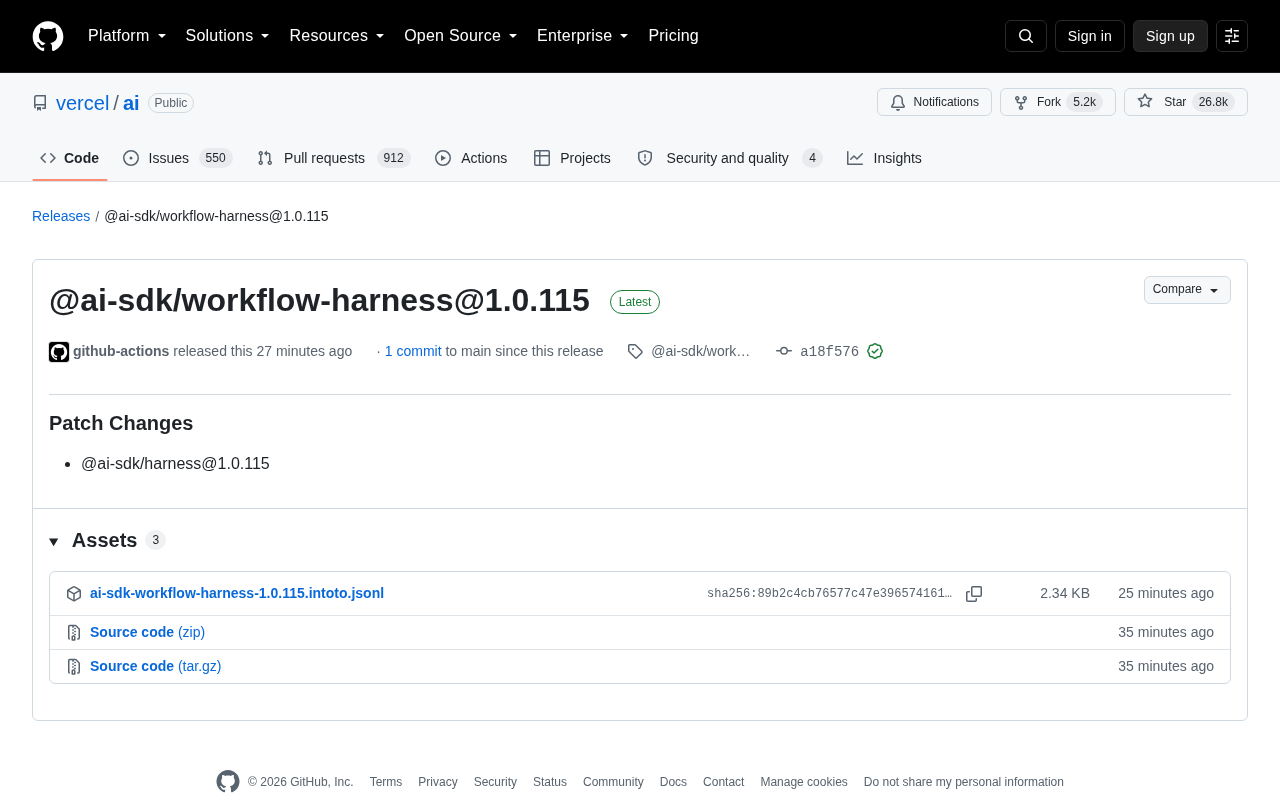
Vercel AI SDK Releases workflow-harness 1.0.115 Patch Update
Vercel AI SDK releases @ai-sdk/workflow-harness 1.0.115 patch update, syncing the @ai-sdk/harness dependency. Learn about the update, release mechanism, and what it means for developers.
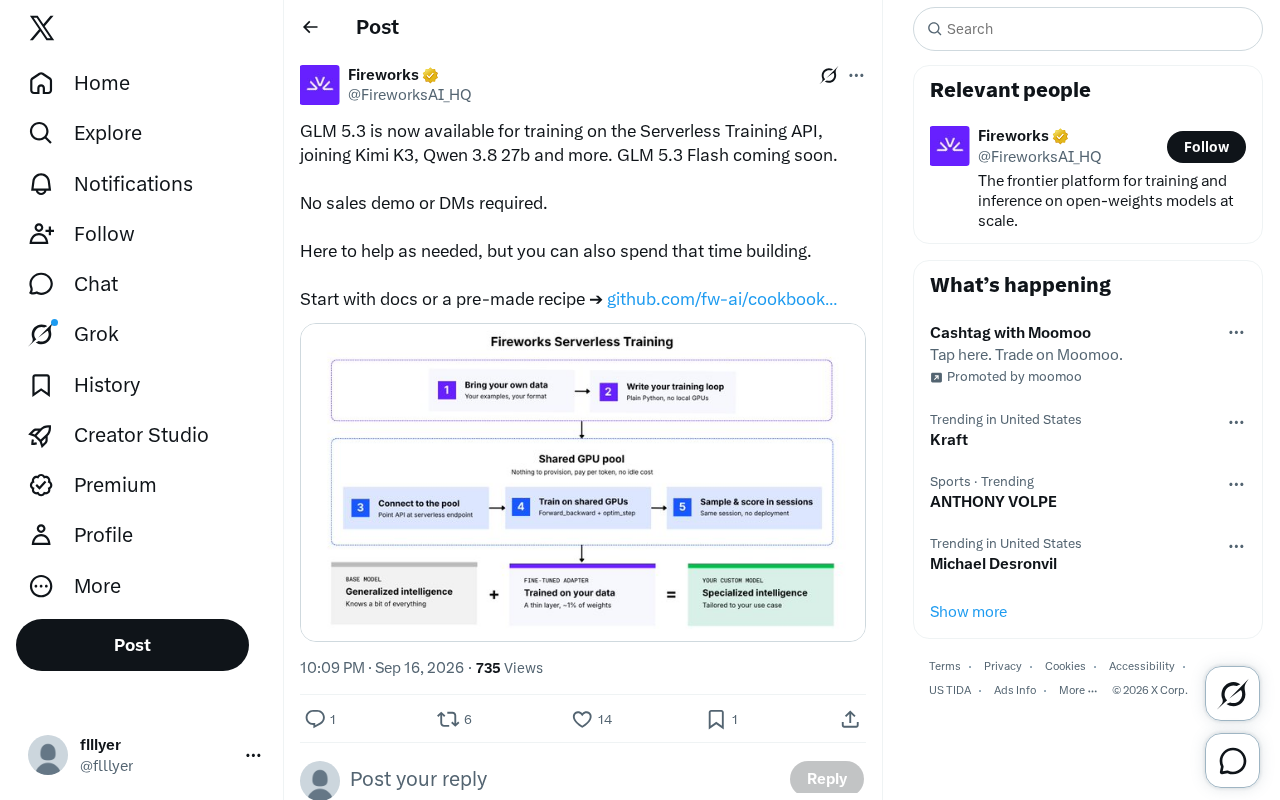
GLM 5.3 Now Available on Serverless Training API — No Sales Process Required
GLM 5.3 is now available on Serverless Training API alongside Kimi K3 and Qwen 3.8 27b. No sales process needed — start fine-tuning directly via docs or pre-made recipes.