GLM-5.2 Spotted in Testing | Claude Fable 5 Launches: 4 Key AI Updates

Claude Fable 5 launches, GLM-5.2 nears release, MusaCoder open-sourced, Gemini adds real-time translation.
Anthropic officially launched Claude Fable 5, achieving SOTA benchmarks and rapid ecosystem adoption across Copilot and Cursor. Zhipu AI's GLM-5.2 appears to be in internal testing based on API error signals. Moore Threads open-sourced MusaCoder, the first code LLM fully trained on domestic GPU infrastructure. Google released Gemini 3.5 Live Translate supporting 70+ languages in real time.
AI Industry Updates: GLM-5.2 on the Horizon, Claude Fable 5 Makes Its Debut
June's AI landscape remains red-hot. China's Zhipu AI has shown signs of testing its next-generation GLM-5.2 model, Anthropic has officially launched Fable 5 as the first model in the Claude 5 series, Google has introduced a new real-time translation product, and Moore Threads has achieved an open-source breakthrough on domestic GPU infrastructure. Here's a rundown of the key developments worth watching.
Zhipu GLM-5.2 Appears to Be in Testing
Some developers noticed an interesting detail while calling Zhipu's API: attempting to call a model named "GLM-5.2" returns an access denied error, while calling "GLM-6" returns a model not found response.
This distinction is telling. "Access denied" typically means the model exists on the server but hasn't been publicly released yet, whereas "model not found" indicates no such resource exists at all. This suggests GLM-5.2 is likely in internal testing or preparing for launch. Using API error codes to infer server-side status has become a common practice in developer communities for tracking upcoming feature releases — a technique frequently seen across large cloud service ecosystems.
Zhipu AI's GLM (General Language Model) series is one of the most prominent large language model families in China, jointly developed by Tsinghua University and Zhipu AI. The GLM architecture was first introduced in 2021, with its distinctive Autoregressive Blank Infilling training objective setting it apart from GPT's unidirectional autoregression and BERT's bidirectional masked language modeling. From GLM-130B to the ChatGLM series and GLM-4, Zhipu has maintained a roughly 2–3 month iteration cadence, with each generation improving Chinese language understanding, multimodal processing, and long-context capabilities.
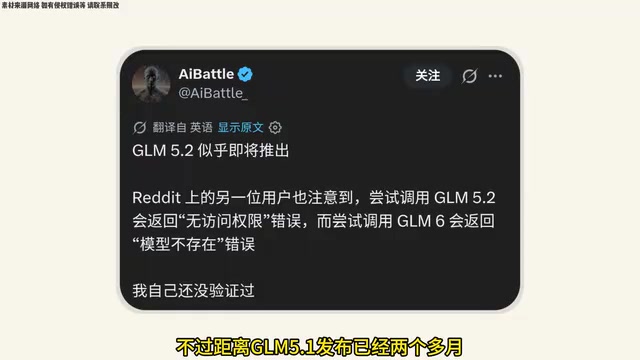
It's worth noting that this information is unconfirmed by Zhipu officially and is purely inferred from API responses. That said, more than two months have passed since GLM-5.1's release, making a new version consistent with Zhipu's historical release pace. The rapid iteration of domestic large language models is worth continued attention.
Anthropic Officially Launches Claude Fable 5
The biggest news this week comes from Anthropic. The company officially released Claude Fable 5, the first model in the Claude 5 series. According to the official announcement, the model delivers comprehensive improvements across multiple capability dimensions and has been widely recognized as a top-tier flagship product.
Anthropic was founded in 2021 by former OpenAI core team members including Dario Amodei and Daniela Amodei, with a central philosophy of "Responsible Scaling Policy." The Claude model series is notable for incorporating Constitutional AI (CAI) into its alignment pipeline — beyond RLHF, models use an explicit set of value principles to self-critique and self-correct, giving Claude a distinctive balance between safety and helpfulness. The name "Fable" in Claude 5 continues Anthropic's tradition of using literary or mythological imagery for sub-model naming (e.g., Haiku, Sonnet, Opus) to differentiate capability tiers and use cases.
In benchmark evaluations, Fable 5 achieves SOTA (State-of-the-Art) performance across multiple tests. SOTA is a core term in AI for describing a model that outperforms all previously known methods on a given task or dataset. Common LLM benchmarks cover a range of dimensions: MMLU measures knowledge breadth, HumanEval and SWE-bench test code generation, MATH and GPQA assess mathematical and scientific reasoning, and LMSYS Chatbot Arena collects real human preference data through blind testing. Google employee Logan also posted public congratulations to Anthropic on social media — peer recognition from a rival company is often considered more meaningful cross-validation than benchmark scores alone, further reflecting broad industry acknowledgment of this model.
Two-Version Strategy: Differentiated Positioning for Consumers and Enterprise
Anthropic has taken a clear product differentiation approach. Alongside Fable 5, the publicly accessible model with built-in safety guardrails, the company also released Methos 5, available exclusively to partner organizations as a high-end B2B offering.

This "dual-track strategy" reflects the common "differentiated guardrails" business logic adopted by leading AI labs: public versions include stricter safety constraints, while enterprise partner versions offer greater capability flexibility and customization. On pricing, the official figures weren't as extreme as earlier rumors suggested, though they remain in the mid-to-high range. Notably, Anthropic announced a reset of the 5-hour and weekly usage limits to encourage users to fully explore the model — a clear benefit for heavy users.
Developer Ecosystem Moves Quickly
The speed of ecosystem adoption has been impressive. Microsoft announced that Copilot and the Foundry platform now support Code Fable 5, and popular AI coding tool Cursor quickly followed with its own integration.

Rapid adoption by mainstream developer tools underscores Fable 5's competitiveness in code-related capabilities. For developers, this means they can access the latest model within their existing workflows immediately, without waiting through lengthy platform integration cycles.
Moore Threads Open-Sources MusaCoder: A Milestone for Domestic GPU Full-Stack Development
There's also good news from China's domestic compute ecosystem. Moore Threads released and open-sourced MusaCoder, a specialized code large language model for GPU-level operator generation, available in two parameter sizes: 9B and 27B.

The company positions it as the industry's first open-source code large language model to complete full-pipeline training and validation on a domestic GPU compute foundation. To appreciate the significance of this breakthrough, some technical context is helpful: GPU operators (also called kernels) are the lowest-level compute units in deep learning frameworks, responsible for implementing core operations like matrix multiplication, convolution, and attention mechanisms. Their performance directly determines model training and inference throughput. Hand-writing high-performance operators for specific hardware architectures requires deep parallel programming expertise and carries extremely high development barriers.
Moore Threads' MUSA (Moore Threads Unified System Architecture) is a domestic alternative to NVIDIA's CUDA ecosystem. Domestic GPU ecosystems have long faced a bottleneck of incomplete operator libraries, causing mainstream frameworks like PyTorch and JAX to perform far worse on domestic hardware than on NVIDIA platforms. MusaCoder, by using a large model to automatically generate and optimize operator code, has the potential to systematically accelerate the completion of this software ecosystem.
The fact that training and validation ran entirely on domestic GPUs demonstrates that domestic compute is now capable of supporting the full development lifecycle of large models — not just inference or partial workflows. That is the most technically significant meaning behind the term "full-pipeline." Model weights and related materials have been fully open-sourced.
Google Launches Gemini Real-Time Translation Model: 70+ Languages Supported
Google also introduced Gemini 3.5 Live Translate, a real-time audio translation model supporting speech-to-speech translation across 70+ languages, with clear deployment targets:
- Now live in the Google Translate app
- Available in Google AI Studio
- Open to developers via the Gemini Live API
Real-time Speech-to-Speech Translation (S2ST) has long been a goal in natural language processing. Traditional approaches use a three-module cascade: Automatic Speech Recognition (ASR) → Machine Translation (MT) → Text-to-Speech (TTS). The main drawbacks of this pipeline are error accumulation and latency stacking — each module's mistakes are amplified by subsequent ones, leading to consistently high latency and poor speech naturalness. More recent end-to-end Direct S2ST research attempts to replace this cascade with a single neural network, reducing latency while preserving prosody and emotional characteristics. Gemini 3.5 Live Translate, built on the Gemini multimodal foundation, can simultaneously process audio temporal features and semantic information, representing a new approach to this classic problem in the era of large models.
Supporting 70+ languages far exceeds most comparable products on the market. If real-world performance holds up, this model could deliver genuine value in international conferences, cross-border communication, and everyday travel. Translation quality for low-resource languages — such as certain African and Southeast Asian languages — will be an important dimension for evaluating its true capabilities.
Summary
This week's updates reflect AI competition playing out on multiple fronts simultaneously: Anthropic is pushing for peak performance with Claude Fable 5 while rapidly building its developer ecosystem; Zhipu's GLM-5.2 is poised for release, continuing the fast iteration pace of domestic models; Moore Threads has achieved a full-pipeline open-source breakthrough on domestic compute infrastructure; and Google continues to invest deeply in real-time translation as a high-frequency, high-demand use case.
Whether it's intense competition in foundational model capabilities, independent breakthroughs in domestic compute ecosystems, or the accelerating integration of AI into specific application scenarios — progress is advancing on all fronts simultaneously. For developers and everyday users alike, the selection of high-quality tools is growing richer by the day.
Related articles

Amphibious Transforming Drone: Beyond 100x Power Savings, What Are the Real Needs?
Is the amphibious transforming drone just a gimmick? Starting from the 100x power difference of the M4 Morphobot, explore real application scenarios and thesis topic ideas, analyzing boundary conditions where pure drones and pure ground robots both fail.

Warhound Raises $200 Million: Genetically Engineered "War Dogs" Paired with Anduril Gear
Warhound raises $200M, backed by Ben Lamm and Palmer Luckey, to genetically engineer dogs for military and law enforcement use and equip them with Anduril gear. This article analyzes its technology direction, funding logic, and ethical controversy.

Claude API Comes to Google Cloud: IAM Integration and SDK Access Guide
Anthropic hosts the full Claude API on Google Cloud with IAM-controlled permissions and unified billing. This guide covers the Vertex AI and Anthropic-hosted entry points, IAM role configuration, and SDK access.