GLM-5.4 Debuts Loop Transformer as AI Coding Tool Race Heats Up

Z.ai releases GLM-5.4, the first Loop Transformer model, as OpenAI, coding tools, and infrastructure advance on multiple fronts.
This morning's brief covers multiple parallel developments. Z.ai released GLM-5.4, claiming it is the first Loop Transformer model that deepens the network through weight-sharing loops without increasing parameters; it is currently API-only via Coding Plan, with weights to be released after security hardening. OpenAI released two preprints: the GPT-6 series can design proteins using only reasoning and code tools, and argues the square-matrix penalty exponent is four-ninths, with the lower bound awaiting independent verification. AI coding tools updated densely, with CodeShip entering code review and auto-merge, and Syntra Agent launching a multi-agent desktop workbench. Additionally, Google used multi-agents to improve quantum algorithms with formal verification, Abstract put robot models in the cloud, and US data centers are turning to off-grid gas plants.
Tech Morning Brief | Z.ai Releases GLM-5.4, the First Loop Transformer Model
This edition of the Tech Morning Brief is packed with high-density news: Z.ai has released GLM-5.4, which it claims is the first Loop Transformer architecture; the AI coding tool sector welcomes several new products; OpenAI drops back-to-back preprints on protein design and mathematical proofs; and cloud-based robot inference and off-grid data centers emerge as new infrastructure trends.
Z.ai Releases GLM-5.4: Loop Transformer Architecture Lands for the First Time
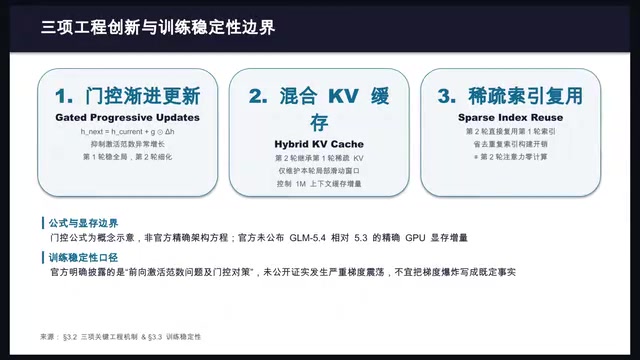
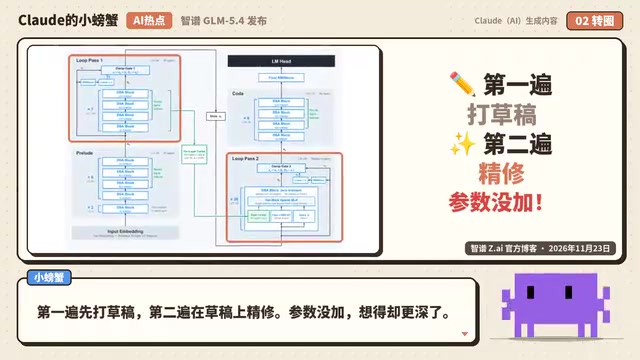
According to the Bilibili Tech Morning Brief program, Z.ai has released GLM-5.4 and claims it is the first Loop Transformer model. The core idea is to deepen the model by running the network multiple times through weight sharing, rather than increasing the parameter count. This design opens a new path between parameter scale and inference depth, and in theory can improve model capability without significantly driving up VRAM usage.
Well-known developer Simon Willison found during testing that a Coding Plan subscription is required to call the model via the Z.ai API. Z.ai says the model weights will be released after security hardening. This cadence is consistent with the "API first, open source later" release strategy of several model vendors, and indicates that GLM-5.4 is still in a controlled rollout phase.
The concept of Loop Transformer is not entirely new in academia, but adopting it as the core architecture of a flagship model and publicly claiming "first" means Z.ai has chosen a more aggressive path in architectural innovation. What's worth watching next is how the community reproduces the results once the weights are open, and how this looping structure actually performs on long-context and reasoning tasks.
The core idea of Loop Transformer can be traced back to explorations of decoupling Transformer depth from parameters. Every additional layer in a standard Transformer brings new weight matrices, and parameter count and VRAM usage grow accordingly; a looping structure lets the same set of weights be called repeatedly, effectively turning "number of layers" into an adjustable number of inference steps. During training, the loop is unrolled via backpropagation through time, combined with techniques such as stochastic depth and gradient checkpointing to control VRAM. Such designs had early prototypes in works like Universal Transformer and recurrent depth networks, but using them for a flagship large model and touting performance gains is still rare. The potential cost is that inference latency increases linearly with the number of loops, and deep loops are prone to optimization instability, requiring targeted design in learning rate, normalization, and residual structure.
OpenAI's Dual Preprints: Protein Design and Mathematical Proofs
OpenAI has published a preprint claiming that the GPT-6 series can design protein structures and sequences using only reasoning and code tools. The internal model matches or exceeds specialized models on most tasks, and in trials with Onnibar, at least one protein for each of five targets showed binding evidence. This means the boundary of general large models on specialized scientific tasks is being further compressed.
Another preprint focuses on mathematics: OpenAI argues that the square-matrix penalty exponent over arbitrary fields is exactly four-ninths. An October paper gave an upper bound of no more than 2.25 over reproduced fields, and a November paper supplemented the lower bound. OpenAI also released a formalized version, but the lower bound has not yet been independently verified. Both research lines point to one trend—large model vendors are treating "reasoning + tool calling" as a general paradigm for tackling hard scientific problems.
The difficulty of protein design tasks lies in the high dimensionality of structure space and the expensive cost of experimental validation. Traditional methods rely on specialized structure prediction models such as RoseTTAFold and AlphaFold, combined with sequence optimization or diffusion models to generate candidates. General large models entering this field typically rely on a combination of "reasoning chain + code execution": the model writes scoring functions, calls structure prediction tools, and iteratively filters candidate sequences, thereby approaching specialized model performance without dedicated fine-tuning. The "binding evidence" mentioned in the preprint generally refers to in vitro binding experiments (such as SPR, ELISA) or computational docking scores, rather than confirmed druggability conclusions; readers should note the gap between preliminary evidence and preclinical validation.
AI Coding Tools Update Densely: From CodeShip to Syntra Agent
Anthropic and Enterprise launched the CodeShip beta, which can review pull requests in the cloud, handle fixes, and approve merges according to team policy. The stated goal is to make delivery speed approach writing speed. This positioning targets code review, the most time-consuming step in the R&D process.
DiHunting recently migrated its Messages API from Python to Rust. An engineering blog explains that they used existing services to validate the new implementation and had the Code agent team investigate and fix discrepancies between the two versions—using AI agents to migrate and validate the code of an AI product itself is a rather intriguing closed loop.
Chinese AI coding desktop workbench Syntra Agent integrates multi-agent interaction, usage insights, and reasoning control for centralized management, development, drawing, and artifacts. In addition, Andafturk, as a local command-line tool, can check constraints and identify rule changes during handoffs before a coding agent resumes a task, targeting state consistency in multi-agent collaboration.
Quantum Computing and Multi-Agent Evaluation Frameworks
A team under Google and Google Quantum AI used a Gemini4 agent team to improve quantum algorithms and generate efficient quantum circuits. The team verified each item with the Lin theorem prover and open-sourced the library, problem specifications, and verified solutions on GitHub. The role of multi-agents in scientific discovery workflows is moving from "assisted generation" to a complete chain of "generation + formal verification."
Another Google team released a social reasoning evaluation framework based on multi-agent social simulation, letting evaluated assistants infer hidden motives of goals from users' subjective narratives, while open-sourcing the framework and a dataset of over 20,000 generated forces. Such evaluations fill the gap in traditional benchmarks regarding "mind-reading" capability.
The Shenzhen Loop Area Institute released SNGN, targeting kernel optimization for Huawei Ascend NPUs. It requires agents to improve kernels within a budget while maintaining correctness; in tests, Opus 5 ranked first, followed by GPT-5.6 and GLM-5.3. AI optimizing AI chip kernels is becoming a hardcore testing ground for coding agents.
Kernel optimization for Huawei Ascend NPUs is a typical high-barrier programming task: developers must adjust operator implementations at the Ascend C or low-level instruction level, balancing throughput, latency, and numerical correctness while being constrained by on-chip memory and pipeline scheduling. Using "improve the kernel within budget while maintaining correctness" as an evaluation setting effectively places coding agents in an automatically scorable, reproducible closed-loop environment, which is closer to real engineering than open-ended code generation. The value of such benchmarks lies in measuring both optimization ability and the discipline of not making errors—the latter is often where agents lose the most points in low-level systems programming.
Robotics: Cloud Inference and New Product Launches
Amazon and Meta are negotiating to resolve the access block on the shopping agent Muse in Amazon's store. Amazon blocked Muse in September, with advertising revenue and control over search results as the main points of contention; the agreement still requires approval from both CEOs.
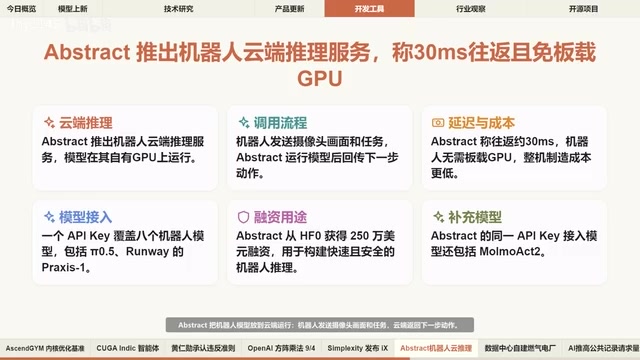
Abstract runs robot models in the cloud: robots send camera frames and tasks, and the cloud returns the next action. It claims a round-trip latency of about 30 milliseconds, no onboard GPU required for the robot, and one API key can connect to 8 models including Pi 0.5. This opens a "cloud brain" path for low-cost robot bodies.
SimplePlexi Robotics, or Ant Group-led $100 million Pre-A round, at a valuation of $1.6 billion. It also released the wheeled humanoid robot IX, targeting public service scenarios such as exhibitions and corporate reception, and said it has already put a warehouse sorting line into operation with Hangcha.
Infrastructure and Ecosystem Miscellany
US AI data centers, to bypass grid interconnection queues, are turning to self-built off-grid gas power plants. PGM newly added net half-capacity for gas, and Meta's Louisiana project's supporting gas plants increased from 3 to 10. Energy is becoming a hard constraint on AI compute expansion.
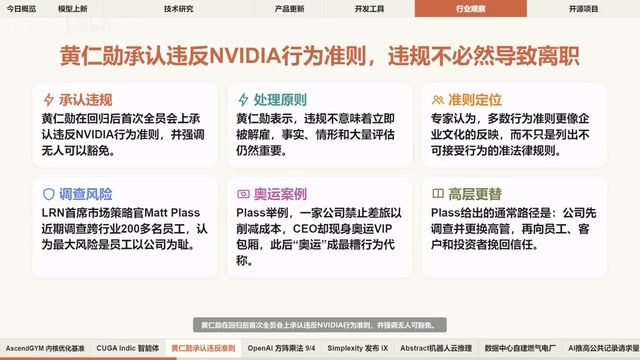
Jensen Huang, at his first all-hands meeting after returning, acknowledged violating NVIDIA's Code of Conduct and stressed that no one is exempt. He said a violation does not mean immediate departure, and that facts, circumstances, and assessment still matter. Some observers believe that a leader's breach of trust makes employees uncomfortable and angry.
AI Networking Academy offers in-browser cluster networking courses, fault simulation, and hands-on validation, covering RDMA, ROSIA2, MPBand, and NCCL. For engineers who want to enter the AI infrastructure field, this is a learning resource worth bookmarking.

Florency and Wast build uses multi-agents to analyze code attack surfaces and validate them, automatically generating proofs of concept, suitable for automated security review. Security is becoming the next battleground for multi-agent coding tools.
The New York Times photo chief Mehan Lauren and Josh Hainer asked freelance photographers in an email to avoid using Photoshop 2027, on the grounds that related AI features may label photo metadata as AI-generated. The battle over content authenticity labeling has extended into the daily workflow of news photography.
US grid interconnection queues often last years; if large data centers wait for public grid expansion, they may miss the window to bring compute online, so the "bring-your-own-power" model has emerged in recent years. Off-grid gas plants can bypass interconnection approval and quickly form hundreds of megawatts of supply capacity, but the cost is higher carbon emissions, fuel supply, and emissions permits that must be arranged separately, and in the long run they may still face regulatory and community resistance. Putting this phenomenon together with factors such as gas turbine delivery cycles and transformer shortages, energy infrastructure—not chips—is becoming the more rigid bottleneck for AI compute expansion.
One-line Summary
Z.ai releases GLM-5.4, the first Loop Transformer model, as OpenAI, coding tools, and infrastructure advance on multiple fronts.
Paragraph Summary
This morning's brief focuses on several parallel developments. Z.ai released GLM-5.4, claiming it is the first Loop Transformer model, deepening the network through weight-sharing loops without increasing parameter count; it is currently available only via API through a Coding Plan, with weights to be released after security hardening. OpenAI released two preprints: the GPT-6 series can design proteins using only reasoning and code tools, and mathematically argues the square-matrix penalty exponent is four-ninths, with the lower bound awaiting independent verification. AI coding tools updated densely, with CodeShip entering code review and automated merging, and Syntra Agent launching a multi-agent desktop workbench. In addition, Google used multi-agents to improve quantum algorithms with formal verification, Abstract put robot models in the cloud, and US data centers are turning to off-grid gas plants.
Related articles
GLM-5.4 Loop Transformer Deep Dive: Architecture and Cost-Effectiveness
An in-depth analysis of GLM-5.4's Loop Transformer architecture: shared-weight looping, 30B ablation data, multi-model API cost simulations, strong-weak collaboration strategies, and the challenges of scaling computational depth.

Zhipu GLM-5.4 Debuts Loop Transformer, Upgrading Coding and Vision
Zhipu releases GLM-5.4, debuting the Loop Transformer architecture, adding vision capabilities and stronger coding, with existing users' quota raised to 1.5x. Also covers MiniMax H3's low-VRAM runtime, the information compression perspective, and subscription ecosystem developments.
Zhipu GLM-5.4 Released: 750B Model Achieves 2-3 Trillion Parameter-Level Intelligence
Zhipu releases GLM-5.4, a 750B model achieving 2-3 trillion parameter-level intelligence via repeated layers, with a 30B experiment showing major math reasoning gains plus new vision capabilities and generalized programming applications.