Zhipu GLM-5.4 Released: 750B Model Achieves 2-3 Trillion Parameter-Level Intelligence
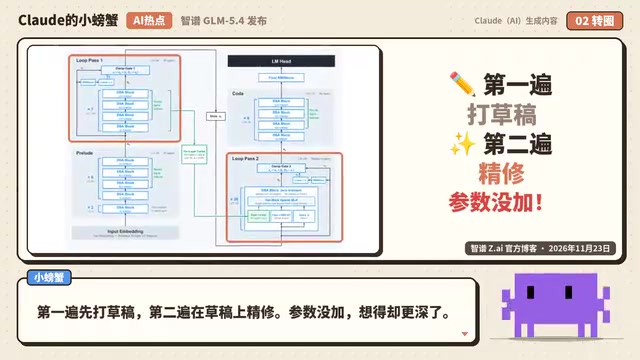
Zhipu GLM-5.4 runs the middle 28 layers twice, boosting reasoning depth without adding parameters—30B tests show major score gains and more concise answers.
Zhipu AI released GLM-5.4, a 750B-parameter model whose core innovation is "generalized programming"—running the middle 28 layers twice, with the first pass drafting and the second refining, boosting reasoning depth without adding parameters. Three tricks—small gates, shared cache, and key selection—keep costs manageable, with 1M-context deployment costs controllable. Public 30B comparisons show AM25 math competition rising from 19 to 30, GPQA from 47.6 to 56.3, and long-text tests up over 7 points, with responses over 10% shorter. The model adds vision, with 200 tokens/s off-peak and 70-80 tokens/s at peak. The company admits the model can get stuck in ultra-long thinking; full 750B scores are unreleased and open-source weights have no date.
Zhipu AI has just released GLM-5.4, a 750B-parameter large model. The company claims its intelligence rivals that of models with 2-3 trillion parameters. The secret sounds surprisingly simple: run the same set of layers twice. This innovation, dubbed "generalized programming," not only boosts model capability but also unexpectedly makes responses more concise.
Core Innovation: Running the Same Layers Twice
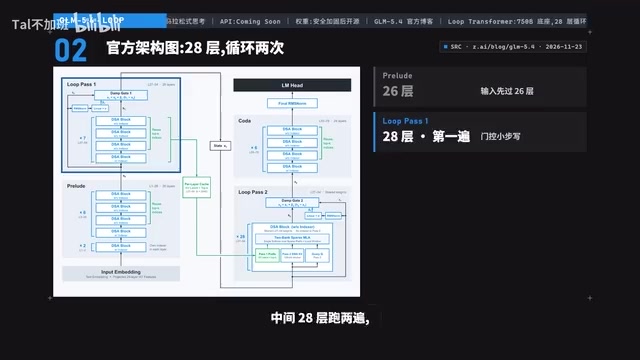
A typical large model works like an assembly line—each layer runs only once, and to get smarter you need to stack more layers and more parameters. GLM-5.4 does the opposite: it runs the middle 28 layers twice in succession. The first pass is like drafting, and the second pass refines the draft. No parameters are added, but the model "thinks" more deeply.
Moreover, it wasn't trained from scratch—it was further trained on the GLM-5 base. This means it inherits the original model's knowledge and gains extra reasoning depth through the repeated-layer structure. The company calls this design "generalized programming."
Loop/repeated-layer structures are not an entirely new concept—early models like Universal Transformer and ALBERT (layer sharing) explored parameter sharing and recurrent computation. GLM-5.4 differs in that it only does a "two-pass" on the middle 28 layers rather than a global loop, and it continues training on a pretrained base rather than being designed from scratch. This "local looping" balances parameter efficiency and training stability—the bottom layers handle basic feature extraction, the top layers handle output, and the middle layers enhance reasoning depth through a second refinement pass. Its essence is trading computation for parameters: running layers an extra time at inference is like trading time for space, and deployment-cost-sensitive scenarios (such as long context) require accompanying cache and gating optimizations.
Cost Control: Three Tricks to Avoid Being Slow and Expensive
Running layers an extra time sounds like it would double compute costs. Zhipu used three tricks to control costs:
- Small gates: Each token has a gate at each pass—the first pass writes conservatively, and the second pass opens up. This is akin to dynamically adjusting information flow to avoid over-computation on the second pass.
- Shared cache: The second pass only stores a small extra segment, greatly reducing memory usage. The company says deployment costs for 1M context can be kept under control.
- Key selection: The second pass directly copies the key points selected in the first pass, reducing the cost of finding key points to zero. This means the first pass has already filtered out critical information, and the second pass only needs to focus on processing it.
KV cache is the main source of memory usage in large model inference, especially with long context, where Key and Value tensors must be stored at every layer. GLM-5.4's "shared cache" only stores a small extra segment on the second pass, likely achieved through cross-pass sharing or compressed caching. The gating mechanism is similar to gated linear units (GLU) or dynamic routing, controlling the intensity of information flow at each pass to avoid over-computation on the second pass. Key selection is similar to sparse attention or token pruning: the first pass has already computed importance weights, and the second pass reuses them directly, saving the overhead of repeated filtering. Together, these three tricks reduce the extra compute overhead of repeated layers from a theoretical doubling to about a tenth of training compute—a key engineering safeguard that makes the structural innovation practical.
Validation: Public Comparison on a 30B Model
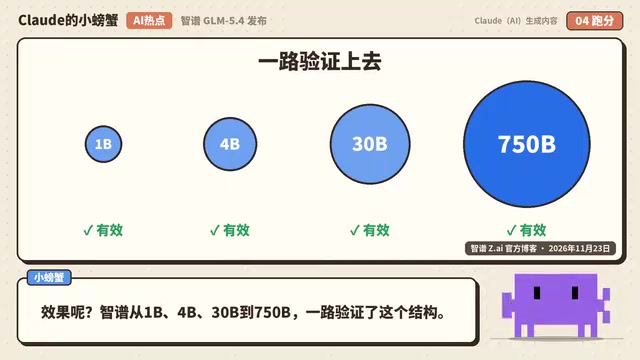
Zhipu validated this structure progressively from 1B, 4B, 30B to 750B. The public comparison data comes from the 30B model—same parameters, only about a tenth more training compute, but with significant gains.
- Math competition AM25: from 19 to 30 points, a full 11-point increase.
- Graduate-level science questions GPQA: from 47.6 to 56.3.
- Long-text test AALCR: also up by more than 7 points.
What's more, in most tests the responses were actually over 10% shorter, saving more tokens. This shows the model is not only smarter but also more concise in expression.
It should be noted that the above are experimental results from the 30B model. Full benchmark scores for the 750B flagship have not yet been officially released, and they are not yet available on the AA leaderboard.

AM25 (math competition) and GPQA (graduate-level science Q&A) are common benchmarks for evaluating large model reasoning. AM25 focuses on multi-step mathematical derivation, while GPQA requires graduate-level scientific knowledge—both test deep reasoning rather than memorization. AALCR (long-text test) examines a model's ability to locate and integrate information in long documents, where the repeated-layer structure's improvement to long-range dependencies is particularly evident. It's important to distinguish that these scores come from the 30B model, whose absolute level differs from the 750B flagship, but the relative improvement (same parameters, only a tenth more compute) is informative. The company has not released full 750B scores, so "rivaling 2-3 trillion parameters" remains a claim rather than a verifiable conclusion.
Generalized Programming: Using Code for Video, Games, and Industrial Design
The company describes GLM-5.4's capability as "generalized programming"—using code to create video, game 3D, and industrial design. Demo cases include:
- A Hello World MV, generated entirely by writing code.
- Building a six-axis robotic arm in FreeCAD, with demos from assembly and calibration to the production line.
- A block-style game called Break Wild, a complete game made of toys.
These examples demonstrate the model's potential in code generation and cross-domain applications.
Vision Capabilities and Speed
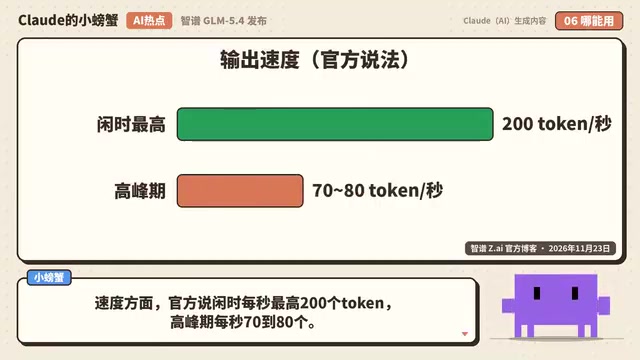
GLM-5.4 this time also adds vision capabilities for viewing images. On speed, the company claims up to 200 tokens per second during off-peak hours and 70-80 tokens per second during peak hours.
It is currently available on Zhipu's Coding Plan, Zcode, and the Z.ai website. Media reports indicate the quota is 50% more than 5.3. The API will open after security evaluation. The weights are said to be open-sourced, but no date has been given.
Limitations and Future
The company itself admits that GLM-5.4 tends to get stuck in ultra-long marathon-style thinking—once it starts, it can't stop. But Zhipu also says a much larger model is coming soon. With 750B achieving the effect of 2-3 trillion parameters, will this "looping" structure become the next big direction? Worth watching.
This article is based on content from Bilibili creator "Little Crab"; data and views come from Zhipu's official blog and public information.
Related articles

GLM-5.4 Coding Test 4.6x Slower? Unpacking the Loop Transformer Architecture
GLM-5.4 coding test took 431 minutes vs. competitor's 109, 4.6x more steps. We analyze its Loop Transformer architecture, KingBench4 score of 55.3, Max tier's 1.04M token cost, and tier selection advice.

Zhipu GLM-5.4 Quietly Released: A Debut for Loop Transformer Architecture
Zhipu GLM-5.4 quietly lands in coding plans: first Loop Transformer flagship with 750B params, 1M token context, AIM math up from 19.2 to 30.4, and native vision for coding from screenshots.
GLM-5.4 Releases 750B Model: Recurrent Transformer Architecture and the 30B Benchmark Controversy
GLM-5.4 releases a 750B model with a recurrent Transformer architecture that runs the same layers twice, claimed to match 2T–3T scale. But the benchmark table tests a 30B small model, not the main model. We break down the architecture changes, benchmark data, four demos, and open-source timeline.