Zhipu GLM-5.4 Debuts Loop Transformer, Upgrading Coding and Vision
Zhipu GLM-5.4 debuts the Loop Transformer architecture and fills in vision and coding capabilities.
Zhipu has released GLM-5.4, whose core highlight is the first official deployment of the Loop Transformer architecture, enabling iterative internal processing for greater reasoning depth at a similar parameter count, especially meaningful for code generation tasks requiring repeated logical verification. The model also fills in vision capabilities, strengthens coding performance, raises existing users' quota to 1.5x, and can be invoked by setting the model name to GLM 5.4. The article also covers a developer compressing 1GB of Wikipedia to 105 MB to illustrate intelligence as information compression, MiniMax H3's open-source low-VRAM runtime enabling 8GB VRAM video generation, and ecosystem rumors about Google subscriptions connecting to third-party Harness, while noting Nvidia-related news lacks official confirmation and should not be used for judgment.
Zhipu GLM-5.4: First Deployment of Loop Transformer, Further Advances in Coding and Vision
As competition among domestic large models intensifies, Zhipu has released GLM-5.4. According to a roundup by Bilibili's "Today's Sheep Report AI," the core highlight of this update is not the stacking of parameter scale, but the first official deployment of the Loop Transformer architecture. On the other side, the model has filled in its vision capabilities, further strengthened coding performance, raised the quota for existing users to 1.5x, and simplified usage—just set the model name to GLM 5.4 to invoke it.
Loop Transformer Deployment: A Substantive Change at the Architecture Level
Loop Transformer can be understood as an architectural approach that lets the model perform iterative processing internally. Each layer of a traditional Transformer performs only one forward computation, while the Loop mechanism allows information to be processed cyclically within specific modules, thereby achieving greater reasoning depth at a similar parameter count. This is especially meaningful for coding tasks—code generation requires the model to repeatedly verify logical consistency within the context, rather than merely performing pattern matching.
Zhipu's first deployment of this architecture in GLM-5.4 means domestic models have taken a substantive step in底层 structural innovation, rather than merely following the existing Transformer paradigm for engineering optimization.
The proposal of Loop Transformer can be traced back to a batch of academic explorations in 2025, one of whose intellectual sources is the Universal Transformer—which shares weights across layers and introduces adaptive computation steps. Unlike traditional Transformers with fixed-depth stacking, the Loop architecture allows the same set of parameters to be called repeatedly, and at inference time the number of loops can be dynamically determined based on task difficulty, similar to the unfolding of an RNN along the time dimension, but retaining the parallel expressive capability of attention. The cost is that training must handle the stability of gradients within the loop, with common practices including randomizing the number of loop steps and normalizing hidden states. For coding tasks, more loop steps amount to giving the model more opportunities to "deliberate repeatedly," which differs from Chain-of-Thought (CoT) explicitly unfolding reasoning externally—Loop internalizes iteration into the network structure.
Vision Completion and Coding Enhancement: Expanding Capability Boundaries
GLM-5.4 has filled in its vision capabilities this time, which is a necessary supplement for application scenarios requiring mixed image-text understanding. The enhancement of coding capabilities continues Zhipu's recent investment in the Coding direction. Combined, the model's applicable scope in multimodal and code tasks has been broadened.
For developers, the more practical change is the lowered barrier to use: the quota for existing users is raised to 1.5x, and setting the model name to GLM 5.4 allows direct use without additional configuration processes. This design of invocation-by-naming is friendlier for rapid validation and daily development.
In the Same Wave of Tech Developments: Compression, Video Generation, and the Subscription Ecosystem
Within the same topic window, there are several other noteworthy technical developments.
The Nature of Intelligence from an Information Compression Perspective
A developer losslessly compressed 1GB of Wikipedia text to 105 MB, illustrating that "intelligence is the compression of information"—the essence of model training is finding patterns in massive amounts of information. This perspective echoes the idea of Loop Transformer: more efficient internal computation is essentially about carrying more patterns with fewer representations.
The core basis of the "intelligence as compression" perspective is the equivalence between arithmetic coding and prediction: a model that can make more accurate probability predictions for the next symbol can compress a sequence shorter when using arithmetic coding. Therefore, the compression rate can be regarded as a quantitative indicator of how well the model has mastered the patterns in the data. Compressing 1GB of Wikipedia to 105 MB, a compression ratio of about 10:1, indicates that the compressor has strong modeling capability for the repetitive grammatical structures and semantic patterns in the text. This perspective also explains why large models' parameter counts are related to compression capability—the more parameters, the more complex the patterns that can be fitted, but more parameters do not necessarily mean higher compression efficiency; architectural efficiency is equally key, which is precisely the direction that structural innovations like Loop Transformer attempt to optimize.
Video Generation Moving Toward Low VRAM
A developer has open-sourced a low-VRAM runtime for MiniMax H3, which can run on 8GB of VRAM, producing a 5-second video in 3 minutes, with VRAM usage reduced to about one-third. Video generation moving from "high-end exclusive" to ordinary development devices is a relatively clear trend in this round of open-source tool evolution.
The high VRAM usage of video generation models mainly comes from three aspects: the diffusion process requires repeated denoising in latent space, and each step must retain intermediate activations; the time dimension multiplies sequence length, and attention computation grows quadratically with the number of frames; the feature maps in the high-resolution decoding stage are large in volume. Low-VRAM runtimes typically compress usage through chunked computation, activation recomputation, weight quantization, and offloading some computation to CPU memory. Being runnable on 8GB of VRAM means consumer-grade GPUs (such as the RTX 3060 level) can also participate in video generation, which will significantly expand the experimental space for creators and developers, and simultaneously lower the barrier for fine-tuning and secondary development of video generation models.
Rumors and Unconfirmed Information About the Subscription Ecosystem
It is rumored that starting December 2, Google subscriptions can connect to third-party Harness, with the first supported being Hermes Agent, and the rest presumably not far behind. On the other side, the platform is tightening public statements by Google engineers, and Ultra memberships obtained through BugHodl will be quickly removed and refunded. These are ecosystem-level developments, and specific implementation details still need to be based on official information.
Additionally, there are reports that Nvidia has restored Jensen Huang's position and that the stock surged in pre-market trading, but there is currently no official original text, so it can only be treated as an unconfirmed rumor and should not be used as a basis for judgment.

Professional Anchor: What Exactly Is a Transformer
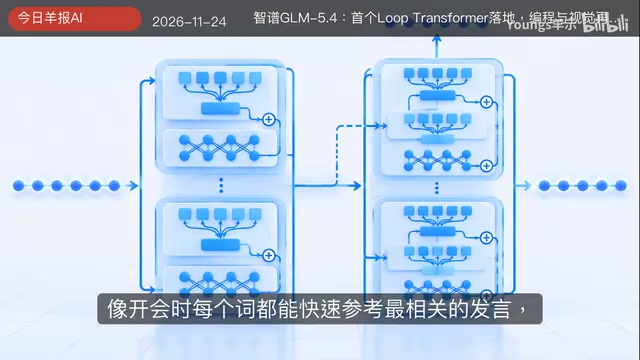
A Transformer is a model architecture that processes text sequences using attention mechanisms. Using the analogy from "Today's Sheep Report AI": it's like in a meeting, where each word can quickly refer to the most relevant statements, rather than only listening to the previous sentence. Most large language models today are influenced by it, and speed, context length, and capability performance are all related to it.
Only by understanding this underlying logic can one avoid staying at the surface of version numbers when understanding architectural evolutions like Loop Transformer.

Models will keep changing; only by understanding the fundamentals can you stay calm.
One-line Summary
Zhipu GLM-5.4 debuts the Loop Transformer architecture and fills in vision and coding capabilities.
Paragraph Summary
Zhipu has released GLM-5.4, whose core highlight is the first official deployment of the Loop Transformer architecture, allowing the model to perform iterative processing internally and achieve greater reasoning depth at a similar parameter count, which is especially meaningful for tasks like code generation that require repeated logical verification. The model also fills in vision capabilities, further strengthens coding performance, raises the quota for existing users to 1.5x, and can be directly invoked by setting the model name to GLM 5.4. The article also rounds up the same wave of tech developments: a developer compressing 1GB of Wikipedia to 105 MB to illustrate that intelligence is information compression, MiniMax H3's open-source low-VRAM runtime enabling video generation on 8GB of VRAM, and ecosystem rumors such as Google subscriptions connecting to third-party Harness, while emphasizing that Nvidia-related news has no official original text and should not be used as a basis for judgment.
Related articles

GLM-5.4 Coding Test 4.6x Slower? Unpacking the Loop Transformer Architecture
GLM-5.4 coding test took 431 minutes vs. competitor's 109, 4.6x more steps. We analyze its Loop Transformer architecture, KingBench4 score of 55.3, Max tier's 1.04M token cost, and tier selection advice.

Zhipu GLM-5.4 Quietly Released: A Debut for Loop Transformer Architecture
Zhipu GLM-5.4 quietly lands in coding plans: first Loop Transformer flagship with 750B params, 1M token context, AIM math up from 19.2 to 30.4, and native vision for coding from screenshots.
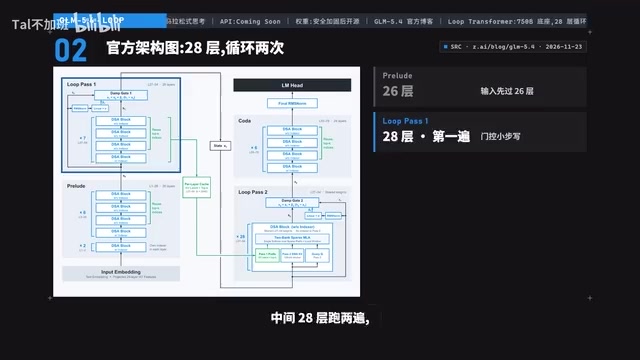
GLM-5.4 Releases 750B Model: Recurrent Transformer Architecture and the 30B Benchmark Controversy
GLM-5.4 releases a 750B model with a recurrent Transformer architecture that runs the same layers twice, claimed to match 2T–3T scale. But the benchmark table tests a 30B small model, not the main model. We break down the architecture changes, benchmark data, four demos, and open-source timeline.