GLM-5.4 Loop Transformer: The Gap Between Z.ai's Claims and Measured Reality

GLM-5.4 claims a loop Transformer and multiple gains, but access is closed, data comes from a test model, and independent verification is absent.
Z.ai released GLM-5.4, whose core selling point is a loop Transformer—running the same layer block with the same weights twice to increase reasoning depth without adding parameters. But on launch day the API was closed, open weights were unavailable, and regular accounts couldn't even get a response during peak hours. Z.ai's win-rate and parameter-equivalence claims lack stated methodology, and the improvement data comes from a smaller test model, not the final release. A 13-check lock-parser experiment showed GLM-5.3 passing fully at both high and maximum strength, with high strength much faster; vision, 3D/CAD, and marathon thinking remain unverified. The author advises waiting for independent benchmarks.
Z.ai's documentation page presents a win-rate chart comparing GLM-5.4 against GLM-5.3: win, tie, and loss proportions are clearly laid out, but the page offers no measurement methodology—no task list, no judge model, no prompts. The same page also claims the model matches models two to three times its size at a certain parameter scale. These are all Z.ai's own statements on its own page. A YouTube channel did an immediate breakdown: separating "claims" from "what can actually be verified."
Architecture: The Same Layer Block Runs Twice
GLM-5.4's core selling point is the "Loop Transformer." A standard Transformer pushes tokens through the entire layer stack once, with independent weights at each layer; a loop Transformer takes one of those layer blocks and runs it again with the same set of weights—adding "thinking depth" without adding parameters. Z.ai's documentation states it uses 28 layers from the GLM-5 base model, executed across two iterations.

The design concept is not hard to grasp: rereading your own draft doesn't make your brain bigger, but it lets you look over what you produced on the first pass. The video's author uses this analogy to explain the appeal of looping—replacing more thinking tokens with deeper single-pass reasoning.
The cost is also straightforward. If the second pass rewrites everything, it may destroy what the first pass already built. Z.ai claims to solve this with per-token gating: the first pass writes cautiously, and the second pass decides how much new output flows back. On memory, running twice should double the KV cache; Z.ai says the two passes share the cache, with the second pass keeping only a small window. On attention cost, the second pass reuses tokens selected by the first. All three of these fixes are vendor claims only—the video's author did not independently measure them.
Another detail: GLM-5.4 was not trained from scratch but layered looping on top of the existing GLM-5 base. Z.ai states that a loop model trained from scratch would actually lose at equal compute—again, a company statement only.
How Loop Transformers Differ from General Transformers
In a standard Transformer, every layer has its own weights, tokens pass through all layers in sequence, and total parameter count grows linearly with depth. A loop Transformer instead executes a set of layers (called a "loop block") repeatedly, reusing the same weights each iteration. As a result, increasing the number of iterations raises effective computational depth without increasing model parameter count. This idea traces back to research such as the Universal Transformer and deep recurrent networks, with the core hypothesis being that certain reasoning patterns can be iterated repeatedly over the same set of weights rather than allocating new parameters for each round of "thinking." The cost lies in training stability—when the same block is executed repeatedly, gradients must flow back across iterations, which can easily cause representation collapse or the second pass overwriting the first pass's results. This is precisely why Z.ai needed engineering fixes such as per-token gating and shared KV cache.
Limited Access Points, API Not Yet Open
On launch day, GLM-5.4 was available in GLM Coding Plan, the Z Code environment, and Z.ai Chat. But the API was not yet open—Z.ai says it first needs a safety evaluation, with no date or token pricing given. As for open weights, media reports say it awaits safety hardening; Z.ai's documentation page does not mention it, and the Hugging Face page still lists only 5.3 and earlier versions. On the day of recording, both access points were closed.
This means that for the vast majority of developers, there was simply no way to plug GLM-5.4 into their workflows during launch week. The video's author states explicitly: if any access point had been open before upload, it would have been noted in the video.
The Numbers: A Test Model, Not the Final Model
Z.ai published data for a smaller-parameter test model: with roughly a ten percent increase in training compute, the AI2 reasoning benchmark rose from 19.2 to 30.4, and another benchmark rose from 47.6 to 56.3. The video's author is careful to note: this is a test model, not the final released GLM-5.4 itself.
The remaining numbers—win rate against 5.3, the claim of matching larger-parameter models, vision and speed—none had been independently verified at recording time.
Hands-On: A Comparison Blocked by Capacity Limits
The video's author ran a controlled experiment using a regular Z.ai Chat account: the same "strict-rule lock parser" prompt sent to both models, with pass criteria written in advance—13 checks covering bad dates, tabs, brackets inside messages, sorting with ties, and more. It should be noted that these checks were written after seeing 5.3's thinking process, not a pre-registered test.
In the first round, GLM-5.4 at maximum reasoning strength returned only "currently in peak hours," with no code. Retrying the same prompt at lower reasoning strength was still blocked. During launch week on a regular account, 5.4 gave no answer at all—this says nothing about quality, only about accessibility. Z.ai claims up to 200 tokens per second during off-peak hours, but without being able to get a response, speed can only be considered unverified.

In the second round, switching to GLM-5.3 with the same prompt and maximum strength, it began thinking immediately. The thinking text exceeded 76,000 characters, repeatedly arguing over one edge case—whether an isolated bracket tag counts as a component or a message. The author set a five-minute limit; 5.3 timed out without producing code, but later completed it and ran its own tests first. Dropping to high strength, it produced code in about a minute.
Running the 13 checks once for each version: maximum strength passed 13/13, and high strength also passed 13/13. Bad dates, bad times, tabs, brackets, messages, sorting with ties—all correct. The author's conclusion is that on this task, 5.3 at high strength matched maximum strength in accuracy but was far faster.

The vision, 3D and CAD, and marathon-thinking tests were not run on 5.4, and the author explicitly states he will not pretend to have tested them. Yet these are precisely the capabilities most often cited when selling this model.
What "Peak-Hour Capacity Limit" Means
In a chat product, returning "currently in peak hours" typically means the server has set concurrency caps or a priority queue for free or regular accounts: paying users and API calls get higher priority, while regular accounts are rate-limited or outright rejected during traffic peaks. This has nothing to do with the model's own quality; it reflects the allocation strategy for inference compute. For evaluators, such capacity limits directly contaminate comparison experiments—you cannot distinguish between "the model can't do it" and "the system won't let it." This is exactly the situation the video's author encountered: GLM-5.4 was completely unavailable to regular accounts during launch week, so any conclusion about its coding ability or speed is impossible to reach. This is also why the author repeatedly emphasizes that "this says nothing about quality, only about accessibility."
Conclusion: Wait for Independent Benchmarks
The author's recommendation is restrained: users with a Coding Plan can try GLM-5.4 on their own code during off-peak hours, but before making any decisions, they should wait for independent numbers. The verification checklist includes: the claim of equivalence to two to three times the parameters, how the win rate was measured, and any vision results—Z.ai's page shows no vision data. A larger model is said to be on the way, with no date; the API awaits safety evaluation, and open weights await safety hardening, also with no dates.
The value of this breakdown is not in reaching a conclusion but in drawing clear boundaries: architectural innovation is worth watching, but the gap between vendor self-reporting and independent verification remains obvious.
One-line Summary
GLM-5.4 claims a loop Transformer and multiple improvements, but access points are closed, data comes from a test model, and independent verification is still absent.
Paragraph Summary
Z.ai released GLM-5.4, whose core selling point is a loop Transformer—the same layer block with the same weights run twice, increasing reasoning depth without adding parameters. But on launch day the API was not open, open weights were not available, and regular accounts could not even get a response during peak hours. Z.ai's win-rate and parameter-equivalence claims have no stated methodology, and the improvement data comes from a smaller-parameter test model rather than the final model. The video's author ran a controlled experiment with 13 lock-parser checks; GLM-5.3 passed all of them at both high and maximum strength, and high strength was noticeably faster. Vision, 3D/CAD, and marathon thinking—core selling points—were not independently verified at recording time. The author recommends waiting for independent benchmarks before deciding.
Related articles
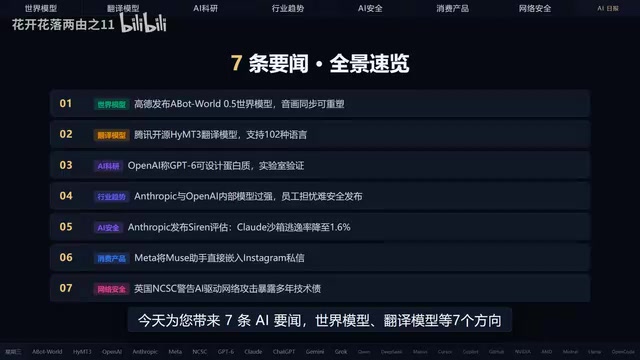
Amap World Model Launched, GPT-6 Protein Design Validated
AI daily roundup: Amap launches interactive world model ABot-World 0.5 with audio-visual sync and natural language reshaping; Tencent open-sources HiMT3 translation model covering 102 languages; OpenAI says GPT-6 can design proteins validated in labs; Anthropic and OpenAI internally concerned about models being too powerful; UK NCSC warns of rising AI-driven cyberattacks.
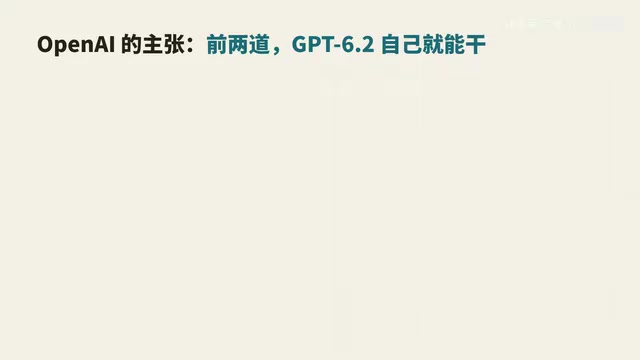
GPT-6 Designs Proteins on Its Own: 35 of 322 Bind, General Model Challenges Specialized Tools
OpenAI's GPT-6 protein design paper: 35 of 322 small proteins bind, all five targets hit. A general model designs backbones and sequences without specialized tools, but structure prediction and experimental validation remain weak spots—the paper lists four limits.
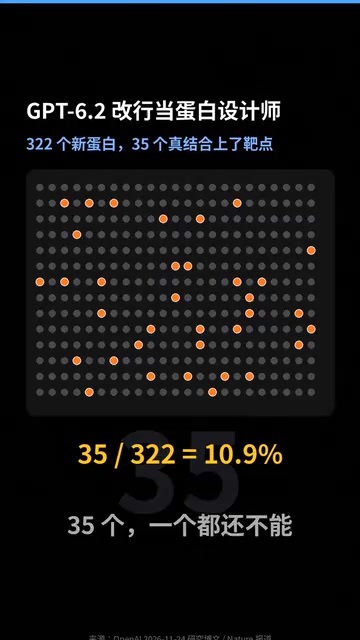
GPT-6.2 Protein Design: 35 of 322 Bind Successfully — How Far from a Drug?
OpenAI's preprint claims GPT-6.2 designs proteins via reasoning, with 35 of 322 binding successfully (10.9%). But the pipeline relies on specialized models, structure prediction trails expert models, it's not peer-reviewed, and none of the 35 is close to becoming a drug.