GLM-5.4 Released: 50% More Quota but 9x Token Consumption
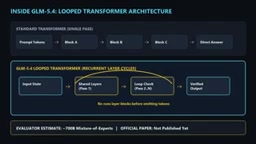
GLM-5.4 trades its looped architecture for capability gains, at 9-14x the token cost.
Zhipu quietly launched GLM-5.4 for paid coding plan users only, starting at ~$18/month. Its looped transformer design (~700B MoE estimated) brings native vision, 66% tool-call recovery, and 50% more weekly quota, scoring 33.2/60 on a coding benchmark. But independent tests show reasoning token consumption is 9-14x Gemini 4 Neon; high/max tiers underperform low on short tasks due to overthinking. Low tiers suit quick scripts, high tiers only for large multi-file work.
Title
GLM-5.4 Released: 50% More Quota but 9x Token Consumption
Meta Description
GLM-5.4 quietly launched: native vision, 50% quota boost, but independent tests show its reasoning token consumption is 9 to 14 times that of Gemini 4 Neon — the looped transformer architecture delivers performance and billing pressure alike.
Article Content
Zhipu quietly launched GLM-5.4 — no official blog, no model card, no HuggingFace weights, and the documentation was even throwing errors at launch time. Product lead Zixuan Li confirmed on Chinese channels that this version is available to all paid GLM coding plan users, with pricing starting at about $18/month (Lite), $80 for the Pro tier, and $168 for the top tier.
On paper, this is a genuinely earnest upgrade: native vision capabilities, a 50% increase in weekly quota, and a tool-call recovery rate exceeding the Claude Opus 5.5 and GPT 6.2 series. But independent tests quickly poured cold water on it — on the same coding benchmark, GLM-5.4 consumes 9 to 14 times the reasoning tokens of Gemini 4 Neon. Quota went up by half, but the bill may have gone up by an order of magnitude.
What Was Actually Released
According to hands-on testing by a YouTube review channel, the barrier to entry for GLM-5.4 is extremely low: in most tools, simply setting the model name to GLM 5.4 gets you a 200K context and 64K max output; adding the 1M tag in Cloud Code unlocks the full million-token context window. You may not have noticed that Z.AI's previous free web chat is still stuck on 5.3 Flash — only paid users get to experience 5.4.
What really sets 5.4 apart from 5.3 is an architectural change. Zixuan Li confirmed that the new model adopts a looped transformer design — rather than simply widening the parameter count, the same set of layer blocks is executed multiple times before producing an answer. Reviewers estimate its scale at around 700B MoE, but since no official paper has been published, this number remains third-party speculation for now.
This looped design directly explains two notable upgrades. First, the mainline GLM can finally "see" screenshots — early testers observed it proactively launching a headless browser to inspect the page layout it generated and measure frame rates. Second, tool-call error correction: when facing failed tool calls, GLM-5.4 achieves a 66% recovery rate, ahead of Claude Opus 5.5, Fable 5.2, and both GPT 6.2 models.
Looped Transformer is a scaling approach different from the mainstream "stack more layers" method: the model internally has only one (or a few) reusable Transformer layer blocks, and during the forward pass these blocks are executed repeatedly, effectively deepening the "computational depth" without increasing the parameter count. It draws partial inspiration from Universal Transformer and "recurrent depth" research, and is also seen as an implicit form of test-time compute scaling — the same set of weights can be invoked multiple times, trading for stronger reasoning and self-checking capabilities at inference time. The cost is multiplied FLOPs and tokens for every generation, which is the structural reason behind GLM-5.4's soaring bills.
MoE (Mixture of Experts) refers to placing multiple parallel "expert" subnetworks in the Transformer's feed-forward layers, with a gating network activating only a few of them for each token. This allows the total parameter count to be very large (such as the rumored 700B), while the number of parameters actually involved in computation per forward pass (active parameters) is far smaller, balancing capability and inference cost. Common MoE challenges include uneven expert load and high VRAM usage, typically requiring expert parallelism and capacity factor tuning. The "700B MoE" mentioned in this article is third-party speculation; official parameter details have not been released.
Benchmark Scores and Real Generation Quality
On an independent coding benchmark comprising 6 applications, GLM-5.4 improved by 5.7 points over 5.3, reaching 33.2/60 and ranking seventh — while also being the highest-scoring open-source model tested to date, slightly ahead of Kimi K3.1 Pro, DeepSeekAd V4.1 Flash, Qwen 4.0 Max, and even beating GPT 6.1 Sol.
The scores look good, but how is the actual output? In a four-way comparison Three.js monument test, GLM-5.4 Max accurately reproduced the dark gold lighting and the rising column structures; in a single-file island scene, it generated rotating voxel models of Paris and Mount Fuji Tokyo entirely in code.

In a three-round rapid 3D benchmark showdown against GPT 6 Astra, GLM maintained clean structural symmetry on the Gothic cathedral cutaway and the rotating jet engine, but fell clearly behind on the white double-helix library staircase — Astra solved the open spiral geometry, while GLM only produced a regular ring of bookshelves. In the classic SVG stress test, facing Gemini 4 Neon's "pelican riding a bicycle," GLM's anatomical structure and background both looked considerably simpler; however, in the peacock test, GLM could fold feathers into a 3D perspective, while Gemini 4 Hydrogen was essentially just pulsing.
The Cost of the Looped Architecture: Token Bills
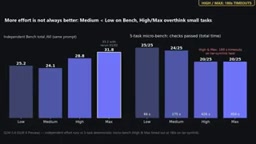
If the looped layers are the source of performance, they are also the source of cost. On the same 6-application coding benchmark, GLM burned through over 1 million reasoning tokens in total, taking 431 minutes — 9 to 14 times that of Gemini 4 Neon. Even more counterintuitive: on 3-minute short tasks, the high and max tiers actually scored lower than the low tier — the model "overthinks" until it times out.
The review channel also demonstrated a failure case that others missed: asking GLM-5.4 to write a Three.js folding banquet table with rigid-body stress testing. The hinge timing and table-leg folding kinematics animation looked quite clean, but after clicking "drop 3 cubes" and "shake the table," both physics features failed completely — the cubes passed straight through the oak tabletop and fell to the floor, and shaking couldn't drive them correctly. That said, the green telemetry panel on the left was still displaying "Clear. No clipping." — the interface confidently detached from reality.
Reasoning tokens refer to the tokens corresponding to the intermediate thinking content a model generates before producing its final answer. Models with extended thinking capabilities (such as the various high/max reasoning tiers) first output a "chain of thought" before answering, and these tokens also count toward billing and the context window. Therefore, "reasoning token consumption is 9 to 14 times that of competitors" means: even with identical input and output lengths, the actual bill could be an order of magnitude higher.
The quota bucket mentioned in the article is a common rate-limiting mechanism for subscription-based coding assistants — tokens or request allowances are issued on a rolling 5-hour window, and once exhausted you must wait for a reset or trigger overload throttling. This differs from token-billed APIs: under a fixed plan, low token efficiency doesn't necessarily cost you more money directly, but it significantly shortens your available time, especially on high-tier long-loop tasks. Additionally, cache reuse rate refers to the proportion of tokens from repeated context (such as codebase prefixes) that hit the prompt cache; a high cache hit rate can greatly dilute unit costs, which is why the 98.4% cache reuse rate mentioned in the article is considered an advantage.
Three Reminders Before You Pay

The reviewer summarized three facts you need to be clear about before spending money:
Quota consumption may exceed expectations. Long max-tier loops can easily exhaust the 5-hour quota bucket or trigger overload throttling — even with a 50% extra allowance, it's hard to fully offset.
Limited openness. There are still no public weights, API reporting anomalies with empty thinking, and security restrictions on untrusted symlinks.
Notable weaknesses remain under heavy load. Under high-intensity testing, you can still observe overthinking loops, rigid-body physics failures, and early vision capabilities that are closer to OCR than genuine scene understanding.
Should You Use It, and How
Honest positioning: GLM-5.4 still can't beat Claude Fable 5.2, Gemini 4 Neon, or GPT 6.2 Sol on frontier build tasks. Where it genuinely earns its place is heavy coding under a fixed plan, its 98.4% high cache reuse rate, and multi-hour TypeScript or Rust workspaces when you hit Claude's quota ceiling.
The most practical tip is to build the habit starting today: keep quick scripts on low or medium tiers to avoid infinite loops; only switch to high or max when facing large multi-file architectures. The looped architecture gives GLM-5.4 deeper self-checking capability, but it also hands the choice back to the user — do you want to run a slow model with deep self-checking, or deliver quickly with a quarter of the tokens like Gemini 4 Neon?
One-line Summary
GLM-5.4 trades its looped architecture for capability gains, at the cost of 9 to 14 times the tokens.
Paragraph Summary
Zhipu quietly launched GLM-5.4 with no blog, no model card, and no weights, available only to paid coding plan users starting at about $18/month. The new model uses a looped transformer design, estimated at around 700B MoE, bringing native vision, a 66% tool-call recovery rate, and a 50% weekly quota boost. It scores 33.2/60 on a 6-application coding benchmark, 5.7 points higher than 5.3 and the highest score among open-source models tested. But independent evaluations show its reasoning token consumption is 9 to 14 times that of Gemini 4 Neon; on short tasks, high/max tiers underperform low due to overthinking, and under heavy load there are shortcomings such as rigid-body physics failures and vision that leans toward OCR. The article recommends low tiers for quick scripts and high tiers only for large multi-file architectures.
Related articles

Trained Entirely on Ascend NPU! Phai-A1-35B Code Model Hands-On Test
Phai-A1-35B-1M is a 35B expert model based on Qwen 3.6, targeting code and Agents, with its entire fine-tuning and reinforcement learning training done on Huawei Ascend NPUs. This article covers its MoE architecture, 1M context, official benchmark scores, and deployment, plus license caveats for the base model.

RK3588S Benchmarks Local LLMs: 35B MoE vs. NPU Acceleration — Which Is Faster?
RK3588S benchmarked with local LLMs: 4B dense, 35B MoE, and NPU-accelerated models compared. Pure CPU hits 5.8 tokens/s generation; NPU reaches 26 tokens/s prefill — revealing edge device selection strategies.

GLM 5.4 Recurrent Transformer Explained: How 750B Parameters Surpasses DeepSeek?
Zhipu AI releases GLM 5.4, the first recurrent Transformer flagship with 750B parameters claiming 2-3T-model intelligence. Analysis of its tech, DeepSeek comparison, and lack of third-party tests.