GLM Reverse Proxy Tool Analysis: The Technology and Risks Behind Login-Free AI Access

GLM reverse proxy tools bypass official auth for free AI access, but carry serious stability, compliance, and security risks.
A "GLM reverse proxy" tool circulating in tech communities uses a JavaScript relay layer to reverse-engineer Zhipu GLM's web interface, claiming login-free AI access. It evades risk controls by simulating browser fingerprints and resets identity by "clearing" them when blocked — revealing it's locked in a fragile arms race with the provider. The article warns that such tools are inherently unstable, may violate terms of service, and pose real malware and data-leakage risks when downloaded from unofficial sources. Official API channels remain the safer choice for serious developers.
What Is a GLM Reverse Proxy Tool
Recently, a category of tools known as "GLM reverse proxies" has been circulating in certain tech communities. The core idea is to build a proxy layer using JavaScript that relays API calls to Zhipu's GLM large language model, enabling so-called "login-free" access. This follows the same playbook as similar tools previously seen for DeepSeekAd — both fundamentally use technical means to bypass official authentication systems, packaging the capabilities of web or client interfaces into directly callable APIs.
According to the video author, this tool is a "modded" version of an original project, with an added feature button and a fix for output formatting bugs. The author claims it is "more stable and easier to use" compared to the previous DeepSeek proxy tool.

To be clear, this article analyzes these tools purely from a technical observation and risk-awareness perspective, and does not endorse any method that bypasses official authorization.
Reverse Proxy means something specific in this context and is worth clarifying. In the traditional sense, a reverse proxy is a server-side intermediary between clients and backend servers. Here, however, "reverse proxy" is closer to API reverse engineering: developers capture network traffic or analyze browser requests to identify the endpoint URLs, request formats, and Cookie/Token authentication methods used by the web frontend, then write programs that simulate those requests and wrap them into a standardized interface for others to use.
The fundamental difference from using an official API is this: official APIs are authorized, rate-limited, and billed through legitimate channels; reverse-engineered interfaces "borrow" the session credentials of logged-in users or bypass login entirely — constituting unauthorized access. Both Zhipu GLM and DeepSeek offer official APIs with paid and free-tier quotas. Tools like this are, in essence, consuming official resources without authorization.
Claimed Capabilities
Based on the video demonstration, the author highlights two key selling points.
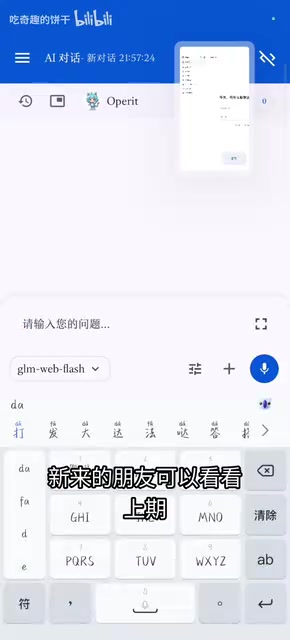
Login-Free Calls
The biggest selling point is "no login required." The author demonstrates sending conversation requests without any account credentials, with the tool handling the backend API calls automatically. (The phrase "attack calls" repeated in the video appears to be a speech-to-text transcription error for "API calls.") Response speed in the demo appears reasonably fast.
Beyond Plain Text
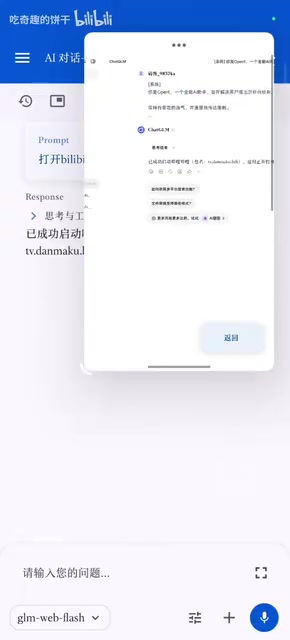
The author also addresses user skepticism about the tool being limited to plain-text conversations, demonstrating more complex interaction scenarios to show that the tool supports a variety of use cases beyond simple Q&A.
Usage Flow and the "Anti-Ban" Logic
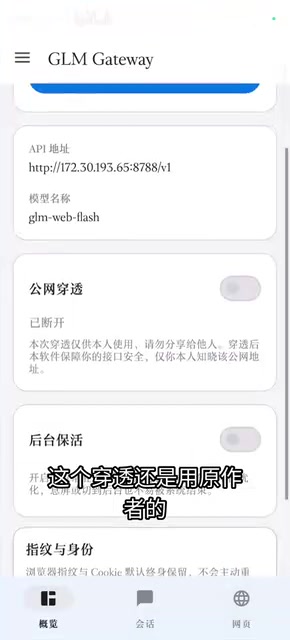
The author's described setup is straightforward: download the software, fill in the required information, and run it. The intranet tunneling component follows the original author's approach.
What's particularly revealing is the "anti-ban" strategy the author mentions: for light usage, no login is needed; if the tool gets blocked, "clearing the fingerprint" resets the identity so usage can continue. This exposes the fundamental nature of such tools — they rely on simulating a normal user's browser fingerprint to evade the service provider's risk-control systems, rather than obtaining any legitimate authorization.
From a technical standpoint, the fact that "clearing the fingerprint" is even necessary confirms that the service provider already has the capability to detect anomalous calls. The tool and the risk-control system are in a constant arms race — which explains why these tools tend to have short lifespans and can stop working at any time when the provider updates its defenses.
Browser Fingerprinting is a key technique service providers use to identify and differentiate users. It's not a single identifier, but a unique composite value derived from dozens of parameters: browser version, operating system, screen resolution, font list, Canvas rendering characteristics, WebGL information, timezone, plugin list, and more. Even if a user clears their cookies and never logs in, providers can still use fingerprinting to determine that "this is the same device/browser making repeated requests."
These reverse proxy tools typically use headless browser frameworks like Puppeteer or Playwright to simulate real user behavior, randomizing the above parameters to "clear the fingerprint" and create the illusion of a new user. However, risk-control systems are continuously evolving as well — they analyze request frequency, behavioral patterns, IP geolocation, and other multi-dimensional signals in combination. Simple fingerprint resets are becoming increasingly ineffective, which is the root cause of why these tools frequently "break."
A Rational Technical Assessment
Reverse proxy tools of this kind are nothing new in the tech community. Their appeal lies in "zero-cost" access to large model capabilities. But beyond the marketing language, there are several issues users should be aware of.
Stability cannot be guaranteed. These tools rely on reverse-engineering the official web interface. The moment the provider updates its API or tightens its risk controls, the entire setup breaks. Any claim that it "runs stably" is based on short-term observation and is not sustainable.
Compliance and security risks. Bypassing official authentication to call a service may violate the provider's terms of service. Furthermore, downloading executable programs of unknown origin from unofficial channels (such as "join the group to get the software") carries the risk of embedded malicious code and local data theft. When users fill in the "required information," they have no way to verify where that data actually goes.
Lack of verifiability. The video focuses on effect demonstrations and funneling viewers toward "like, follow, and join the group to get the software," without publicly disclosing full technical implementation details for community review. In practice, users are running a black-box program under conditions of significant information asymmetry.
Conclusion: Weighing Convenience Against Risk
Tools like the GLM reverse proxy reflect a real demand among some users for free AI capabilities and showcase the technical creativity behind large model API reverse engineering. But in the long run, they are built on the fragile foundation of an ongoing battle against provider risk-control systems — inherently unstable, and accompanied by compliance and security risks.
For developers with legitimate use cases, the official API — with its free-tier quotas, stable service, and clear terms of responsibility — is a far more worthwhile investment. Technical exploration is understandable, but placing your productivity on a third-party tool of unknown origin that could fail at any moment is rarely worth the trade-off.
Related articles

CSS Anchor Positioning: A New UI Positioning Approach Without JavaScript
A deep dive into CSS Anchor Positioning: from anchor-name and position-anchor to the anchor() function, position-area shorthand, position-try-fallbacks, anchor-size, and upcoming anchor queries.

New AI Chart Interaction: Continuous Follow-up Questions and Visualization in Conversation
Explore a new AI interaction method for continuously generating charts in conversation. Use the /visualize command to ask follow-up questions and visualize answers in the same chat window, improving data analysis efficiency.

Cursor Merges Into X Subscription: Paid Plans Share Unified Usage Pool, Grok Model Coding Usage Doubled
Cursor joins The X Subscription with a unified usage pool and doubled Grok coding quota. Third-party models shift to API pricing. Existing users can keep or migrate plans.