GlowUp Local: An Open-Source AI Tool That Helps Local Businesses Understand Their Competitiveness

Open-source AI tool GlowUp Local helps local businesses compare competitors and generate actionable improvement suggestions.
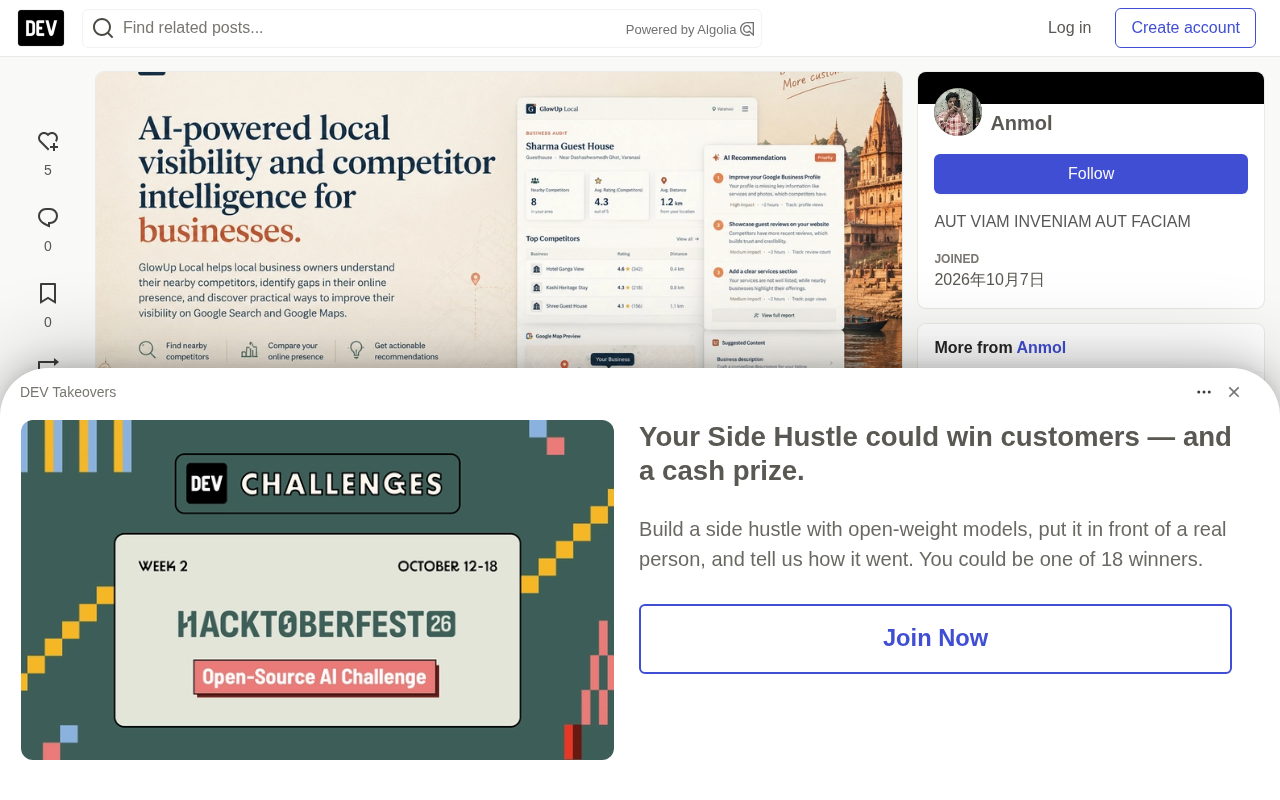
GlowUp Local is a prototype tool submitted by a developer to the Hacktoberfest open-source AI challenge, designed to help local businesses understand their online performance, compare with nearby competitors, and get actionable advice. Targeting hotels, guesthouses, cafes, and restaurants in Varanasi, India, it pulls public business data via the Google Places API and uses the open-weight Gemma model to generate prioritized, evidence-cited improvement suggestions. The stack is Python + FastAPI + React/Vite, and the code is open source on GitHub. Currently a working prototype with no real users or paying customers, its business model is still being explored, with the next step being on-the-ground validation in Varanasi.
Local businesses trying to get discovered tend to get stuck on the same problem: they know they need a strong online presence, but they don't know where to start. Traditional SEO tools can spit out a mountain of metrics, but small shop owners neither have the time to dig into them nor the experience to judge which metrics are worth paying attention to.
A developer submitted GlowUp Local during the second week of the Hacktoberfest open-source AI challenge—a prototype tool that uses open-source models to help local businesses understand their own online performance, compare themselves against nearby competitors, and receive actionable improvement suggestions. The project's first target market is hotels, guesthouses, cafes, restaurants, and local shops in Varanasi, India.
What problem does the tool solve
GlowUp Local starts from a very concrete premise. Varanasi draws a huge number of tourists looking for places to stay, restaurants, and local goods, yet the businesses serving these tourists aren't necessarily good at expressing their value online: some have great products and services but can't articulate them clearly; some have incomplete business information; and others simply don't have the time to figure out how they differ from the competitor next door.
The author draws a clear line in the original article: GlowUp Local is not about repackaging generic SEO advice as personalized competitive analysis. Its recommendations must be based on information the app actually retrieves, and it doesn't promise anyone a #1 ranking on Google Search. The goal is to make local business intelligence easier to understand and translate into concrete next steps.
This positioning is worth noting. Many "AI marketing tools" on the market actually output platitudes generalized from training data, and businesses that follow them often see little effect. Tying recommendations to specific evidence is where this project is methodologically more honest.
Breaking down the workflow
The entire process has five steps and a fairly clean structure:
- Enter business information: The owner provides the name, category, address, and products or services.
- Discover nearby competitors: The Google Places API pulls public information on relevant nearby businesses.
- Structured comparison: Available information is organized into a data structure that supports evidence-based comparison.
- AI generates recommendations: Gemma processes the structured data to produce prioritized improvement suggestions and action steps.
- Output actionable insights: Help the owner decide what to do first.
For a restaurant, for example, suggested actions might include expressing the menu more clearly, completing business information, describing services more effectively, and establishing a process for asking satisfied customers for genuine reviews. Recommendations are also planned to include evidence citations, confidence labels, and draft local marketing copy.
Google Places API is a place-data interface provided by the Google Maps Platform. Developers can query public information such as business names, addresses, opening hours, ratings, and review counts by keyword, coordinates, radius, and other criteria. Its value lies in providing a stable, structured data source for nearby competitors for tools like GlowUp Local, without having to scrape or maintain a merchant database yourself. However, the API has call quotas and billing rules, and the returned fields are subject to Google's terms; commercial use also needs to account for restrictions on data caching and display, which is a cost item such tools must factor in once they scale.
Tech stack and open-source choices
The implementation combines: Python for the backend and business logic, FastAPI for the API layer, React + Vite for the frontend, Google Places API for nearby business discovery, and the language model layer uses Gemma called through Hugging Face.
Choosing open-weight models has practical considerations. The target customers are small businesses with limited budgets, who may not be able to afford expensive marketing tools or hire SEO experts. Open-source models give developers room to experiment without depending on a single closed-source vendor. At the same time, the application code can be audited, improved, and contributed to by the community.
The author remains clear-eyed about the boundaries of open-source AI: open source doesn't mean free to operate—inference costs, data quality, model capability ceilings, and recommendation reliability are all open questions. This kind of framing, which doesn't overstate the advantages of open source, is rare in project introductions of this kind.
Gemma is a family of open-weight language models released by Google, available in different parameter sizes, downloadable via platforms such as Hugging Face, and runnable in your own environment. Compared with closed-source APIs, open weights mean developers can control data flow, fine-tune as needed, and avoid lock-in to a single vendor. But "open weights" is not the same as fully open source: training data and some training details are not disclosed, and the model license sets conditions on redistribution and commercial use. For GlowUp Local, Gemma is well suited to converting structured information into natural-language recommendations, but output quality still depends on how complete the input data is.
Monetization still being validated
GlowUp Local is currently at the working-prototype stage and has yet to gain its first real user or test customer. The author openly acknowledges there is no validated customer feedback, no paying users, and no quantifiable business results.
Potential paying parties include hotels and guesthouses looking to improve their online presence, restaurants and cafes wanting to explain their menus and services clearly, local shops wanting to understand the competitive landscape around them, and freelancers and small marketing agencies who want data to support their advice. Business models under exploration include pay-per-audit reports, freemium, subscriptions, and revenue-sharing partnerships with local marketing practitioners—the author stresses these are possibilities, not validated revenue streams.
The next step is to put the prototype in front of restaurant, cafe, and guesthouse owners in Varanasi, focusing on figuring out five things: which recommendations are actually useful, whether competitor information helps them identify areas worth improving, whether people without an SEO background can understand the report, which features they'd be willing to pay for, and what information is missing or unreliable.
This order—validate value before talking monetization—is rational for a side project. Generating AI recommendations doesn't create value in itself; whether businesses adopt them and whether they work after adoption is the key to judging whether the product stands.
Freemium refers to a business model where basic features are free and advanced features are paid, commonly used in tool products that are sensitive to customer acquisition costs. For GlowUp Local, a viable path might be offering a free basic business information check and a limited competitor comparison, with payment unlocking full audit reports, more competitor samples, or periodic monitoring. The key to freemium is that the free tier must be useful enough to build trust, while the paid points must correspond to value the business clearly perceives—otherwise it's easy to fall into the trap of "users leave once the free trial ends." In a market where small businesses have limited budgets, the conversion rate of this model needs real validation.
Reference value for aspiring AI side-hustlers
GlowUp Local offers a reusable template for thinking: first pick a real scenario you're familiar with (the author chose Varanasi), find a category of customers willing to pay but lacking professional skills (local small businesses), build a minimum closed loop using public data sources plus open-source models, tie recommendations to evidence, and then validate with real users before discussing monetization.
The code is hosted on GitHub (AnmolCanCodes/GlowUp-Local), using a full-stack combination of Python + FastAPI + React, with a low barrier to entry for developers who want to reproduce it or contribute. The project's ultimate success depends on a question that remains unanswered: will small businesses actually pay for a competitive analysis report they can understand?
One-line Summary
Open-source AI tool GlowUp Local helps local businesses compare competitors and generate actionable improvement suggestions.
Paragraph Summary
GlowUp Local is a prototype tool submitted by a developer to the Hacktoberfest open-source AI challenge, designed to help local businesses understand their online performance, compare themselves with nearby competitors, and receive actionable advice. With hotels, guesthouses, cafes, and restaurants in Varanasi, India as its first target market, it pulls public information on nearby businesses via the Google Places API and then uses the open-weight model Gemma to generate prioritized improvement suggestions with evidence citations, avoiding generic SEO platitudes. The tech stack is Python + FastAPI + React/Vite, and the code is open source on GitHub. The project is currently at the working-prototype stage with no real users or paying customers, and its business model is still being explored; the next step is to validate in Varanasi whether the advice is useful, understandable, and worth paying for.
Related articles

Amphibious Transforming Drone: Beyond 100x Power Savings, What Are the Real Needs?
Is the amphibious transforming drone just a gimmick? Starting from the 100x power difference of the M4 Morphobot, explore real application scenarios and thesis topic ideas, analyzing boundary conditions where pure drones and pure ground robots both fail.

Warhound Raises $200 Million: Genetically Engineered "War Dogs" Paired with Anduril Gear
Warhound raises $200M, backed by Ben Lamm and Palmer Luckey, to genetically engineer dogs for military and law enforcement use and equip them with Anduril gear. This article analyzes its technology direction, funding logic, and ethical controversy.

Claude API Comes to Google Cloud: IAM Integration and SDK Access Guide
Anthropic hosts the full Claude API on Google Cloud with IAM-controlled permissions and unified billing. This guide covers the Vertex AI and Anthropic-hosted entry points, IAM role configuration, and SDK access.