When Claude Writes 90% of the Code, Should Developers Say Goodbye to Hand-Writing?

Claude already writes 90% of his code; hand-writing is retreating to a craft, and AI amplifies curiosity rather than replacing creation.
Frontend engineer Theo admits Claude writes over 90% of his code, and hand-writing is fading to the margins like artisan shoemaking. He uses the Italian shoemaker analogy to show hand-writing won't vanish but will become a niche craft. He acknowledges nostalgia for late-night debugging is real, but firmly opposes using it to belittle AI builders—especially dismissing veteran engineers like Lauren, a former React Compiler core contributor, with the vibe coder label. The article argues AI truly amplifies curiosity: young learners once limited by nearby resources can now ask AI about any public knowledge anytime. Labels systematically compress perceptions of engineers' abilities, with women engineers suffering most. Advice for veterans: learn to love change itself, and web developers, long used to framework churn, are actually better positioned.
From "Hand-Writing Code" to "Directing AI": A Developer's Confession
"Claude writes more than 90% of my code, so I don't only trust that 90% figure Anthropic cites." The speaker is YouTube tech creator Theo, a frontend engineer who came up through the React era. A year and a half ago, he was still doing large-scale migrations by hand, relying on AI completions at most as a sidekick; today his daily workflow has become describing intent in natural language and letting an Agent write the code.
He's not alone. In his video, Theo cites engineer Lauren's article "Coding is dead" and spends considerable time on a reality that's already unfolding: code as the craft of "typing at a keyboard yourself" is rapidly fading. If you're still agonizing over "can AI-written code be trusted," you may already be behind the认知 shift most of your peers have undergone over the past three to six months.
Why "Hand-Writing Code" Is Becoming a Niche Craft
Theo uses a clever analogy: Italy still has hand-stitched shoemakers, but look down at the shoes on your feet—almost no one walks out the door in artisan-made shoes. Code is headed the same way: hand-written code won't disappear entirely, but it will retreat to a position akin to "handcraft art" rather than being the mainstay of everyday software production.
Several lines of reasoning support this. First, AI has already taken over the act of "translating ideas into syntax" in the vast majority of scenarios; when it occasionally errs, you either correct it or fill in that small piece yourself, but overall the proportion of manual keyboard work is shrinking sharply. Second, even the most stubborn skeptics in the developer community have been coming around over the past few months. Theo even jokes that if you'd told him this a year ago, he'd have insisted "we're real engineers, we write real software"—and now he admits that claim no longer holds up.
Vibe coding is a term coined by Andrej Karpathy in early 2025, referring to a way of working where developers no longer write code line by line but instead describe intent in natural language and let AI generate and iterate on the code. It emphasizes "going with the feel"—describe what you want, run it, and if it's wrong, keep adjusting through conversation rather than thinking through implementation details in your head first. The term spread quickly through the community, used both to describe an efficient new workflow and, increasingly, by some as a derogatory label implying the user lacks underlying engineering ability. Understanding this dual meaning helps grasp the discussion in this article about "how labels compress the image of an engineer."
Nostalgia Is Real, but Don't Use It to Belittle Others
The article contains a moving passage about "late-night debugging": it's one or two in the morning, you've been grinding on a bizarre bug for hours or even days, eyes blurry and head foggy, when suddenly it clicks—just delete half the code and the problem dissolves. Then you keep writing, look up, and it's already 4 a.m.; the problem is solved and you go to bed excited.
Theo says he understands that sense of loss, even misses it. But he draws a clear line: you can be nostalgic, but you can't attack people who build with AI because of it. He cites Lauren's example—if someone questions her engineering ability because she's a "vibe coder," not knowing she was one of the core contributors to React Compiler, then that person's own engineering judgment is suspect.
Those who created the internet, kernels, frameworks, and languages deserve our respect. But the world of code won't stand still—"hand-writing" fading doesn't mean "creation" fading.
React Compiler is a compile-time optimization tool Meta developed for React, formerly known as React Forget. Its goal is to automatically perform the re-render optimizations developers previously had to achieve by hand-writing APIs like useMemo, useCallback, and memo, generating fine-grained memoization logic by statically analyzing component code at build time. The project involves deep waters including compiler theory, JavaScript semantic analysis, and framework runtime; contributing to its core typically implies a substantial understanding of both React internals and compilation principles. The article uses this to illustrate: a person's engineering depth cannot be inferred from the development approach they currently use or their social platform identity.
Curiosity Amplified by AI: The Next Generation's Structural Advantage
In her article, Lauren offers an optimistic judgment: programming automation isn't the end but a new beginning—a new generation of developers who express intent in natural language will build things previous generations couldn't imagine, faster and at higher quality. Theo goes further: what AI truly amplifies is curiosity.
In the past, how far a high schooler fascinated by the Linux kernel could go depended on whether there was someone knowledgeable around, whether they could plow through obscure mailing lists, whether anyone encouraged them to keep going. Much curiosity was consumed in that isolation. Now, a machine that can answer almost any public-knowledge question is at hand—even a free-tier chat model is enough for a 16-year-old to chase "why is the sky blue" all the way to "how does an operating system schedule processes."
Theo compares this shift to Google back in the day: it gave a generation the ability to "ask anytime, get an answer anytime" for the first time, and AI pushes that ability to a deeper level. Interestingly, he also recalls a story of a teacher getting angry at him for looking things up on Google—essentially the same reaction as some people's fierce rejection of AI-assisted programming today.
Agentic coding refers to AI agents with tool-calling capabilities autonomously completing programming tasks: they can read and write files, execute commands, run tests, and repeatedly revise based on errors, rather than merely completing the next line as you type. Representative tools include Claude Code, Cursor's Agent mode, Aider, and others. The key difference with these tools is the "closed loop"—the model can observe the results of its own actions and adjust accordingly, so it can take on cross-file, multi-step migration and refactoring tasks. What Theo means by "describing intent in natural language and letting the Agent write the code" is precisely this paradigm, and it's also the direct technical reason the proportion of hand-written code is plummeting.
Labels and Bias: Why "Vibe Coder" Becomes a Burden
Theo spends considerable time on a subtler issue: how labels compress a person's image in others' minds.
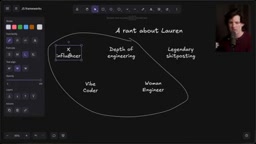
His own experience: once his YouTube subscriber count crossed a certain threshold, outsiders' perception of him flipped from "a developer who does open source and knows frameworks, who also makes videos" to "a YouTuber pretending to write code." This perceptual switch happened in barely a week or two. He observes that the same mechanism compounds for women engineers—if a woman engineer is simultaneously tagged "vibe coder" and "influencer," her technical ability gets systematically underestimated.
He candidly admits that when Lauren began being active as a vibe coder and X platform creator, he worried her engineering depth and sense of humor would be overlooked. But what happened later changed his view: she is regarded both as a highly capable engineer and remembered for her sharp views and expression—though such "having it all" cases remain rare in the industry.
Advice for Developers: Fall in Love with "Change" Itself
Theo's advice for veteran developers is direct: learn to love the process of things moving, not where they currently rest. He says his biggest career moments were never "discovering an old pattern and falling in love with it" but "just as I understood one pattern, something new appeared"—what he loves is that sense of trajectory.
He connects this adaptability to the historical situation of web developers: frontend frameworks change so fast it's become a meme—jQuery, Angular, React, Vue, Svelte, Solid… one after another. It's precisely this experience of "forced continuous learning" that makes a cohort of web-bred engineers comfortable in the AI development era—they're long accustomed to drastic toolchain upheaval.
As for those currently learning to program, Theo's stance is: this article isn't written for you, but for those who've been programming for ten-plus years and are facing the reality of "a craft disappearing." But he offers a positive closing—transfer the excitement that drove you to learn programming back then, that curiosity about building and exploring, to building with AI, and you'll end up somewhere more interesting.
Code will die, but the abilities you forged while learning to program won't.
One-line Summary
Claude already writes 90% of his code; hand-writing is retreating to a craft, and AI amplifies curiosity rather than replacing creation.
Paragraph Summary
Frontend engineer Theo admits Claude writes over 90% of his code, and hand-writing code is fading to the margins like artisan shoemaking, no longer the mainstay of everyday software production. Using the Italian shoemaker analogy, he explains: hand-writing won't disappear but will become a niche craft. He acknowledges that nostalgia for late-night debugging is real, but firmly opposes using it to belittle AI builders—especially opposing dismissing veteran engineers like Lauren, a former React Compiler core contributor, with the vibe coder label. The article further argues that what AI truly amplifies is curiosity—young learners once limited by nearby resources and encouragement can now ask AI about any public knowledge at any time. Labels systematically compress outsiders' perception of engineers' abilities, with women engineers suffering most. The advice for veteran developers is to learn to love change itself, and web developers, long accustomed to framework churn, are actually better positioned.
Related articles
GNOME Moves to Ban All AI Contributions, Open Source Community Faces Split
GNOME Foundation proposes a draft policy banning all AI contributions across code, docs, translations, and more. Community reaction is split, accelerating divisions in open source.

From Cloud to Local: A Complete Guide to Full Control of AI Coding Workflows
From Claude Code cloud baseline to OpenCode+OpenRouter to LM Studio local models, this course uses one app to show how AI coding workflows progressively reclaim control. It compares sub-agent splitting, large/small model division of labor, and cost/privacy trade-offs, plus key engineering techniques for making small models work.

Perplexity Launches Orchestrator API: Unified Multi-Model Access with Failover
Perplexity releases the Orchestrator API, enabling single-endpoint access to OpenAI, Anthropic, Google, xAI, and open-weight models with same-model provider failover, unified billing, and a preview perplexity/auto auto-routing option.