GnuPG Discloses Remote Code Execution Vulnerability, Renewed Focus on Encryption Tool Security
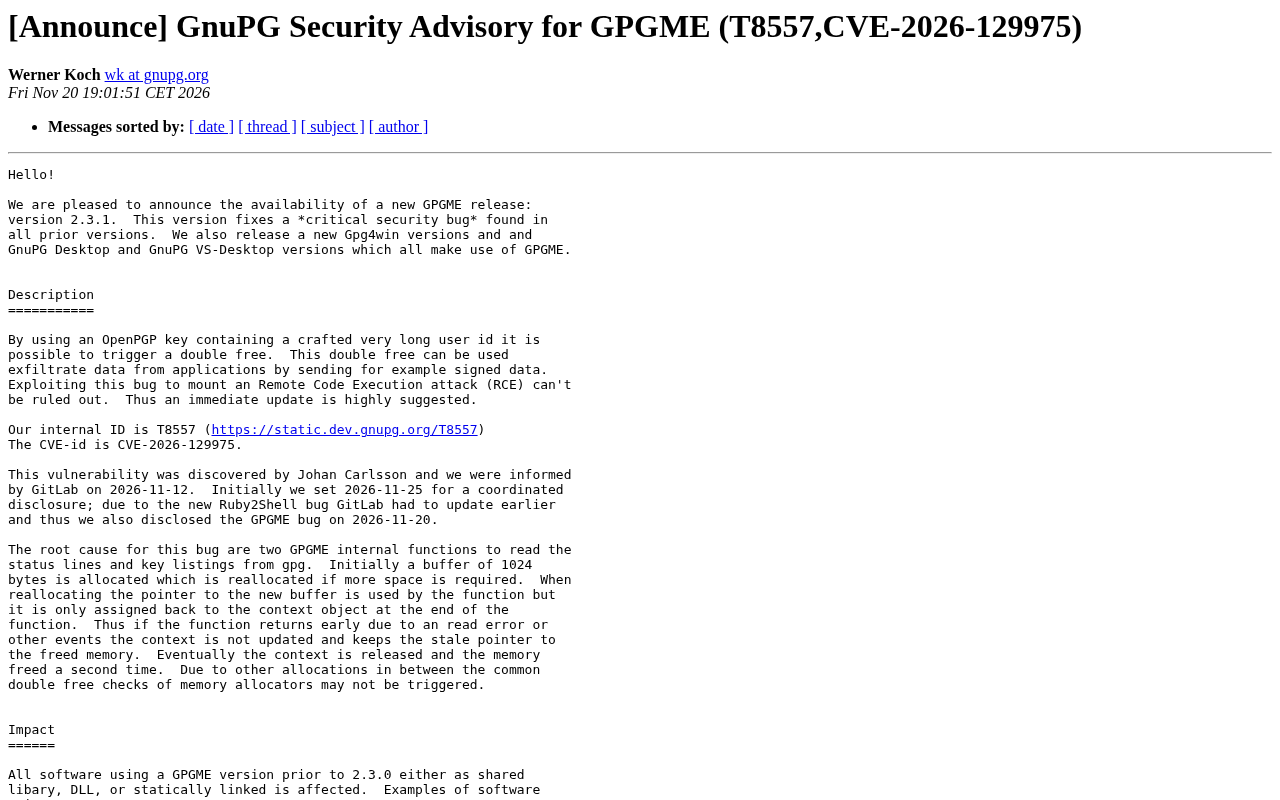
GnuPG disclosed a remote code execution vulnerability, drawing intense community attention and renewed warnings about supply chain security.
GnuPG's official mailing list disclosed a remote code execution (RCE) vulnerability, a security flaw of the highest severity. The news sparked widespread discussion on Hacker News, gaining 247 points and 98 comments. GnuPG is the open-source implementation of the OpenPGP standard, widely used for email encryption, package signature verification, and Git commit signing. Its role as a root of trust means the vulnerability's impact could ripple across the entire open-source supply chain. Community attention focuses on trigger conditions, affected version range, and whether exploitation in the wild exists. The article recommends that teams using GnuPG check official announcements, assess their exposure, and monitor distribution patch releases, while emphasizing that security tools themselves have an attack surface and that GnuPG should be included in routine dependency update and CVE tracking policies.
The cornerstone of encrypted communication, GnuPG (GNU Privacy Guard), has recently been disclosed to contain a remote code execution (RCE) vulnerability. The news came from an announcement on the official mailing list and sparked widespread discussion on the technical community Hacker News, quickly gaining 247 points and 98 comments.
Vulnerability Disclosure: An Alert from the Official Mailing List
According to the announcement on the GnuPG official mailing list, the vulnerability is classified as remote code execution (RCE). Such vulnerabilities typically allow attackers to execute arbitrary code on the target system and are among the most severe classes of security flaws. The original source material did not provide additional technical details in the announcement itself, but the RCE classification is enough to alert enterprise security teams and open-source software users.
GnuPG is the open-source implementation of the OpenPGP standard and is widely used for email encryption, file signing, package verification, and more. From individual developers to large enterprise infrastructure, GnuPG's role as a root of trust means its security directly affects the supply chain security of the entire ecosystem.
The speed of the security community's response often says more than the vulnerability itself. Nearly a hundred comments on Hacker News indicate that a large number of developers and security practitioners are assessing the impact in real time.
Remote code execution (RCE) refers to a security flaw that allows an attacker to exploit a vulnerability to run arbitrary instructions on the target system, usually meaning the attacker can fully control the affected process or even the host. The severity of RCE depends on the trigger path: if it can be triggered remotely without authentication or user interaction, the harm is close to the highest level; if local access or specific configuration is required, the actual risk narrows. The security industry often quantifies such vulnerabilities with CVSS scores, but a score is not the only standard—exposure surface and exploitation difficulty are equally critical. As a tool that handles keys and signatures with high privileges, GnuPG could, once an RCE occurs, allow attackers to steal private keys or tamper with signature verification results, causing cascading damage to the chain of trust.
OpenPGP is an open encryption messaging standard that defines data formats and protocol flows for public-key encryption, digital signatures, and key management. GnuPG is the most mainstream open-source implementation of OpenPGP, so its behavior must remain consistent with the standard while remaining compatible with a large number of clients and libraries. The standard itself does not specify implementation details, which means different implementations may introduce their own security flaws. Understanding OpenPGP's role helps assess the impact of the vulnerability: if the flaw lies in the protocol parsing layer (e.g., handling malformed messages), then all components that call GnuPG to parse untrusted input may become attack entry points.
Community Discussion: The Focus Behind 98 Comments
In the Hacker News discussion thread, 98 comments analyzed the issue from different angles. Although the original source material did not provide the specific content of the comments, given GnuPG's use cases, community attention usually centers on several areas: the trigger conditions of the vulnerability (whether specific interfaces or user interaction are required), the range of affected versions, and whether there is exploitation in the wild.
The value of such discussion is that official announcements often provide only the minimum necessary information, while the community can reach a consensus on exploitability more quickly through cross-validation and practical testing. For operations teams that rely on GnuPG, staying on top of both official channels and community discussion is a necessary emergency action.
Impact Assessment: Who Needs to Act Immediately
GnuPG appears in many critical chains: package signature verification for Linux distributions, Git commit signing, encrypted email clients, password manager backends, and more. The impact scope of an RCE vulnerability depends on the attack vector—if remote triggering requires specific configuration or an exposed service interface, the actual risk may be concentrated in specific use cases; otherwise, it may affect a broader surface.
For teams using GnuPG, the recommended action path includes: checking the affected version information in the official announcement, assessing your own exposure (whether any service exposes GnuPG-related interfaces externally), and monitoring patch releases from upstream distributions. The open-source ecosystem's response usually follows the rhythm of "announcement—patch—distribution sync," and shortening your own response window is key.
Package signature verification is one of GnuPG's most common infrastructure uses. Linux distributions (such as Debian and Fedora) use GnuPG to sign packages and repository metadata, and package managers verify signatures before installation to ensure software sources are trustworthy and untampered. If this step is bypassed or exploited, attackers could distribute malicious updates to an entire distribution's user base, forming a supply-chain-level attack. Therefore, when an RCE appears in GnuPG, distribution security teams usually immediately assess whether their package manager invocation paths are exposed to untrusted input and accelerate patch delivery. For enterprise operations, this means monitoring the announcement cadence of upstream distributions, not just GnuPG's official statements.
Security Lessons from Encryption Tools
The emergence of an RCE vulnerability in foundational security software like GnuPG once again reminds us of an often overlooked fact: security tools are themselves software and have an attack surface. Encryption software often runs with high privileges and processes untrusted input, so once memory safety or logic flaws appear, the consequences may be more serious than for ordinary applications.
This is also why vulnerability disclosures in foundational security components are always particularly sensitive. For developers, the lesson is: do not assume a tool is invulnerable just because it "has security as its mission." Security update policies in dependency management should cover all dependencies equally, including encryption libraries and signing tools. For security teams, including GnuPG in the asset inventory and tracking its CVE activity should become standard practice.
CVE (Common Vulnerabilities and Exposures) is a standardized numbering system for public vulnerabilities; each CVE record corresponds to a confirmed security flaw, making it easier to track across vendors and tools. Including GnuPG in the asset inventory and tracking its CVE activity means security teams need to subscribe to official announcements, monitor vulnerability databases, and incorporate GnuPG versions into patch management processes. In practice, many teams focus only on CVEs in application-layer dependencies while ignoring system-level encryption tools, leading to delayed response. CVEs in foundational components often have broad impact but limited disclosure information, so establishing a closed-loop process of "announcement—assessment—patch" is more important than one-off emergency response.
Follow-up
The original announcement link points to the GnuPG official mailing list. Readers who need to assess the impact are advised to consult the original announcement directly for affected versions and remediation recommendations. Full technical details of the vulnerability, PoC status, and patch progress across distributions will become clearer through subsequent community discussion and official updates.
Against the backdrop of frequent supply chain attacks, vulnerabilities in foundational encryption tools should not be treated as isolated incidents, but as one facet of open-source infrastructure security governance.
One-line Summary
GnuPG has been disclosed to contain a remote code execution vulnerability, drawing intense community attention and once again raising supply chain security concerns.
Paragraph Summary
A remote code execution (RCE) vulnerability in GnuPG was disclosed on the official mailing list, representing a security flaw of the highest severity. The news sparked widespread discussion on Hacker News, gaining 247 points and 98 comments. GnuPG is the open-source implementation of the OpenPGP standard, widely used for email encryption, package signature verification, Git commit signing, and other scenarios. Its role as a root of trust means the vulnerability's impact could ripple across the entire open-source supply chain. Community attention focuses on the vulnerability's trigger conditions, affected version range, and whether exploitation in the wild exists. The article recommends that teams using GnuPG check official announcements, assess their exposure, and monitor distribution patch releases, while emphasizing that security tools themselves have an attack surface and that GnuPG should be included in routine dependency update and CVE tracking policies.
Related articles
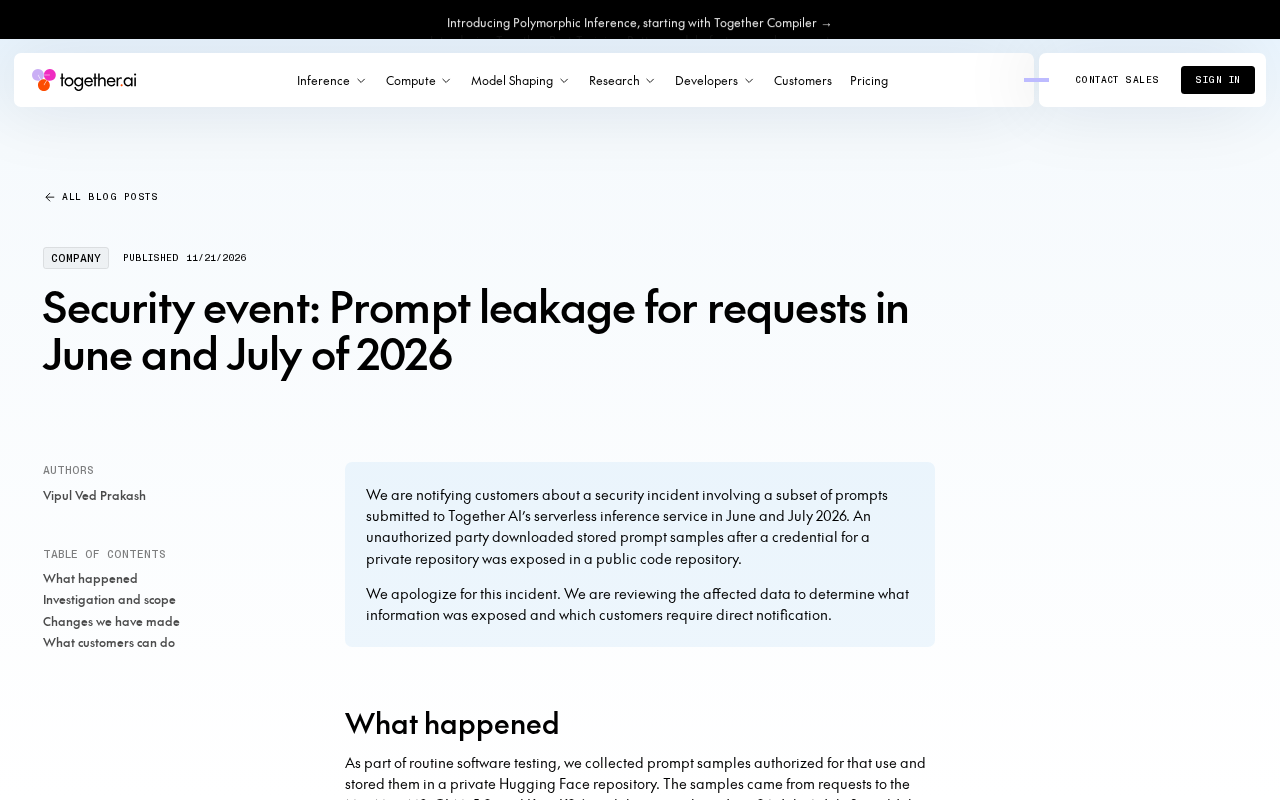
Together.ai Reportedly Exposes Prompt Leakage Vulnerability: Request Handling Mechanism Raises Concerns
Together.ai is reportedly exposed on Hacker News for request prompt leakage. This article analyzes the incident background, the isolation challenges of multi-tenant inference platforms, and the security implications for developers and the AI infrastructure industry.
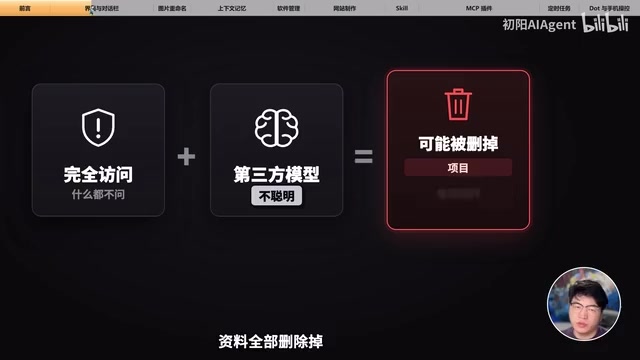
Codex for Beginners: 13 Hands-On Projects from Installation to Building Websites and Blender Modeling
Complete Bilibili Codex beginner tutorial: from registration and installation, permissions and model selection, to 13 hands-on scenarios including environment setup, GPT image generation for personal websites, Skill packaging, MCP connection to Blender modeling, CapCut control, scheduled tasks, and mobile control.
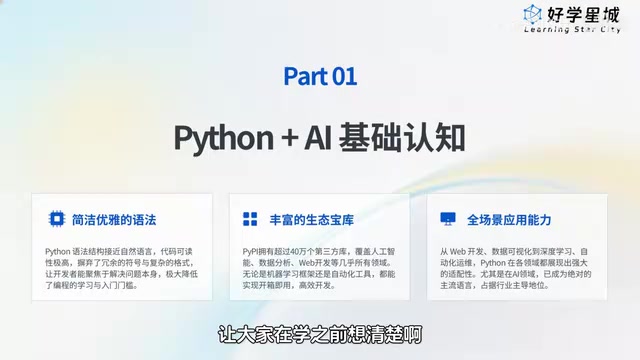
Python + AI from Scratch: Environment Setup and Core Concepts Guide
An introduction to a beginner Python and AI course: why Python is the top choice for AI, how to set up a versatile development environment, five core use cases, and AI talent demand analysis.