Go Introduces Platform-Independent SIMD: A New Experiment in Performance Optimization

Go releases an experimental platform-independent SIMD feature to simplify cross-architecture high-performance programming.
The Go official blog has published an experimental platform-independent SIMD proposal, sparking lively discussion in the Hacker News community. SIMD enables CPUs to process multiple data elements in parallel, delivering major performance gains for image processing, machine learning, and data compression — but traditionally requires separate assembly code for architectures like x86 AVX and ARM NEON. Go's experiment aims to provide a unified high-level abstraction so developers can write one codebase and gain SIMD acceleration across different CPU architectures, with the compiler handling the mapping to target-platform instructions. This aligns with Go's emphasis on simplicity and portability. If the feature graduates to the standard library, it could significantly strengthen Go's competitiveness in numerical computing, multimedia, and AI inference — domains long dominated by C/C++.
The Go official blog published an experimental article on platform-independent SIMD (Single Instruction, Multiple Data) support, which quickly garnered 238 upvotes and 86 comments on Hacker News, making it a hot topic in the community. This experiment represents a significant exploration by the Go team into the realm of high-performance computing.
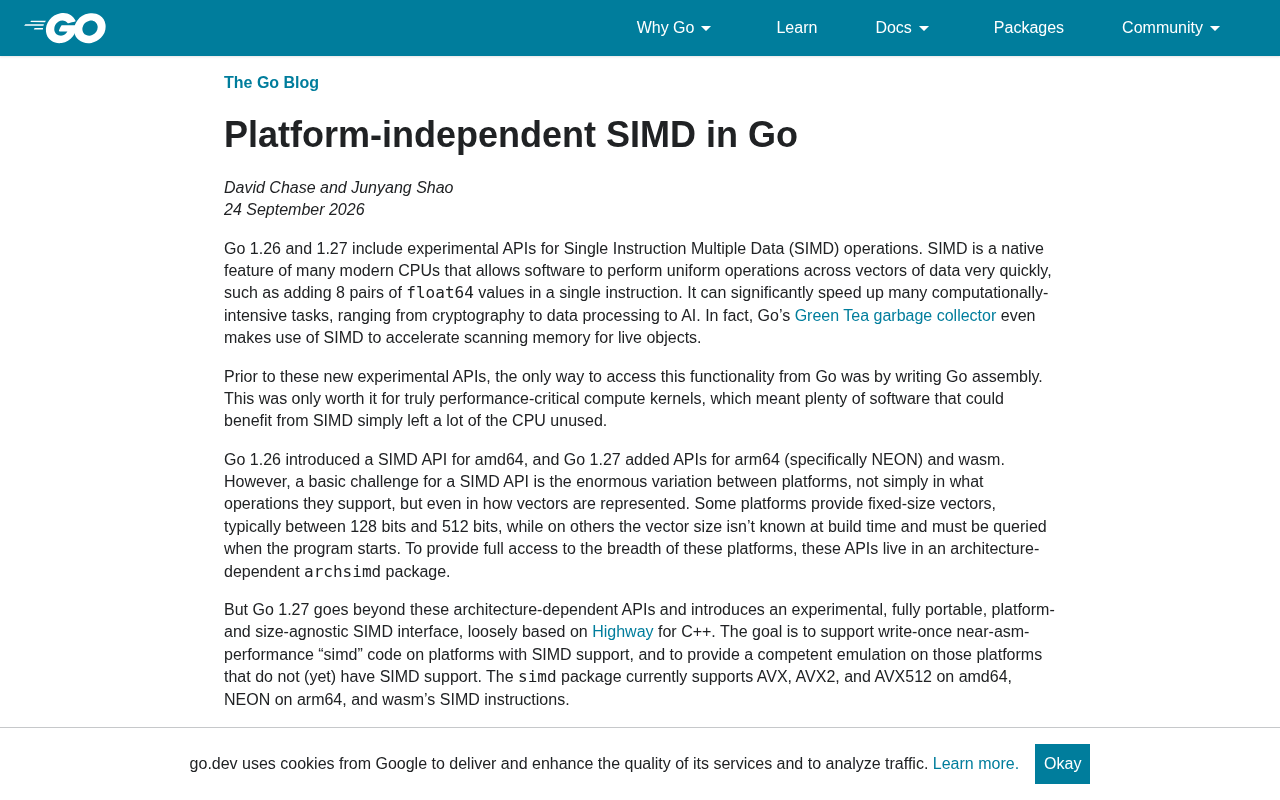
What Is SIMD and Why Does It Matter
SIMD (Single Instruction, Multiple Data) is a parallel computing capability provided by modern CPUs. It allows a single instruction to perform the same operation on multiple data elements simultaneously, rather than processing them one by one. This can deliver several times — or even orders of magnitude — more performance in scenarios such as image processing, machine learning, data compression, encryption, and numerical computation.
Previously, using SIMD in Go relied primarily on two approaches: calling assembly code, or relying on the compiler's auto-vectorization. The former requires writing and maintaining separate assembly implementations for different CPU architectures (e.g., AVX for x86, NEON for ARM), which is costly and error-prone; the latter is constrained by the compiler's optimization capabilities, making fine-grained control difficult.
Taking x86 as an example, Intel/AMD's SIMD instruction sets have evolved through MMX → SSE → SSE2/3/4 → AVX → AVX-512, with each generation doubling the register width (from 64-bit to 512-bit) and proportionally increasing the amount of data a single instruction can process. The ARM platform has NEON (128-bit) and the newer SVE/SVE2 (variable-length, up to 2048-bit). This fragmentation means the same algorithm often requires maintaining multiple platform-specific implementations. Rust addresses this through std::simd (portable-simd), and C++ through the Highway library — both exploring unified cross-platform abstractions. Go's current experiment is a follow-up effort in this same direction.
The Core Idea Behind Platform-Independent SIMD
The key innovation in Go's experiment is the "platform-independent" aspect. Traditional SIMD programming is tightly coupled to specific hardware instruction sets, requiring developers to write different code for different architectures. Go's experimental approach aims to provide a unified abstract interface, allowing developers to write a single codebase and still benefit from SIMD acceleration across different CPU architectures.
This design philosophy aligns closely with Go's long-standing emphasis on simplicity and portability. Developers no longer need to dive deep into the differences between underlying instruction sets — the compiler and runtime are responsible for mapping high-level SIMD operations to the specific instructions of the target platform. This significantly lowers the barrier to using SIMD and makes code much easier to maintain.
The core technical challenge of achieving "platform-independent SIMD" lies in width abstraction and operational semantic alignment. Different architectures have different SIMD register widths and support operations at different granularities (for example, ARM SVE supports variable-length vectors, while x86 AVX-512 is a fixed 512 bits). A common solution is to introduce a "Vector Length Agnostic (VLA)" programming model, where code is written in terms of logical vectors and the compiler selects the optimal register width for the target platform. Whether Go's experimental approach adopts a similar strategy, and how it handles the greatest-common-denominator problem across platform operation sets, is one of the focal points of community discussion.
Community Interest and Discussion
The 86 active comments on Hacker News demonstrate that this feature touches on a long-standing pain point for many developers. Go has long been celebrated for its strengths in network services and cloud-native applications, but the lack of native SIMD support has been a weakness in compute-intensive scenarios that demand maximum performance.
For Go developers working in high-performance computing, data processing, and AI inference, native and platform-independent SIMD means being able to squeeze more hardware performance out of their code while maintaining readability. This is a major reason for the community's enthusiastic response to the experiment.
The Significance of an Experimental Feature and What Lies Ahead
It's worth emphasizing that this is still an "experiment." The Go team typically uses experimental features to gather community feedback, assess the feasibility and real-world effectiveness of the design, and then decide whether to incorporate it into the official standard library. This cautious, incremental approach to evolution is an important safeguard for Go's stability.
If this experiment matures and eventually makes it into the standard library, it will further expand Go's application domain, making it more competitive in areas traditionally dominated by C/C++ or Rust — such as numerical computation, multimedia processing, and machine learning. Developers are encouraged to follow the Go official blog for updates, participate in the experiment, and provide feedback to help refine this feature.
Summary
Go's platform-independent SIMD experiment is a proactive response to the demand for high-performance computing. It reduces the complexity of SIMD programming while preserving Go's hallmark cross-platform portability. Although it remains in the experimental stage, its potential value and the community's keen interest both signal that Go has taken a promising step forward on the road to performance optimization.
Related articles

Gaussian Process Bandit Optimization: Exploration Strategies and Inference Regret Guarantees
Cumulative regret guarantees in Bayesian optimization fail to reflect final recommendation quality. This article examines a new study that provides inference regret guarantees for Gaussian process bandit optimization through exploration query strategies and fill distance analysis, validated on hyperparameter optimization and control tasks.

The Most Detailed Codex Guide on Bilibili: From Installation to Real-World Practice
The most detailed Codex guide on Bilibili: from app store installation to daily work mode configuration, with a real coffee shop project demonstrating file organization, data extraction, dashboard creation, and other practical tasks. Learn to use Plan Mode and desktop pets to leverage Codex efficiently.

Appearance Compensation in Volume Rendering: Why RGB Accuracy Cannot Guarantee Density Correctness
Volume rendering research reveals that volumetric data perfectly reproducing external RGB views may still contain density errors: appearance compensation can double central density and keep external rays unchanged even when L2 error exceeds 14.52%. Density recovery depends on appearance capacity, spatial resolution, and measurement design.