Go Releases a Brand-New JSON API: The Changes Brought by jsonv2
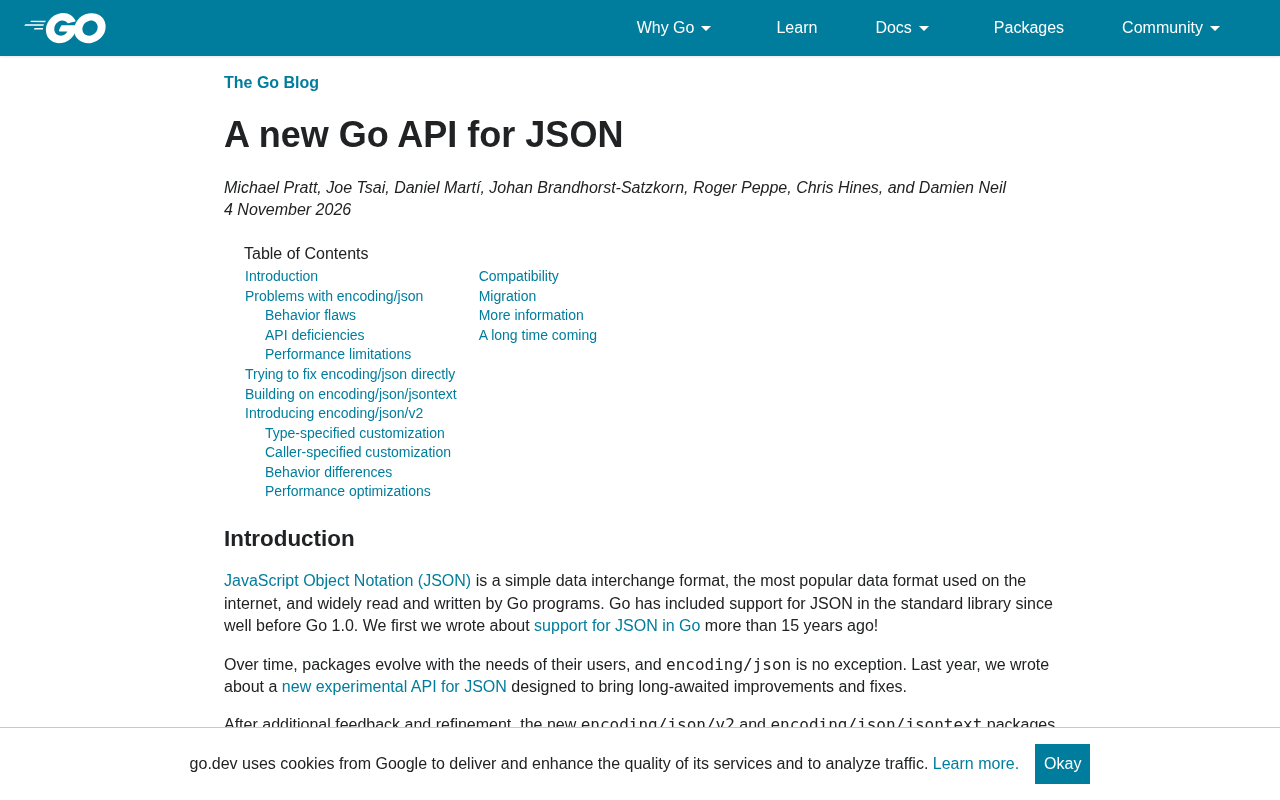
Go's official blog releases a new JSON API aimed at addressing the performance and extensibility limitations of encoding/json.
The official Go blog published "A new Go API for JSON," introducing a brand-new API for the standard library's JSON package, which the community calls jsonv2. The new API is not a patch on the original encoding/json but a redesign of the encoding/decoding abstraction, introducing clearer interface layering that lets developers control serialization and deserialization more precisely while maintaining the standard library's simple style and backward compatibility. The topic garnered 275 points and 125 comments on Hacker News, with discussion focusing on practicality, learning curve, migration strategy, and its relationship with third-party JSON libraries. The official recommendation is to try the new API in new projects and introduce it gradually in existing projects after assessing compatibility.
The official Go blog recently published an article titled "A new Go API for JSON," introducing a brand-new API for the JSON package in the Go standard library. The news quickly sparked heated discussion on Hacker News, garnering 275 points and 125 comments—a testament to how much the Go community cares about JSON handling.
Why Is a New JSON API Needed?
Go's encoding/json package has long been the core tool developers use to handle JSON data, but the historical baggage of its design has gradually become apparent. As application scenarios grow more complex, the original API has started to strain in terms of performance, flexibility, and extensibility. According to the official blog, the design goal of the new API is to address long-standing pain points while maintaining backward compatibility.
In community discussions, many developers mentioned the limitations of the original JSON package when handling large datasets, custom serialization, and error handling. The introduction of the new API is precisely a response to this real-world feedback.
The encoding/json package has been in the standard library since Go 1.0, and its core API consists of the two functions Marshal and Unmarshal, which rely on struct tags to map fields. It depends on reflection to resolve type information at runtime, which brings two long-standing pain points: first, reflection overhead is significant when processing large-scale data; second, custom serialization can only be achieved by implementing the json.Marshaler/json.Unmarshaler interfaces, which is fairly coarse-grained. In addition, the lack of structured information in error handling, limited streaming capabilities, and lagging support for new JSON features are all issues the community has raised repeatedly. Only by understanding this historical baggage can one appreciate why the Go team chose to redesign rather than patch.
The Core Design Philosophy of jsonv2
According to the official blog, the new JSON API (referred to by the community as jsonv2) is not simply a patch on the original package, but a rethinking of how JSON encoding and decoding are abstracted. It introduces a clearer interface layering that lets developers control the serialization and deserialization process more precisely.
You may not have noticed that while the new API maintains the standard library's一贯 simple style, it offers stronger extensibility. This means developers can implement more complex custom logic without sacrificing ease of use. Commenters on Hacker News generally agreed that this balance is the most commendable aspect of this update.
The Trade-off Between Performance and Compatibility
Performance has always been a key focus of the Go community regarding the JSON package. The official blog notes that the new API took performance optimization fully into account during design, but the specific degree of improvement needs to be tested by developers according to their actual scenarios. At the same time, backward compatibility is given an important place, so existing code will not immediately break due to the introduction of the new API.
This gradual migration strategy has been recognized by the community. Some comments pointed out that the Go team's consistently cautious approach to standard library evolution allows developers to upgrade at their own pace.
Backward compatibility is a core constraint in the evolution of the Go standard library. The Go 1 compatibility promise stipulates that published public APIs will not be changed in a breaking way, so the existing function signatures of encoding/json must be preserved. A typical approach to gradual migration is: new functionality is introduced as new packages or new interfaces, the old API remains available, and the two may share underlying logic at the implementation level. This means developers can adopt the new API directly in new projects while gradually replacing it module by module in existing projects, without having to rewrite all serialization code at once. This strategy has precedents in Go's history, such as the coexistence of math/rand and crypto/rand, and the transition between old and new routing APIs in net/http.
Community Reaction and Discussion Focus
Among the 125 comments on Hacker News, developers engaged in lively discussion around the practicality of the new API, its learning curve, and comparisons with third-party JSON libraries. Some developers praised the interface design of the new API, believing it solves pain points that have long troubled them; others remained cautious, hoping to see more actual benchmarks and migration cases.
A frequently mentioned topic is: will the new API replace existing third-party JSON libraries? Community opinions differ on this. Some believe that improvements to the standard library will reduce the need for external dependencies, while others believe that third-party libraries still have value in specialized scenarios.
Third-party JSON libraries occupy an important position in the Go ecosystem. The most well-known are json-iterator/go and goccy/go-json, which bypass reflection through code generation or hand-optimized codecs and can achieve several times the performance in high-frequency serialization scenarios; easyjson uses code generation to generate encoding/decoding methods for specific types. In addition, libraries such as jsonparser focus on fast field reading without full deserialization. The existence of these libraries shows that the standard library does have gaps in performance and flexibility. If the new API is to reduce external dependencies, the key lies in whether its extensible interfaces can cover the typical use cases of third-party libraries, such as code generation, streaming processing, and custom types.
Impact on Go Developers
For developers who use Go daily, the arrival of the new JSON API means one more modern option. The official blog recommends that developers pay attention to the migration guide and try the new API in new projects. For existing projects, it can be introduced gradually after assessing compatibility.
Overall, this JSON API update is a microcosm of the continuous evolution of the Go standard library. It reflects both the Go team's attention to community feedback and its efforts to improve functionality while maintaining the language's simplicity. As developers gradually adopt it, the new API is expected to become the new standard for JSON handling in the Go ecosystem.
One-line Summary
Go's official blog releases a brand-new JSON API aimed at addressing the performance and extensibility limitations of encoding/json.
Paragraph Summary
The official Go blog published an article titled "A new Go API for JSON," introducing a brand-new API for the standard library's JSON package, which the community calls jsonv2. The new API is not a patch on the original encoding/json but a redesign of the encoding/decoding abstraction, introducing clearer interface layering that allows developers to control serialization and deserialization more precisely while maintaining the standard library's simple style and backward compatibility. The topic garnered 275 points and 125 comments on Hacker News, with discussions focusing on practicality, learning curve, migration strategy, and its relationship with third-party JSON libraries. The official recommendation is to try the new API in new projects and introduce it gradually in existing projects after assessing compatibility.
Related articles
 Tech Frontiers
Google Omni 1.2 Flash: 15-Second AI Video at Just $0.07 per Second
Google DeepMind releases Gemini Omni 1.2 Flash: 15-second video, 720p at $0.07/sec (30% cheaper), multi-turn editing without regeneration, draft upscaling to 4K.
 Tech Frontiers
No AI Ghostwriting: Writer's Quarter Reinvents Novel Writing with a Visual Workbench
The Writer's Quarter is an AI-free novel writing and planning tool that unifies character building, story planning, and manuscript writing in one visual workbench. This article analyzes its positioning, target users, and differentiated value amid the rise of AI writing tools.
 Tech Frontiers
Fleeep: A Unified Inspiration Collection Notes App for Creatives
Fleeep is a notes app for creatives that unifies screenshots, bookmarks, saved posts, and inspiration into one calm, cross-device, offline-capable space. This article analyzes its positioning, differentiation, and target users.