Google Accused of Copying Open-Source Code: 228 Out of 229 Files Identical, Engineer Credits Removed
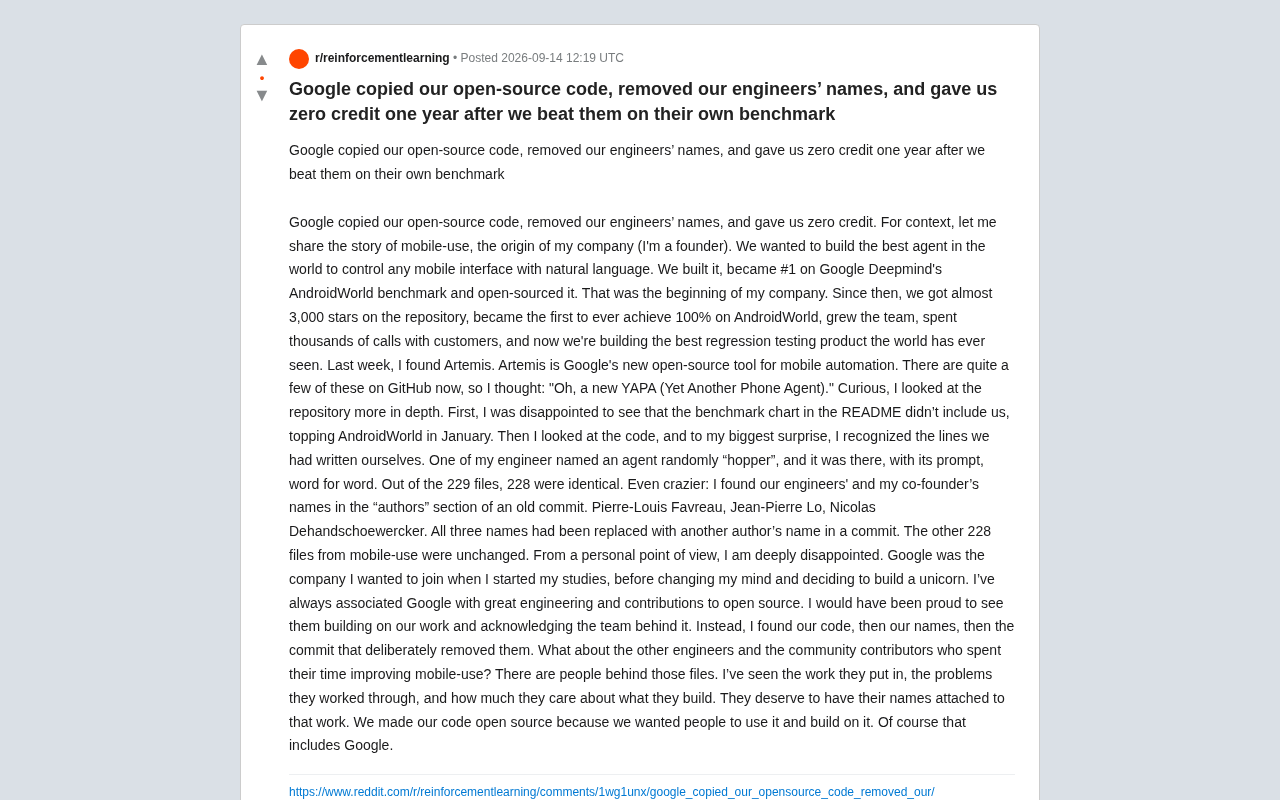
Startup founder accuses Google's Artemis of copying mobile-use code and removing original engineer attribution.
A startup founder posted on Reddit accusing Google's new open-source mobile automation tool Artemis of copying code from their project mobile-use: 228 out of 229 files were identical, and the names of three engineers and a co-founder recorded in the commit history were replaced with another author's name. mobile-use had topped Google DeepMind's AndroidWorld benchmark and was the team's core technical achievement. The founder stressed he wasn't opposed to Google using open-source code — what disappointed him was the deliberate removal of attribution, which may violate MIT/Apache license terms and crosses an ethical line in the open-source community. Google has yet to respond publicly, but the incident has sparked widespread discussion about trust between tech giants and the open-source ecosystem.
A startup founder took to Reddit to accuse Google of extensively copying code from their open-source project mobile-use in a new tool called Artemis — without any attribution, and with the original engineers' names deleted. The incident quickly drew attention from the open-source community and reignited questions about trust between tech giants and open-source contributors.
From AndroidWorld Champion to Being "Copied"
At the center of the controversy is a mobile agent project called mobile-use. According to the founder, the team's goal was to build "the world's best agent capable of controlling any mobile interface using natural language." After launch, the project performed impressively: it topped Google DeepMind's AndroidWorld benchmark, becoming the first project to achieve a 100% score, and accumulated nearly 3,000 stars on GitHub.
This track record formed the foundation of the company's early growth. The team expanded, conducted numerous customer interviews, and pivoted toward a regression testing product. The motivation for open-sourcing mobile-use, as the founder put it, was to "let people use it and build on top of it" — and that naturally included Google.
228 Out of 229 Files Identical
The turning point came when the founder discovered Artemis, Google's newly released open-source mobile automation tool. At first, he dismissed it as just another "phone agent" on GitHub — what he sarcastically called a YAPA (Yet Another Phone Agent) — and didn't think much of it.
A closer look at the repository changed everything. His first disappointment was that the benchmark comparison chart in Artemis's README didn't include mobile-use, despite it having topped the AndroidWorld leaderboard. More shocking was the code itself: he recognized lines his own team had written. One engineer had casually named an agent "hopper," and that name — along with its exact prompt — appeared word-for-word in Artemis.
According to the founder's figures, 228 out of 229 files in Artemis were identical to mobile-use. That ratio essentially rules out coincidental parallel development and points to direct code copying.
Author Credits Replaced
What truly ignited the controversy was the attribution issue. The founder said he found the names of his co-founder and engineers — Pierre-Louis Favreau, Jean-Pierre Lo, and Nicolas Dehandschoewercker — in the "authors" section of an older commit. In a subsequent commit, those three names were replaced with another author's name, while the remaining 228 files sourced from mobile-use remained unchanged.
In other words, the problem wasn't just that code had been copied — it was that the original authors' names appeared to have been deliberately removed. In the open-source world, code can be freely used, modified, and redistributed, but attribution to the original authors is both a licensing requirement and an ethical baseline. Removing that attribution crosses both lines.
Major open-source licenses have different requirements around attribution. The MIT License requires that the original copyright notice be retained in all copies. Apache 2.0 goes further, requiring that the NOTICE file be preserved in derivative works and that modifications to the original code be explicitly stated. If a Git commit history replaces original authors with someone else — even if the repository remains open-source — it may constitute a violation of the license's attribution clauses. Legally, violating an open-source license is not merely an ethical matter: it can trigger copyright infringement liability. Open-source licenses are essentially contracts through which copyright holders grant usage rights, and violating their terms voids that grant, exposing the violating party to legal risk.
A Founder's Disappointment
The founder expressed a strong personal sense of betrayal in his post. He mentioned that Google had once been his dream employer during his student years, before he chose to start his own company. In his mind, Google had always stood for "great engineering" and "meaningful contributions to open source."
"I would have been proud to see them build on our work and credit the team behind it," he wrote. "Instead, what I saw was — first our code, then our names, and finally the commit that deliberately removed them."
He also spoke up on behalf of the engineers and community contributors: "There are real people behind these files. I've seen the effort they put in, the problems they solved, and how much they cared about what they were doing. They deserve to have their names on their work."
Why This Matters
It's worth noting that this account comes entirely from a single source — the Reddit post of the startup's founder. Google has not issued a public response, and the full technical details and legal characterization of the incident have yet to be verified.
Even so, the dispute raises several important questions. Open-source licenses like MIT and Apache 2.0 typically require that copyright notices and attributions be preserved. If the code copying is confirmed and the attribution was indeed removed, this could constitute a violation of those license terms. For large tech companies, the open-source community is both a source of technical nourishment and a reputational proving ground — being accused of "taking the work while erasing the contributors" can damage brand trust far beyond the value of any code.
For startups that depend on open source to gain traction, this is also a reminder: open source is a double-edged sword. It brings reach and influence, but it also exposes core work to the risk of being copied. Finding the right balance between openness and protection remains a challenge every open-source founder must face.
Until Google provides an official response, this is more of a public conversation about open-source ethics and attribution than a legally settled infringement case. But regardless of how it unfolds, it serves as yet another reminder to the industry: if you use open source, give credit to the people behind it.
Background
AndroidWorld is a mobile agent evaluation benchmark released by Google DeepMind, designed to measure an AI system's ability to complete natural language tasks on real Android devices — including file management, app interactions, and information retrieval. What makes the benchmark difficult is the high diversity of tasks and the long execution chains involved, requiring agents to make continuous decisions across multiple apps. Achieving a 100% score on this benchmark means the agent can reliably complete every task in the test set — a milestone widely regarded as a major achievement in mobile automation, and the core technical credential that earned mobile-use recognition from the community and prospective customers.
Related articles
Letting AI Build AI Tools: A 7-Day, 31-Commit Bootstrapping Post-Mortem
An engineer ran a fully autonomous AI-builds-AI pipeline for 7 days, 31 commits, with a 1-in-6 success rate. This post-mortem covers 5 failure types, 11 structural rules, and how every mistake became a permanent immunity gate.
Building an AI-Powered E-Commerce Business from Scratch: A Real-World Account of Multi-Agent Architecture for Print-on-Demand
A blogger builds a print-on-demand e-commerce company from scratch using AI agents — documenting specialized Agent profiles, GPT-5.6 vs Claude Fable multi-model orchestration, and reusable skill accumulation.
AI Agent Earns $10K in One Week: 3 Key Upgrades Explained
A blogger shares how he earned $10K in a week with an AI Agent — not by adding more skills, but through verification, approval gates, and subagents to raise trust and enable true automation.