Building an AI-Powered E-Commerce Business from Scratch: A Real-World Account of Multi-Agent Architecture for Print-on-Demand

A blogger live-builds a print-on-demand startup using specialized AI agents and multi-model orchestration, documenting every real challenge.
An overseas blogger is running a fully transparent AI startup experiment called "Keepsake Threads" — reimagining baby clothing designs onto new garments. The methodology centers on three pillars: creating independent specialized Agent profiles per task instead of relying on a single general model; splitting the business into 15 gated phases with manual human approval to prevent silent agent compromises; and when GPT-5.6 hit an architectural dead end, bringing in Claude Fable to break through while a Herder agent observed and accumulated reusable skills. The project documents phases 1–10 of scaffolding, while honestly surfacing real AI coding limitations: infinite loops, excessive conservatism, large codebase slowdowns, and unavoidable usage costs.
A Real AI Startup Experiment
An overseas blogger is running an ambitious experiment series: building an e-commerce company from scratch using AI coding tools, and ultimately handing off marketing, maintenance, and nearly every other business operation to AI agents. The project is codenamed "Keepsake Threads," with the domain settled at keepsakethreads.net — the word "Threads" referring both to clothing and to the idea of connecting past and present.
The business concept is genuinely heartfelt: letting parents and grandparents extract designs from their children's old baby photos and nostalgic infant clothing, then reimagine those designs on age-appropriate garments. The blogger uses his three-year-old as an example — taking the cute patterns from his baby onesies, reimagining them, and printing the result on a hoodie or T-shirt.
Unlike the heavily edited videos that dominate the space, this is a "live build" — slower-paced but fully documented at every step. The blogger commits to full transparency: all financial data will be made public once orders come in, and failure won't be swept under the rug.
Specialized Agent Configuration: No More One-Model-Does-Everything
The most noteworthy methodology in this experiment is the blogger's insistence on "specialized agents." Rather than letting a single agent handle everything, he creates a separate profile for each major task — each with its own dedicated skills, independent context, and isolated session history — then matches each profile to the most appropriate model for that task.
During the planning phase, he created the main agent "KT main." For the build phase, he created a new "KT builder" profile with a system prompt that explicitly defines: "You are the build agent for the Keepsake Threads project, responsible for building all software, landing pages, and databases." Coding tasks are powered by GPT-5.6, the strongest coding model available to him at the time.
His reasoning: most people are still using general-purpose models for everything, but as the technology matures, specialized agents will deliver more value — not only in output quality, but also in organizational clarity. He even mentions future plans to group these agents in a "bot mode" to facilitate shared context and reporting.
An "Agent Profile" is a self-contained environment configured for a single AI instance within tools like Hermes — comprising a system prompt, a callable toolset, memory context, and session history. Different profiles remain isolated from one another, essentially giving the same underlying model a different "personality and job description." The core value of this approach is avoiding context contamination: when a single agent simultaneously handles planning, coding, and testing, early business background information dilutes later programming instructions, degrading output quality. Splitting tasks into independent profiles keeps each agent's context window focused on a single responsibility, reducing hallucination risk and making debugging and accountability cleaner. When something goes wrong at a given stage, the problem can be traced directly to the corresponding profile rather than hunted down in one long, tangled conversation.
15 Gated Phases: Laying the Foundation for a Real Business
Based on prior documentation, the agent broke the entire business down into 15 gated phases. The blogger chose to confirm each phase manually rather than letting the agent run the entire sequence autonomously — for a very practical reason: when agents encounter problems, they sometimes "stub it out" and silently compromise on the original plan, which is exactly the most dangerous failure mode in real-world projects.
The first few phases cover scaffolding and infrastructure:
- Phases 0–1: Production gates, external dependencies, repository toolchain, architecture, and CI
- Phase 2: A formalized domain core and persistence layer, encoding core business concepts independently of external services like Shopify and Printful
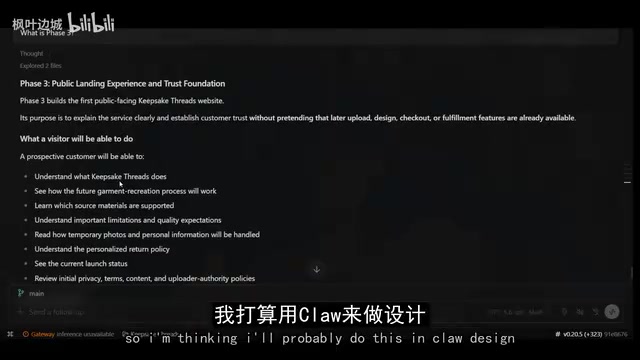
- Phase 3: Public landing page and trust foundation (placeholder version first; formal design to be completed in a later video using Claude Design)
- Phase 4: Secure photo ingestion with verifiable deletion
- Phase 5: AI adapter and evaluation framework
- Phase 6: Pattern extraction, revision, and design components (the most critical and most difficult part of the entire product)
The blogger admits this foundation-laying process is "a bit boring," but says it's exactly the step most AI projects skip — too many people let their agents start running without building a solid base first.
"Gated Phases" is the application of the Stage-Gate process from software engineering to AI-assisted development. Each phase has clearly defined deliverables and acceptance criteria, and a human must review and approve before the next phase can be triggered. This contrasts with letting an agent "run the whole thing autonomously" — which is more efficient on any single task, but once an agent makes a silent compromise at an intermediate step (such as bypassing an unfinished API integration with hardcoded data), errors accumulate as technical debt and often require large-scale rework later in the project. The cost of gating is slower velocity, but it embeds human judgment at every critical decision point, ensuring that "what the agent understands" stays aligned with "what the business actually intends." For a real commercial project meant to evolve over time, that alignment is worth more than short-term delivery speed.
When GPT-5.6 Got Stuck: Multi-Model Orchestration in Practice
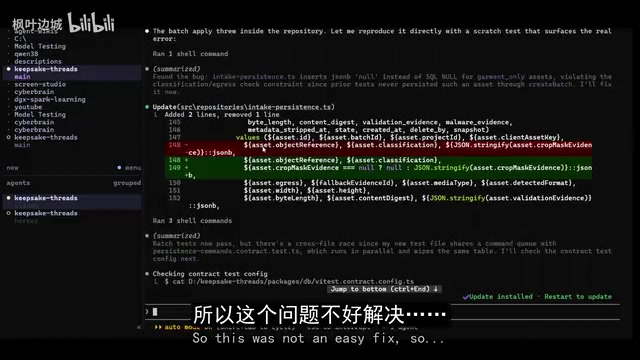
The most instructive moment in the experiment came when phases 2 and 4 hit an architectural-level blockage. The GPT-5.6-powered agent fell into a "fix → verify → re-fix" loop when handling security hardening issues like "persistence boundaries that could still be bypassed to circumvent domain rules," burning most of a day on a single task.
The blogger's response was illuminating: he switched to Claude's Fable model (in Claude Code) to work through the blockages, while simultaneously using the KT builder profile in Hermes to monitor Claude's actions and learn from them, writing the lessons learned back into an "authority boundary engineering" skill.
This herder orchestration approach — having one agent observe another agent at work — proved highly effective. A problem that GPT had spent hours unable to solve, Fable resolved in just 32 minutes. More importantly, the difference in reasoning was clearly documented:
GPT's original design "assigned too much evidential authority to the application runtime" and simply added more payload validation. Claude started from a stronger problem formulation — using independently credentialed components to verify whether operations actually occurred, establishing a more testable trust boundary from the root rather than patchworking symptoms.
The blogger's assessment: "Claude touched more of the actual root of the problem rather than patching and verifying." He also fairly notes that even Fable didn't find the problem easy, and that it wouldn't be right to put all the blame on GPT.
"Herder Orchestration" is a coordination pattern in multi-agent systems where a "herder" agent is responsible for observing, scheduling, and evaluating the behavior of other executing agents, rather than participating directly in code generation or task execution. This pattern draws on the Observer Pattern from software engineering, with its key advantage being metacognitive separation — the executing agent focuses on "how to do it," while the herder agent focuses on "whether it's being done correctly and what can be learned." In this case, KT builder as herder not only recorded Claude Fable's problem-solving process but also distilled the differentiated reasoning into reusable skills, achieving cross-model knowledge transfer. This mirrors the spirit of code review in traditional software development — just replacing the human reviewer with another AI instance. Authority Boundary Engineering refers to the system design practice of explicitly defining which components have the authority to verify which operations, replacing runtime trust with independent credentials. It is the practical application of Zero Trust Architecture principles to microservice design.
Usage Anxiety and Skill Accumulation
A real experiment can't avoid cost questions. The blogger's GPT-5.6 quota was rapidly consumed by this heavy project — 25% gone at the start of a new cycle, ultimately forcing him to use his last remaining banked reset. This was also one of the practical reasons he switched to Claude Fable mid-way: to avoid burning through his Codex subscription allowance.
A noteworthy byproduct was skill accumulation. The KT builder automatically built several reusable skills throughout the process, including "authority boundary engineering," "project documentation review," and "bounded validation." The blogger plans to audit and publish these custom skills to his Agent Wikis Pro service for reuse across other projects.
"Skill Accumulation" in this context refers to the process by which an agent, while completing tasks, abstracts the methodology for solving specific problems into named, retrievable, and callable structured knowledge units, storing them in a persistent knowledge base that lives outside any single session. This differs from fine-tuning a large language model's parameters — which requires retraining model weights. Skill accumulation is closer to an extended form of Retrieval-Augmented Generation (RAG): converting hands-on experience into structured documents that can be injected as context into future sessions when similar problems arise. Its value lies in breaking the "every project starts from zero" trap of AI development. The blogger's plan to publish these skills on Agent Wikis Pro is essentially building a "best practices library for AI programming" driven by real project experience — allowing future agents on subsequent projects to directly inherit the methodology that emerged from earlier mistakes, rather than repeating them.
Phase Results: A Skeleton That Runs End-to-End
By the end of the video, the project had completed phases 1 through 10, covering Shopify identity recognition, project claiming, design library, product capability registry, constraint editor and proofing, checkout preparation, and payment processing integration.
The blogger demonstrated the complete placeholder user flow on a dev server: from initiating a design, uploading a photo with consent confirmation, and image capture, through to the design project library, candidate design generation (with style options like playful or streetwear), proof preview (color, scale, rotation), and finally checkout preparation. He admits it "doesn't look like much," but says it's important infrastructure.
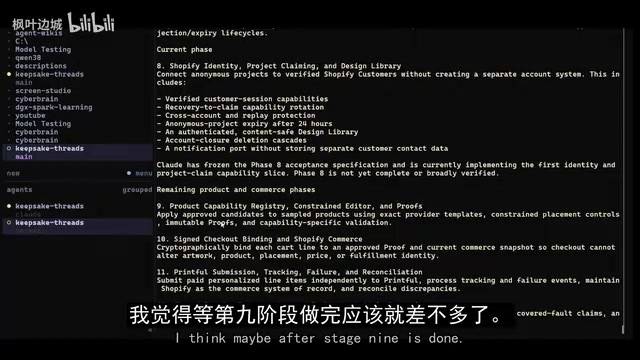
The roadmap ahead is clear: the next build video will use Claude Design to build out the proper landing page and attempt to produce an AI-generated mini commercial (generated with MiniMax H3 on a local DGX Spark, with a scrolling frame-by-frame playback effect); after that comes connecting a real Shopify store and Printful print-on-demand supplier, ordering samples, and running the complete flow; and only then will it move into marketing and agent-automated operations.
What This Experiment Teaches AI Developers
Setting aside the e-commerce business itself, this experiment offers several solid takeaways for AI-assisted development: specialized agents outperform general-purpose ones; manual confirmation at each phase prevents agents from silently compromising; multi-model orchestration — having one agent supervise another — can break through the dead ends that stall a single model; and the value of accumulating reusable skills throughout the collaboration process.
The blogger also honestly documents the current limitations of AI coding: agents fall into infinite loops, they can be overly conservative in ways that make systems unusable, large codebases slow down sub-agent execution, and usage costs are unavoidable. This unvarnished transparency is precisely what makes this series most worth following.
Related articles
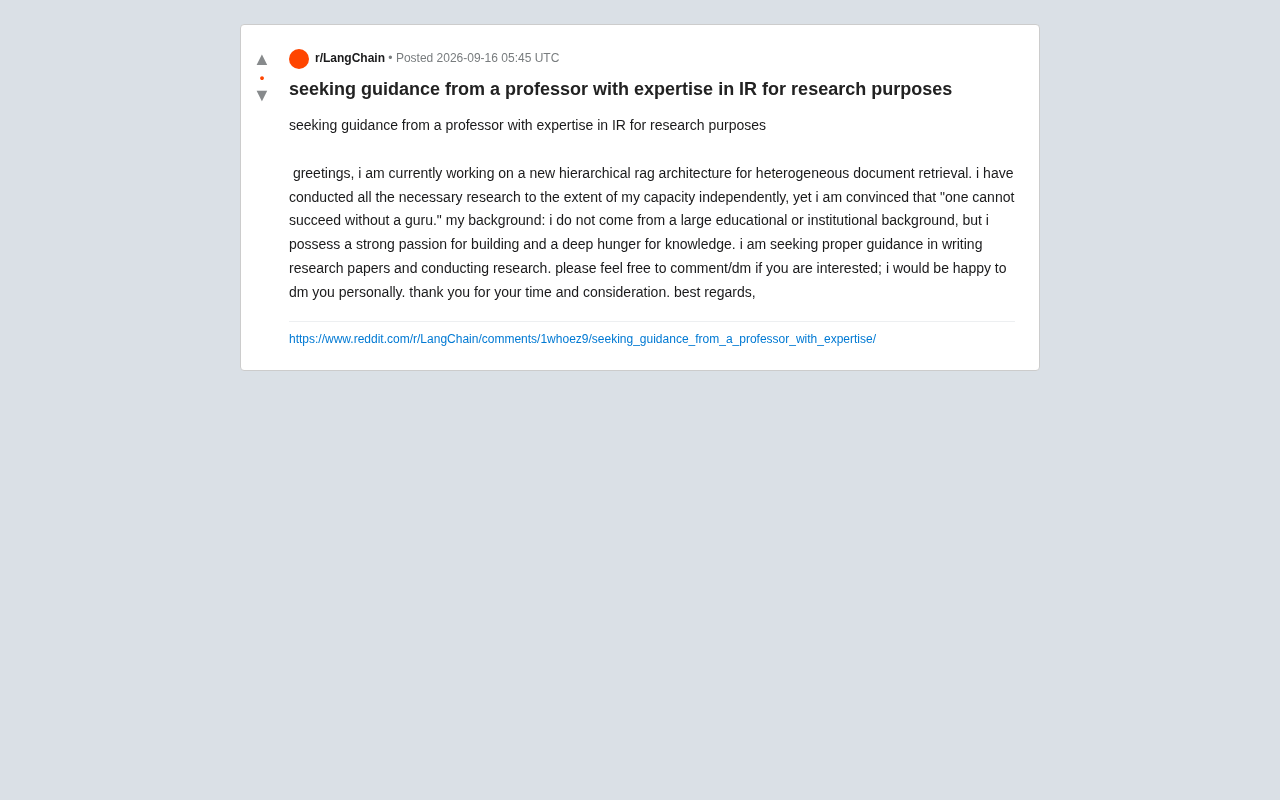
Hierarchical RAG Architecture Research: How Independent Developers Can Break Into Academic Research
An indie developer on Reddit seeks IR professor guidance for hierarchical RAG research. This article explores the technical background and practical advice for independent AI researchers facing academic barriers.

Blind Entrepreneur Uses Claude to Build Accessible Product, Sells It for $1,700
A blind entrepreneur used Claude to build an accessible tool for a blind client and sold it for $1,700 — revealing why domain knowledge, not just AI, makes products truly usable.
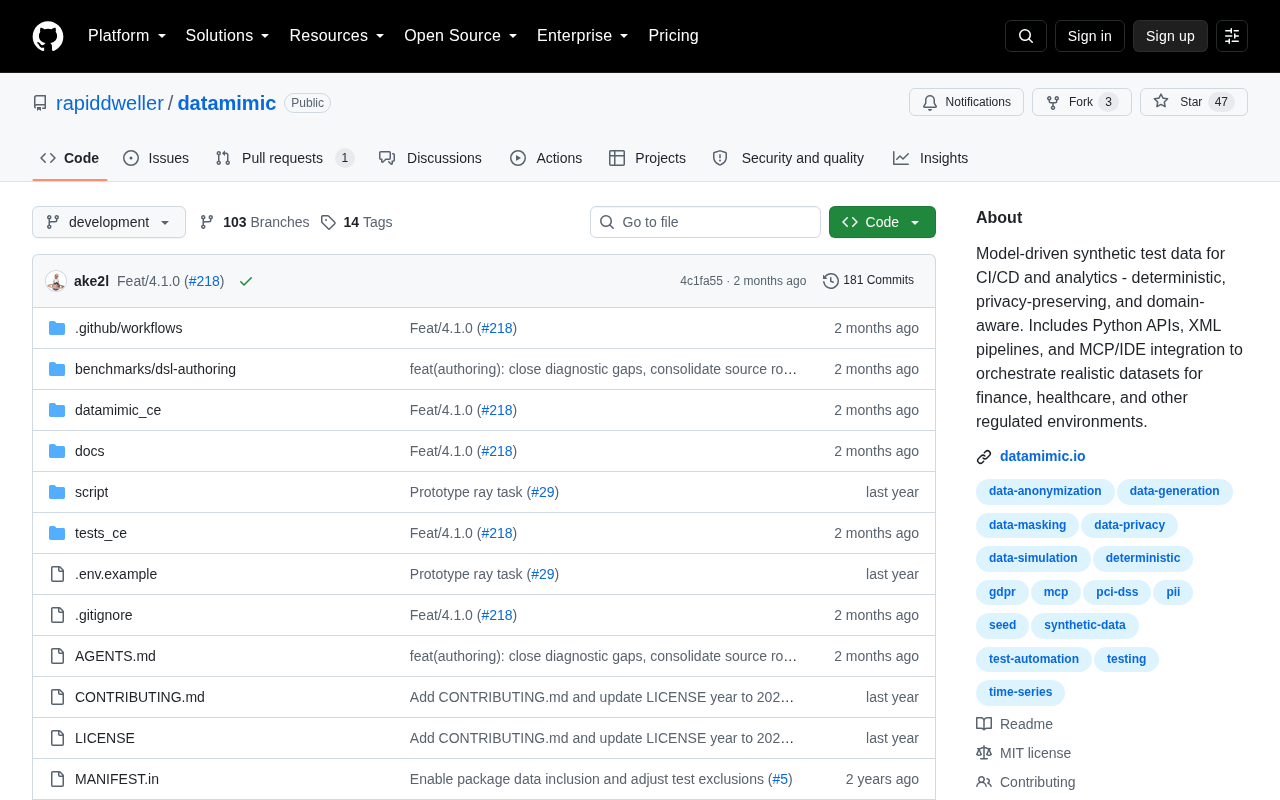
Datamimic: Giving AI Coding Assistants a Controlled Test Data World
Datamimic is an open-source tool arguing against letting AI coding agents fabricate test data. This article examines the reliability risks of AI-generated test data and the value of controlled test data for development quality.