Google AI Monthly Roundup: Multimodal, Agents, and Developer Ecosystem Accelerate on All Fronts

Google accelerates its AI push across multimodal models, Agents, and developer tools.
Google's latest AI monthly roundup reveals a broad offensive across multimodal capabilities, deep product integration, AI Agents, and developer ecosystem tools. From Gemini's native multimodal architecture to Agent-based task automation and strategic open-sourcing of Gemma, Google is rapidly translating research into real-world products and platform advantages.
Google's AI Offensive Enters a New Phase
The pace of the global AI race keeps accelerating, and Google has been releasing a dense stream of major updates spanning models, products, and developer tools. Based on the company's official monthly AI roundup, Google is rapidly pushing its AI capabilities from the research lab into consumer products and enterprise scenarios — all in an effort to solidify its competitive position against rivals like OpenAI and Anthropic.
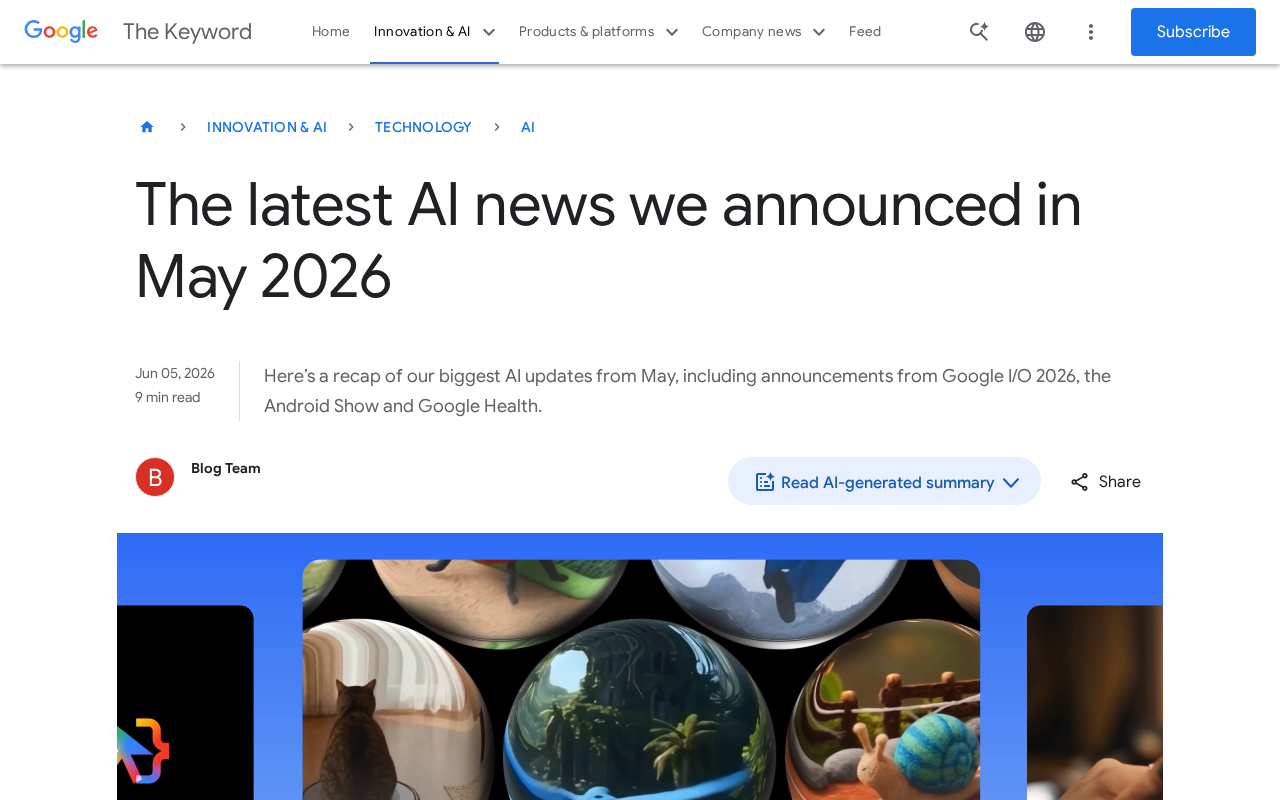
This article draws on Google's official monthly updates to trace the technical threads and product logic behind these developments, giving readers a comprehensive view of Google's current AI strategy.
Gemini Multimodal: From "Understanding" to "Creating"
After continuous iteration, the Gemini family has evolved from a purely text-based model into a natively multimodal architecture. Native multimodality is fundamentally different from earlier "stitched-together" approaches — those early solutions typically chained standalone visual encoders and speech modules to a language model, resulting in significant semantic loss as information passed between modalities.
The core breakthrough of a native multimodal architecture lies in building a unified semantic representation space. During pre-training, natively multimodal models like Gemini use a unified encoder to map data from different modalities — text, images, audio, video — into the same high-dimensional vector space. This means the model can "perceive" the relationships between different modalities at a foundational level. For example, when a user uploads a photo of a sunset, the model doesn't just identify visual elements like "sky," "orange-red," and "clouds" — it naturally associates them within the same semantic space with abstract concepts like "dusk," "poetry," and "tranquility," rather than going through a clunky, information-lossy translation step. This underlying unification is precisely what makes cross-modal transitions smoother and cross-modal reasoning more precise. Google's Gemini series is built along this path, and along with OpenAI's GPT-4o, belongs to this new generation of architectural paradigms. The latest updates continue in this direction, further strengthening the model's ability to understand and generate across modalities including images, audio, and video.
The Real Value of Multimodality
The significance of multimodality goes beyond letting a model "read" images or videos — it enables free conversion between different modalities and opens up new possibilities for content creation. Users can simply describe what they need in natural language, and the model can generate images, edit videos, or synthesize speech, dramatically lowering the technical barrier to content creation.
From an application perspective, native multimodal capabilities are reshaping workflows across multiple industries: in education, text-based materials can be transformed in real time into animated visual explanations; in medical imaging, text-based clinical records can be analyzed alongside CT scans for comprehensive diagnosis; in e-commerce, users' voice descriptions can directly generate product search results complete with visual previews. This kind of multimodal collaborative reasoning far surpasses the simple visual comprehension of early "describe the image" systems.
This capability leap stems from Google's sustained investment across three dimensions: training data, model architecture, and inference efficiency. For everyday users, the most intuitive experience is this: a single AI interface can now handle tasks that once required multiple specialized software tools.
Deep Product Integration: An Intelligent Assistant Everywhere
One of Google's core advantages is its massive product ecosystem with enormous user reach — Search, Gmail, Docs, Photos, Android, and more — which provides a natural channel for scaling AI capabilities.
AI as the Default Experience
Recent updates make clear that Google is embedding AI capabilities into its products like a utility — like electricity or running water: AI Overviews in Search, smart writing assistance in Workspace, intelligent editing in Photos... AI is gradually becoming the default product experience rather than a standalone add-on feature.
This deep integration also carries unique value at the technical architecture level. Google's product ecosystem has accumulated vast amounts of real user behavior data — the writing habits of billions of Gmail emails, editing patterns in Google Docs, query intent in Search — all of which provide ideal conditions for continuous model fine-tuning and personalized adaptation. At the same time, Google's in-house TPU (Tensor Processing Unit) chip infrastructure provides the underlying support for delivering low-latency AI inference at this scale, making it practically viable to embed AI into high-frequency products.
This "quietly pervasive" integration strategy is distinctly different from launching standalone AI applications. Its advantage is the ability to quickly reach billions of users; the challenge is ensuring a consistent experience while genuinely weaving AI features into core use cases without becoming a source of friction.
AI Agents: From "Answering Questions" to "Getting Things Done"
AI Agents are one of the most closely watched directions in the industry right now. Google continues to invest heavily in this space, driving models to evolve from passive responders to active executors.
Core Capability Breakthroughs in Agents
At their core, Agents allow AI to autonomously plan, invoke tools, and execute multi-step tasks. A user presents a complex goal, and the AI breaks it down into steps, retrieves information, operates applications, and delivers a complete result — no step-by-step guidance required.
From a technical implementation standpoint, AI Agents rely on three core capability layers: planning, memory, and tool use. The planning layer typically employs frameworks like ReAct (Reasoning + Acting) or Tree-of-Thought. ReAct alternates between "thinking" and "acting" steps, allowing the model to reassess the task state after each tool call and dynamically adjust its next action; Tree-of-Thought allows the model to explore multiple reasoning paths simultaneously — similar to a human "comparing options" — and select the optimal execution path. Together, these significantly improve the success rate of Agents handling non-linear, complex tasks. The memory layer includes a short-term context window and long-term external storage (such as vector databases), ensuring the Agent maintains task continuity across multiple execution steps without "forgetting" critical information from earlier steps due to context window limits. The tool-use layer allows the model to operate external systems — search engines, code interpreters, calendars, email, and more — through standardized interfaces such as Function Calling.
The biggest challenge in deploying Agents today is hallucination and error propagation — a single-step error gets amplified across a multi-step execution chain. For example, if an Agent misinterprets the user's intent in the first step, every subsequent step will compound that deviation, ultimately producing a result that's completely off target. As a result, reliability verification mechanisms (such as pre-execution plan review and human confirmation checkpoints at critical steps) and safety boundary design are the core engineering challenges for deploying Agents in production.
With its deep expertise in search and infrastructure, Google holds a unique advantage in the information retrieval and execution chains that Agents depend on. Agent capabilities will be a central battleground for major AI companies for the foreseeable future.
Developer Ecosystem: Lowering the Barrier to Building AI Applications
Beyond consumer-facing products, Google places great emphasis on building a developer ecosystem. By providing more powerful APIs, more comprehensive toolchains, and more accessible development frameworks, Google aims to attract more developers to build innovative applications on top of its models.
The core tools in Google's developer ecosystem include Vertex AI (an enterprise-grade MLOps platform), Google AI Studio (a lightweight prototyping environment), and the Gemini API. Vertex AI is Google's full-stack MLOps platform for enterprise customers, offering end-to-end services spanning data management, model training, hyperparameter tuning, and deployment monitoring. In terms of positioning, it competes directly with AWS SageMaker and Azure Machine Learning, and is Google's core weapon in the battle for enterprise AI market share. Google AI Studio, on the other hand, targets individual developers and startup teams, offering a free visual Prompt debugging environment and rapid prototyping tools that dramatically lower the barrier to working with Gemini's capabilities.
Also worth noting is Google's open-sourcing of the Gemma family of small models — a carefully considered strategic choice. Gemma's open-source strategy draws on the successful path Meta blazed by opening LLaMA to the community: by freely releasing high-quality small models to the community, Google can establish ecosystem influence in edge computing devices and on-premise deployment scenarios (such as enterprise private deployments and mobile applications), reaching users who cannot use cloud-based APIs for reasons of data privacy or cost. This creates a differentiated three-way competitive dynamic against OpenAI's API-first closed-source model and Anthropic's enterprise-focused approach, while also building broader technical credibility for Google within the developer community.
A thriving developer ecosystem is the core moat for platform companies to maintain long-term competitiveness. The platform flywheel logic works like this: the more vibrant the developer ecosystem, the richer the third-party applications, the stronger the end-user stickiness — which in turn feeds real-world scenario data back into model training, driving continuous capability improvements. By continuously opening up and refining its AI capabilities, Google aims to build a positive flywheel of "model → tools → applications," letting more innovation take root on its platform. Once this flywheel matures, the moat effect will be extremely significant.
Conclusion: Google's AI Strategy — Steady and Deliberate
Looking across Google's recent updates, its AI strategy shows several clear characteristics: multimodality as the technical core, the product ecosystem as the deployment channel, AI Agents as the future direction, and the developer ecosystem as the long-term moat.
In this open-ended AI race, Google is steadily advancing at its own pace, backed by comprehensive advantages in data, compute, and product distribution. For users and developers, this means more powerful, more accessible AI tools are arriving faster than ever. Whether Google can truly translate these technical advantages into leadership in user experience and market share remains a story well worth watching.
Related articles

The Truth Behind Codex 'Build a Website in 5 Minutes': AI Isn't Creating Sites—It's Helping You Copy Them
Exposing the truth behind viral Codex 5-minute website videos: creators aren't building original sites with AI—they're copying shared prompts or scraping others' work. Learn AI coding tools' real limits.

Getting Started with AI Agent Development: A Complete Guide from Concept to Practice
A comprehensive guide to AI Agent architecture and development, covering automated marketing, intelligent customer service, and investment analysis scenarios with single and multi-agent collaboration.

The Truth Behind Codex 'Build a Website in 5 Minutes': AI Isn't Creating Sites — It's Helping You Copy Them
Exposing the truth behind viral Codex 5-minute website videos: creators aren't building original sites with AI — they're copying shared prompts or scraping others' work.