Google AlphaGenome Atlas: Predicting 9 Billion DNA Variants to Unlock the Genetics of Rare Disease
Google DeepMind's AlphaGenome Atlas maps molecular effects of 9 billion DNA variants to accelerate rare disease research.
Google DeepMind has released AlphaGenome Atlas, pre-computing the molecular effects of all ~9 billion possible single-base variants across the human genome (roughly 1 PB of data) and making them publicly available. The system predicts how variants affect gene expression and RNA splicing — especially in the previously opaque 98% non-coding genome. Its accompanying AVI score distills thousands of predictions into a single prioritization metric. In practice, the Broad Institute used AVI to identify and experimentally validate a genetic explanation for a long-unsolved severe epilepsy case, while the University of Exeter applied it to UK Biobank data and found 22% more non-coding genetic associations. Google's long-term goal is to integrate AlphaGenome, AlphaMissense, and AlphaFold into a universal biology system capable of fully simulating human biology in silico.
While the world's attention was fixed on OpenAI's math prize announcement and controversy surrounding departing Anthropic researchers, Google DeepMind quietly released something that could reshape the landscape of biomedical research — AlphaGenome Atlas. This system predicts the molecular effects of every possible single-base change across the human genome, covering approximately 9 billion variants. Researchers have already used it to uncover the long-elusive genetic explanation behind a severe epilepsy case, with the finding subsequently validated through laboratory experiments.
From "Reading" to "Understanding": The Core Challenge in DNA Research
Google describes DNA as "the language of life." We can now read a person's complete genome and identify changes in the sequence — but the real challenge is figuring out which changes matter and what they actually do.
DNA is written with four chemical letters: A, C, G, and T. Changing just one letter can sometimes produce significant biological effects, and sometimes be completely harmless — or simply account for ordinary differences between people, like eye color. So when studying a genetic disease, identifying a variant is only the beginning. You still need to determine whether it's relevant and how it might cause disease.
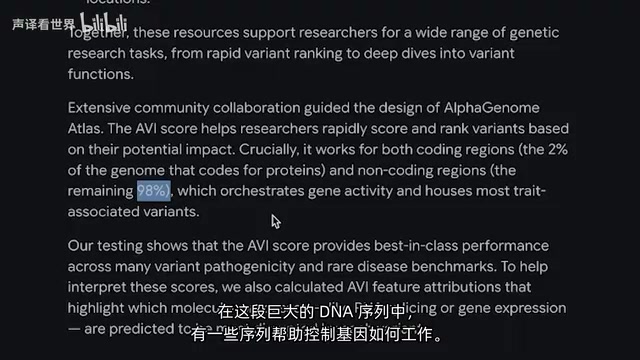
The structural problem makes this even harder: only about 2% of the human genome directly encodes proteins, and we understand the effects of changes in that region reasonably well. The remaining 98% is "non-coding DNA" — it doesn't directly encode proteins, but it contains vast numbers of "switches" and "volume controls" that regulate gene activity.
Not every letter in that 98% serves a function, but it does hide many critical biological processes we don't yet understand — such as how these regions regulate the activity of protein-coding genes. This is precisely the blind spot AlphaGenome aims to address.
Non-coding DNA was long dismissed as "junk DNA," once thought to be mere evolutionary debris. But two decades of research — especially the findings of the ENCODE project (Encyclopedia of DNA Elements) — have completely upended that view. Researchers discovered that non-coding regions are dense with regulatory elements such as promoters, enhancers, and silencers, which control when, where, and how intensely genes are "read." Variants in these elements may not alter the structure of a protein itself, but they can silence a gene that should be highly active, or cause a gene that should be off to become overexpressed. The majority of genetic risk variants for many common complex diseases — including diabetes, heart disease, and psychiatric disorders — fall in this non-coding territory, not in protein-coding regions. This is the biggest blind spot of traditional genetic analysis tools.
AlphaGenome Atlas: A Genomic Map Covering 9 Billion Variants
The AlphaGenome model itself was released earlier. It predicts how genetic variants affect gene expression and RNA splicing — the former referring to how genetic information is utilized, the latter being the critical step in which cells process RNA before making proteins. The model compares the original DNA sequence against an altered version to predict how these processes might be affected.
AlphaGenome Atlas takes this further: Google pre-computed all such predictions across the entire human genome and made them broadly available to researchers. That's where the "9 billion" figure comes from — the genome has approximately 3 billion positions, and the existing letter at each position can be replaced by any of the other three, yielding roughly 9 billion possible single-base changes.
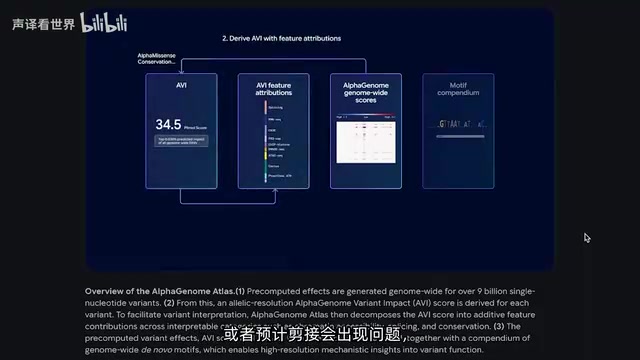
The resulting dataset is approximately 1 PB (roughly 1 million GB). But scale alone doesn't make it useful — scientists need a way to sift out what's actually relevant from an ocean of data. To address this, Google also introduced the AlphaGenome Variant Impact (AVI) score.
The AVI Score: Condensing Tens of Thousands of Numbers Into One
AVI integrates AlphaGenome's predictions with information from other biological signals — including those from AlphaMissense, which assesses protein-altering changes — into a single score, helping researchers rank variants by predicted impact. As Google research scientists involved in the project explained, the core motivation behind AVI was simple: how do you take the tens of thousands of numbers AlphaGenome outputs and turn them into a single number you can use to efficiently prioritize?
The higher the score, the more likely that variant is to have an effect on a phenotype, such as causing disease. In researchers' words, this is about "making the haystack smaller" so that the "needle" is easier to find. It's worth emphasizing that a high score doesn't mean a variant definitely causes disease — it offers a more specific, testable hypothesis worth pursuing.
RNA splicing is a key concept for understanding this work. When cells use DNA instructions to synthesize proteins, they first transcribe the DNA into a precursor RNA. But this RNA isn't used directly — it contains non-coding "intron" segments that must be precisely removed, while the remaining "exon" segments are spliced together to form mature messenger RNA (mRNA), which is then translated into protein. If a DNA variant disrupts a splicing signal, cells may cut or join RNA at the wrong location, resulting in proteins that are missing critical segments or contain unwanted sequences — and thus lose their function. These "splicing variants" are quite common in genetic disease, yet because they don't directly alter a protein's amino acid sequence, they are easily overlooked by traditional variant analysis methods. AlphaGenome's ability to predict these effects is one of its core values.
A Real-World Case: A Genetic Breakthrough in Epilepsy
Scientists at the Broad Institute, working with the Gregor Consortium, used AVI scores to investigate unresolved rare disease cases. In one severe epilepsy case, AVI helped focus their attention on a previously overlooked variant in the DNM1 gene — a gene already strongly associated with epileptic encephalopathy.
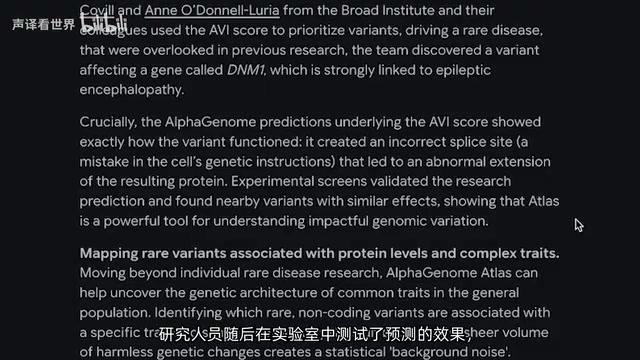
AlphaGenome predicted that the variant creates an aberrant splicing site, leading to an abnormally extended protein — in plain terms, the cell would process RNA in the wrong region, leaving extraneous material in the instructions for building the protein. Researchers then tested this prediction in the lab; the experimental results confirmed it, and also identified nearby variants with similar effects. Combined with other evidence, this was sufficient to recommend classifying the variant as "likely pathogenic."
This represented genuine progress toward explaining the cause of the disease. While developing a treatment remains an entirely separate challenge, finding a plausible explanation for a long-unsolved rare disease case is itself a major step — and it demonstrates that these predictions can guide research toward experimentally validated, real-world results.
Large-Scale Population Studies: Mining More Signal from the Data
Atlas can also serve large-scale population studies. When researchers search for rare variants associated with specific traits, the large number of harmless changes creates statistical background noise that drowns out genuinely relevant signals.
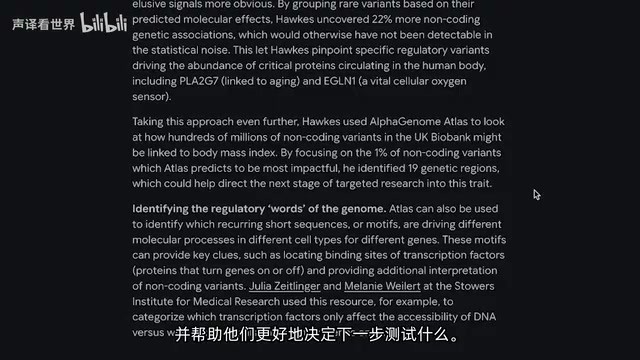
Gareth Hawkes at the University of Exeter applied Atlas to genome data from over 54,000 participants in the UK Biobank, studying associations between rare variants and circulating protein levels in the blood. By grouping variants according to their predicted molecular effects, he found a 22% increase in non-coding genetic associations identified — new discoveries drawn from that neglected 98% of the genome. He also used Atlas to investigate associations with body mass index (BMI), focusing on the top 1% of non-coding variants predicted to have the greatest impact, and identified 19 genetic regions for further investigation.
The key point is that researchers already had this data — think of the enormous genetic datasets accumulated by services like 23andMe — and tools like this can extract far more useful information from it almost overnight, helping scientists better decide what to test next.
A Step Toward a "Universal Biology System"
Google positions Atlas as a starting point. As AlphaGenome itself improves, these maps should become more comprehensive and precise. But there's a bigger vision at play: eventually integrating all the Alpha-series models into one overarching system — AlphaGenome predicting the effects of DNA changes, AlphaMissense assessing protein alterations, AlphaFold understanding protein structure.
The ambition is to merge these capabilities into a complete picture of human biology, and ultimately to accurately simulate biology in silico — enabling virtually unlimited tests and edits. Google is quietly advancing toward a "universal biology system," and this direction may be ahead of where other leading AI labs are focused.
What's perhaps most worth noting is that Google has chosen to build foundational tools and make them available to accelerate discovery by the global scientific community, rather than keeping the results proprietary. This means research teams around the world working on different diseases all have the opportunity to find things they would otherwise have missed — and that may be where this work truly has the potential to change the world.
AlphaFold is Google DeepMind's protein structure prediction system, released in 2020–2021 and widely regarded as one of the most important AI breakthroughs in biology in the past fifty years. A protein's function is determined by its three-dimensional folded structure, but predicting that structure from an amino acid sequence had long been one of computational biology's hardest unsolved problems. AlphaFold solved it with near-atomic accuracy and has since predicted the structures of more than 200 million proteins — all freely available to the public. AlphaMissense extends this work, specifically evaluating whether single amino acid changes in protein-coding regions are disease-causing. Google's current vision is to connect AlphaFold (structure), AlphaMissense (variant effects at the protein level), and AlphaGenome (variant effects at the gene regulation level) into a complete analytical pipeline — starting from a DNA variant, tracing through RNA processing and protein synthesis, all the way to structural and functional consequences. This would be the closest thing to a "digital cell" yet built.
Related articles

Three AI Researchers Debate: How Far Are We from Recursive Self-Improvement?
Three AI researchers including former OpenAI co-founder John Schulman debate recursive self-improvement and intelligence explosion, dissecting continual learning, distillation, RL success, and ASI timelines.

AI Recursive Self-Improvement (RSI): How Far Are We from the Real Thing?
How close is RSI (Recursive Self-Improvement) to reality? We analyze Acer AI's RSI Agent, a Shotcut watermark task, OS World 20 results, and OpenAI's automated researcher goal.

AI Coding Platforms Are Exploding in Popularity: Can Non-Technical People Really Build Money-Making Products?
An AI coding competition unexpectedly drew 1,000+ signups, sparking debate on whether non-technical people can build profitable products with AI. We break down the opportunities and the hype.