Google Antigravity Hides a Research Powerhouse: The 75K-Star Last 30 Days Skill

Integrate the 75000+ star Last 30 Days skill into Antigravity and let AI do cross-platform trend research
The article notes that most people only treat Google Antigravity (or Cloud Code) as a code generation tool, wasting its trend research ability. The open-source Last 30 Days skill on GitHub with 75000+ stars automatically gathers info from Reddit, X, YouTube, Hacker News over the past 30 days and outputs source-backed research briefs instead of scattered links or made-up content. Integration is simple: give the repo link to Antigravity and trigger research in natural language. Typical uses include tracking tech community hotspots, content research, and evaluating project buzz.
Many people treat Google Antigravity (or Cloud Code) as a pure code generation tool, only asking it to write functions and complete code. But if you stop there, you're wasting one of its most interesting capabilities: letting AI do cross-platform trend research for you.
According to a share from an AI tools YouTube channel, there's an open-source skill on GitHub with 75000+ stars called Last 30 Days. Its purpose isn't writing code—it automatically gathers information from the past 30 days across Reddit, X, YouTube, Hacker News, and other platforms, then generates a research brief with source citations. Once integrated into Antigravity, a single sentence triggers the entire research workflow.
Why This Skill Is Worth Noticing
The Pain of Manual Research
To understand what's happening with a topic over the past month, you usually have to dig through each platform one by one: Reddit for discussion heat, X for practitioner opinions, YouTube for video breakdowns, GitHub for project activity. This process is time-consuming and prone to gaps—information is scattered across platforms, and you still have to piece together conclusions yourself.
Last 30 Days automates this entire workflow. You don't need to search each site individually—just tell it what you want to know, and it traverses these sources and compiles a structured research brief.

How It Differs from Ordinary Search
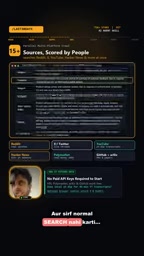
Ordinary search gives you a pile of links, while Last 30 Days gives you a "brief with sources"—a citation-backed briefing. The video mentions that after gathering information, it generates a research-style report, so you can grasp the overall direction of a topic after reading it. This "research first, then deliver" model is far more reliable than having a model generate a summary from thin air, because every conclusion has a traceable source behind it.
What GitHub Stars Mean: Stars are the count of users who have "favorited" a repository on GitHub, generally regarded as a rough indicator of an open-source project's popularity and community recognition. A project with tens of thousands of stars means it's been noticed, cited, or actually used by a large number of developers, which to some extent reflects that the need it addresses is universal. However, stars don't directly equal code quality or long-term maintenance—some popular projects may gain stars rapidly due to topicality, and actual activity still needs to be judged by commit frequency, issue handling, and so on. The 75000+ stars mentioned here is a fairly high magnitude, indicating that the direction of "AI-driven information aggregation" has indeed attracted widespread attention.
What It Can Actually Be Used For
The video gives a concrete example: asking this skill to come up with 10 ideas suitable for starting a business or building products in the AI field, limited to trends from the past 30 days. The skill first gathers information, then outputs a brief of ideas.
This usage can be transferred to many scenarios:
- Tracking community discussion hotspots in a technical direction over the past month
- Doing preliminary research for content topics, quickly identifying which topics are heating up
- Evaluating the market buzz of a new project, seeing actual feedback across platforms
- Before writing a proposal or making a decision, using a source-backed brief instead of scattered searches
The key point is that what it outputs isn't "what the model thinks," but "what platforms are saying recently."
How to Integrate with Antigravity
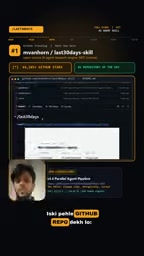
The video gives a simple installation method: copy the skill's repository link, open Google Antigravity (or Cloud Code), hand it the link, and let it complete the skill's installation and initialization based on the link. After that, you can directly issue research tasks in natural language.
This "skill-as-plugin" approach is worth noting—AI coding tools are evolving from single-purpose code assistants into platforms that can mount various external capabilities. Last 30 Days is just one example; its value isn't in coding ability, but in applying AI's information gathering and synthesis capabilities to research scenarios.
The Skill Mechanism: In these AI tools, a "skill" usually refers to a capability module mounted onto the main model in the form of a plugin or configuration, containing a set of preset instructions, callable tools, or external data sources. When the model receives a user task, it judges whether to invoke a skill and executes according to the flow defined by the skill. This design differs from traditional "model fine-tuning"—skills don't require retraining the model, but extend its behavioral boundaries through external mounting, so installation and replacement are relatively lightweight. The article's "copy the repository link and hand it to Antigravity to complete installation" is exactly how this mechanism works—skills are distributed as repositories, the tool handles pulling and initialization, and the user can then trigger them in natural language.
A Few Observations
First, 75000+ stars shows that this kind of "AI-driven information aggregation" need genuinely exists. Developers don't just want AI to write code—they also want AI to help prepare information before making judgments.
Second, source-backed briefs have more practical value than purely generated content. In an environment of information overload, traceability determines whether output can be trusted.
Third, if you usually use Antigravity or Cloud Code only for coding, why not try using it as a research assistant once. Install this skill, give it a topic, and see what platforms have been discussing over the past 30 days. You might discover that the other half of this tool's capabilities has been sitting idle all along.
At the end of the video, it also mentions that if you want the link to this skill, you can leave a comment and the author will send it via private message. If you're interested in open-source skills, you can also search for related projects directly on GitHub.
One-line Summary
Integrate the 75000+ star Last 30 Days skill into Antigravity and let AI do cross-platform trend research
Paragraph Summary
The article points out that most people only treat Google Antigravity (or Cloud Code) as a code generation tool, wasting its ability to do trend research. An open-source skill on GitHub with 75000+ stars, Last 30 Days, can automatically gather information from the past 30 days across platforms like Reddit, X, YouTube, and Hacker News, and output a research brief with source citations rather than scattered links or content generated from thin air. Integration is simple: hand the repository link to Antigravity to complete installation, then trigger research in natural language. Typical scenarios include tracking tech community hotspots, doing research for content topics, and evaluating project market buzz. The article argues this reflects how AI coding tools are evolving from single-purpose code assistants into platforms that can mount external capabilities, with research skills being an underrated use case.
Related articles

A 19-Year-Old's Rental Horror Story: Ceiling Collapse, Bug Infestation, and the Lessons It Taught Me
At 19, my first off-campus rental brought bug infestations, no heat, a collapsed ceiling, and a ruined laptop with no renter's insurance. Here are the hard-won lessons for first-time student renters.

Veda Nurse's Cranial Nerve Exam: Why ASMR Role-Play Is Going Viral
Bilibili creator Veda's cranial nerve exam ASMR video goes viral, blending humor and sensory triggers through nurse role-play. This article analyzes its unique appeal and the audience psychology behind ASMR role-play.

LG Cinebeam AI Review: 120-Inch Giant Screen + 3000 Lumens, a New Choice for the Living Room Theater
LG Cinebeam AI projector review: 3000 ANSI lumens, 4K, 100 inches from about 8 cm and 120 inches from about 18 cm. Built-in webOS, AI Concierge voice recommendations, AI Sound Pro 11.1.2 virtual surround, and Game Optimizer—positioned for fixed living room installation, complementing the portable Cinebeam S.