Google Confirms the Era of Autonomous Attacks Has Arrived: 178 Enterprises Hit by AI Attacks

Google confirms the era of autonomous attacks has arrived, with 178 banks and airlines hit by AI-driven attacks.
Google has confirmed that the "era of autonomous attacks" has arrived, with 178 enterprises including banks and airlines targeted in a single wave. The article notes that these targets span critical industries such as finance and aviation, with a clear high-value orientation, and that the sheer number of targets shows attackers now have batch-processing capability. "Autonomous" means AI systems can complete multi-step attacks with minimal human intervention and adjust strategies based on feedback, compressing defenders' detection and response windows. For banks and airlines with vast attack surfaces, traditional rule- and signature-based detection has limited coverage, and security team staffing has not kept pace with attack automation. The article argues that Google's public characterization carries industry signal significance, and that ordinary enterprises should reassess their security automation levels now.
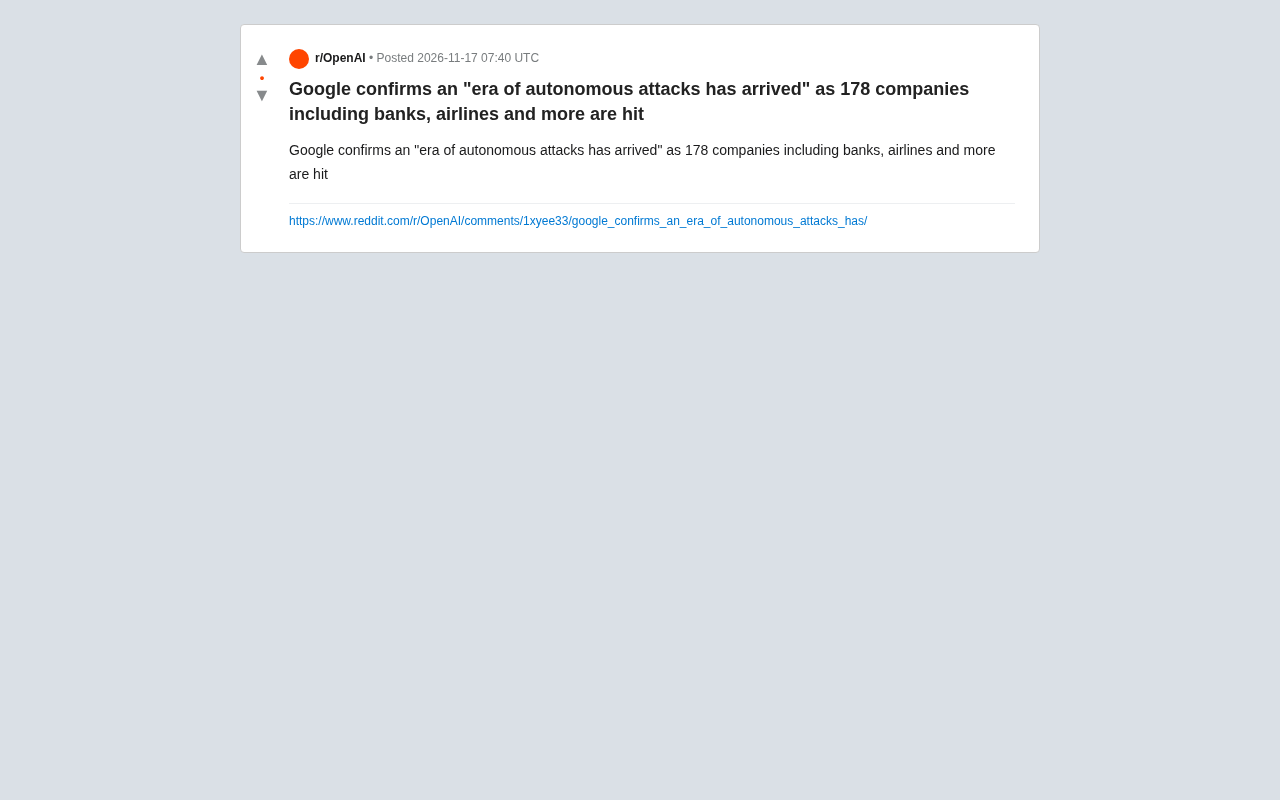
Google has recently confirmed that an "era of autonomous attacks" has arrived. According to reports cited by the Reddit community, 178 enterprises—including banks and airlines—were targeted, with attackers leveraging AI to achieve a higher degree of automation. This event marks a substantive shift in the nature of cybersecurity threats: attacks no longer rely entirely on human operation but are executed autonomously by AI systems for reconnaissance, decision-making, and strike.
Attack Scale and Target Selection
Based on currently disclosed information, the 178 affected enterprises span multiple critical industries including finance and aviation. That banks and airlines became priority targets indicates the attackers were not scanning randomly but deliberately selecting high-value, high-leverage industries.
What deserves attention is the sheer number of targets itself. That 178 enterprises were involved in the same wave of operations means the attackers possess batch-processing capability. Traditional manual penetration is constrained by manpower and time, whereas automated systems can process large numbers of targets in parallel—which explains why the victims are so widely distributed. In Reddit community discussions, many comments focused on the point that "this is not a single vulnerability but a new attack paradigm."
What "Autonomous Attacks" Means
Google characterizes the current situation as the "era of autonomous attacks," with "autonomous" being the key word. In a traditional attack chain, every stage from information gathering to lateral movement requires human judgment. What sets autonomous attacks apart is that AI systems can complete multi-step operations with minimal human intervention and adjust strategies based on environmental feedback.
The direct consequence of this capability is an increase in attack speed. The window for defenders to detect anomalies, analyze, and respond is compressed. When attacks can advance autonomously, security operations models that rely on human staffing and tiered approvals appear sluggish. This is also why Google's statement has been widely shared—it points to a structural problem rather than a single incident.
The Kill Chain is an important reference for understanding the meaning of "autonomous." This concept was first proposed by Lockheed Martin, breaking down an intrusion into stages including reconnaissance, weaponization, delivery, exploitation, installation, command and control, and actions on objectives. In traditional attacks, each stage's progression depends on the attacker's human judgment, and there are often noticeable time gaps between stages—gaps that defenders exploit for interception. The essence of autonomous attacks is that AI systems string together these originally discrete stages into a continuous automated workflow: reconnaissance results directly drive vulnerability selection, and upon failure, the system automatically switches to backup paths without waiting for a human to switch tools back and forth. This explains both why 178 enterprises could be processed in parallel within the same wave of operations and why the "time gap" that defenders previously relied upon is disappearing.
Real-World Challenges for Enterprise Defense
For enterprises such as banks and airlines, the attack surface is inherently large: public-facing services, complex internal systems, and numerous third-party suppliers. Autonomous attack systems can traverse these entry points faster to find weak links.
On the defense side, the difficulty lies in the fact that traditional rule- and signature-based detection has limited coverage when facing automated, mutating attack behaviors. Enterprises need stronger behavioral analysis and automated response capabilities; otherwise, they will remain persistently passive in the attack-defense rhythm. Some practitioners in Reddit discussions also pointed out that many enterprises' security team staffing has not grown in step with the increasing automation of attacks.
Rule- and signature-based detection struggles against automated attacks because of its matching logic. Signature detection relies on characteristic codes of known malicious samples, and rule detection relies on pre-hardcoded anomaly conditions—both assume that attack patterns are relatively stable and enumerable. AI-driven attacks, however, can change tool combinations, path orders, and payload forms with each execution, making signatures difficult to reproduce consistently. In contrast, behavioral analysis focuses on "what was done" rather than "what it looks like"—for example, anomalous data access sequences, multi-step operations outside working hours, and deviation patterns in credential usage. Such signals are harder to evade through simple mutation. Automated response (such as SOAR-type orchestration tools) converts alert handling from manual approval to pre-configured playbook execution to offset attack speed. Only the combination of all three constitutes a defense baseline that matches the pace of autonomous attacks.
Industry Signals and Follow-Up Observations
Google's confirmation carries signal significance. As a company with large-scale infrastructure and threat intelligence capabilities, its public characterization often drives the formation of industry consensus. The fact that 178 enterprises were affected also provides a reference point for other organizations: autonomous attacks are not theoretical speculation but an already-occurring reality.
Directions worth watching include: whether affected enterprises will disclose more attack details, the identity and motives of the attackers, and whether security vendors can deliver detection and blocking solutions targeting autonomous attacks. For ordinary enterprises, the more pragmatic approach right now is to reassess their own level of security automation—if attacks have already become autonomous, defense at the very least cannot rely entirely on humans.
The role of threat intelligence in this incident deserves explanation. Vendors with large-scale infrastructure typically draw intelligence from telemetry on their own networks, aggregated customer-side incidents, and tracking of external attack infrastructure. When such vendors publicly characterize a particular attack form, it often means they have already accumulated enough samples of the same kind internally, rather than making inferences based on a single case. This is also why such statements can drive industry consensus: they integrate anomalies scattered across individual enterprise logs into a nameable threat category. For small and medium-sized organizations, such public characterizations can serve as a low-cost basis for adjusting defense priorities without needing to build intelligence capabilities of comparable scale.
One-line Summary
Google confirms the era of autonomous attacks has arrived, with 178 banks and airlines hit by AI-driven attacks.
Paragraph Summary
Google has confirmed that the "era of autonomous attacks" has arrived, with 178 enterprises including banks and airlines targeted in a single wave of operations. The article notes that these targets span critical industries such as finance and aviation, with a clear high-value orientation in selection, and that the sheer number of targets indicates attackers now possess batch-processing capability. "Autonomous" refers to AI systems' ability to complete multi-step attacks with minimal human intervention and adjust strategies based on environmental feedback, thereby compressing defenders' detection and response windows. For banks and airlines with vast attack surfaces, traditional rule- and signature-based detection has limited coverage, and security team staffing has not grown in step with attack automation. The article argues that Google's public characterization carries industry signal significance, and that ordinary enterprises should reassess their own security automation levels now.
Related articles

ChatGPT Plus Subscription Pitfall Guide: Go/Plus/Pro Tier Comparison and Quick Activation
A complete ChatGPT Plus subscription guide based on a Bilibili tutorial: from registering an account, comparing Go/Plus/Pro tiers, to the practical steps for quickly completing your subscription.

GPT-6.2 Sol/Astra Released! A Step-by-Step ChatGPT Plus Subscription Guide and Tier Comparison
GPT-6.2 Sol/Astra is out—here's a ChatGPT Plus subscription guide: register an account, compare Go/Plus/Pro tiers, and subscribe in a minute.

Comparing Three Channels for Subscribing to GPT Plus in China: Is Website Top-Up the Easiest?
How to subscribe to GPT Plus in China? This article compares website top-up, credit card, and mobile top-up channels—process, cost, and risk—with steps and tips to help you choose wisely.