Google Deprecates Gemini Gems in Favor of New Skills Feature

Google replaces Gems with a unified Skills mechanism, signaling the AI assistant industry's consolidation trend.
Google has announced it will deprecate Gems — Gemini's feature for creating task-specific custom AI agents — and replace it with a new Skills mechanism. Where Gems required users to build and manage separate AI personas for tasks like writing or coding, Skills work more like on-demand capability modules attached to a single unified Gemini assistant. The move is driven by the rise of all-in-one AI agents like Meta's Muse and Instinct, pushing Google to shift from a "manual workflow assembly" model toward a single-entry-point, context-aware, general-purpose agent experience.
Google Reshapes Gemini's Feature Lineup
Google is making a notable change to its Gemini AI assistant: it's sunsetting Gems — the feature that let users build task-specific AI agents — and replacing it with a new mechanism called "Skills." This shift reflects a deeper change in how AI assistant products are being designed, moving away from manually assembling multiple custom agents toward a more unified, general-purpose approach.
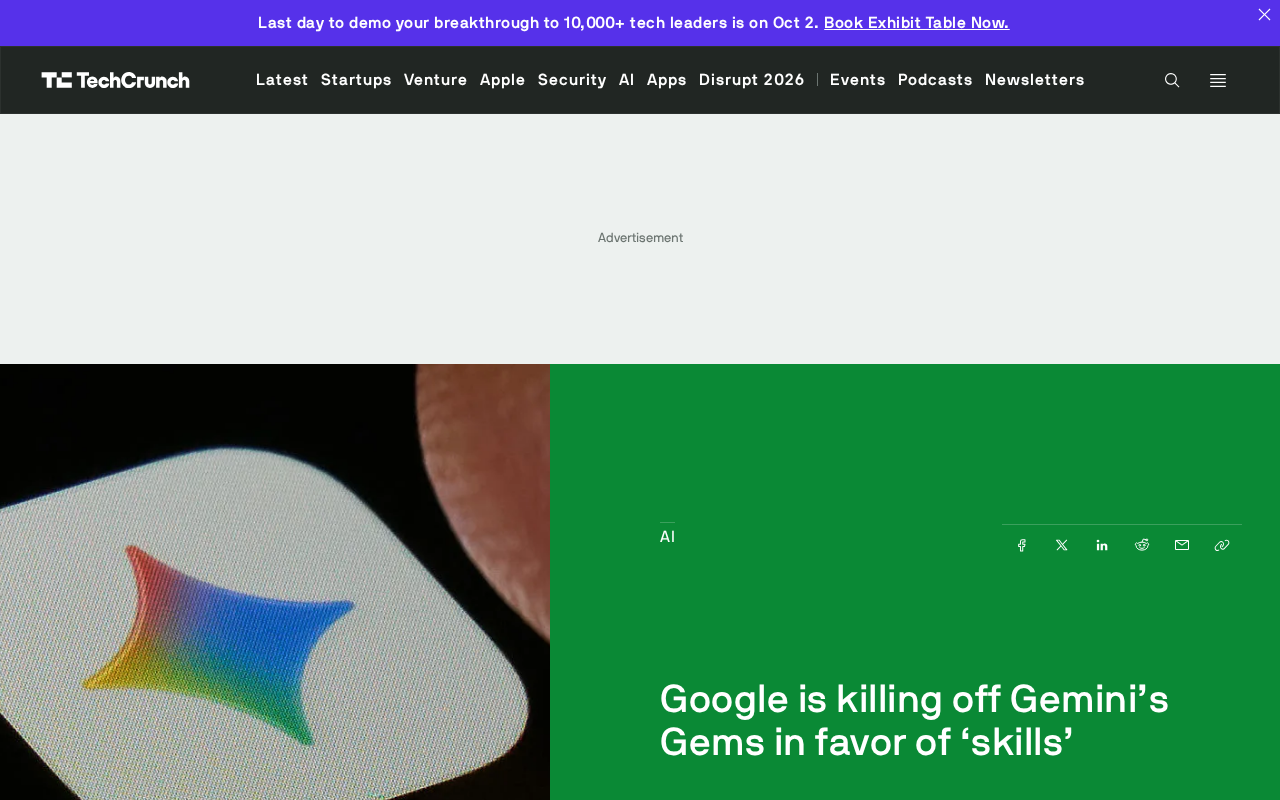
Gems were originally designed to let users create specialized AI personas or assistants for specific tasks. For example, you could configure separate Gems for writing, coding, fitness planning, and so on — each with its own preset instructions and context. In essence, the model fragmented complex needs into a collection of discrete, custom-built assistants.
Why the Switch to Skills
The backdrop to this decision is the rapid rise of all-in-one AI agents in the market. As the original report notes, the popularity of products like Meta's Muse and Instinct — capable, general-purpose agents — has prompted Google to move away from the "one agent per task" paradigm.
The underlying logic isn't hard to follow. For everyday users, creating and managing multiple Gems for different task types carries a steep learning curve and a high barrier to entry. The more appealing experience is a smart, general-purpose assistant that automatically draws on the right capabilities based on context — without requiring users to constantly switch between custom agents.
From "Manual Assembly" to "Capability Invocation"
The name "Skills" itself reveals a new design philosophy. Rather than treating "an entire assistant" as the unit of management like Gems did, Skills are more like mountable capability modules attached to a unified Gemini assistant. Users no longer need to maintain a fleet of independent agents; instead, they rely on a single primary assistant that triggers different skills on demand.
This architecture delivers a more seamless experience and better aligns with the industry's vision of a "general-purpose agent" — a single entry point, multiple capabilities, and automatic context-driven responses.
Meta's Muse and Instinct are two distinct general-purpose agent products under Meta AI. Muse focuses on creative and content generation use cases, while Instinct leans toward task execution and personal assistant functions. What they share is that neither requires users to pre-configure a specific persona — the model itself determines the appropriate response mode from conversational context. This stands in sharp contrast to Gems' "build first, chat later" model, and represents the mainstream direction major tech companies are taking with agent products: encapsulating capabilities within the model itself, rather than exposing them for users to assemble manually.
From an architectural standpoint, the Skills mechanism is closely aligned with the widely adopted "Tool Use / Function Calling" design pattern. In this architecture, the large language model acts as a central orchestrator, dynamically selecting and executing specific functional modules — such as web search, code execution, or calendar management — based on user intent. Users don't need to know what's happening under the hood; the model decides "which skill to use and when." This is fundamentally different from Gems, which required users to actively choose and switch to a specific assistant. From the user's perspective, it significantly reduces cognitive load and comes much closer to the intuitive expectation of what a "truly intelligent assistant" should feel like.
Industry Signal: The Consolidation of AI Assistants
Google's adjustment can be seen as a microcosm of the broader consolidation happening across the AI assistant space. Early AI products tended to offer a large number of customizable components, letting users stitch together their own workflows. But as underlying model capabilities have grown stronger, product teams feel more confident hiding that complexity on the backend and delivering a simpler, more capable unified experience to users.
The fact that Meta's Muse and Instinct are called out as driving this trend suggests that major tech players have reached a kind of consensus on what AI agent products should look like: rather than turning users into "agent builders," make the assistant itself powerful and flexible enough to handle the job.
For users already relying on Gems, this change means adapting to a new way of working. But in the long run, if Skills can truly deliver seamless capability orchestration, the reduction in overall friction will be a tangible benefit.
Summary
Google replacing Gems with Skills is a clear signal that product thinking is shifting from "fragmented customization" to "unified intelligence." As all-in-one AI agents continue to gain traction, this kind of adjustment may just be the beginning. For those watching how AI products evolve, the key question going forward is whether Skills can deliver on its promise of being smarter and more effortless in practice.
(Note: This article is based on a single-source report. For specific feature details and release timelines, refer to official Google announcements.)
Related articles
uGAP: An AI Platform Unifying 100+ African Geospatial Datasets
uGAP is an African geospatial AI platform by a University of Cape Town team, unifying 120+ African datasets with a Python SDK for discovery, processing, and model training, already used in cyclone flood mapping.

Cursor Can Now Control Your Computer: AI Agents Can Drive Desktop Apps for Testing
Cursor adds desktop control: AI agents can drive desktop apps like the iOS Simulator to test their own features. We analyze the impact on dev workflows, possible technical approaches, and reliability concerns.

Vibecoding a Custom Inference Engine: High Hopes, Harsh Reality
A Reddit developer shares the real experience of vibecoding a custom inference engine: running GGUF Q4 models in the browser with WebGL2 and GLSL, only to fall into tokenizer debugging hell. This article analyzes the engineering challenges of browser-side LLM inference and why cloning llama.cpp is the more rational choice.