Google Dreambeans Launches in India: AI-Generated Personal Stories Now Support 13 Languages

Google's experimental project Dreambeans launches in India with support for personal story generation in 13 local languages.
Google's AI experiment Dreambeans is expanding to India and adding support for 13 Indian languages, seen as a key step in bringing AI-generated personal stories to mainstream users. Dreambeans focuses on the "personal stories" scenario, helping users turn experiences, memories, or imagination into readable story text and lowering the barrier to narrative creation. India is highly multilingual with limited English proficiency, and multilingual support enables the product to reach a broader non-English user base, consistent with Google's strategy of seeking incremental users through localization in emerging markets. The article also notes that such products face the dual challenges of privacy protection and content templating, and that Dreambeans remains experimental; its multilingual implementation in India will be an important sample for observing whether AI narrative products can reach the masses.
Google's AI experiment Dreambeans is expanding to the Indian market, adding support for 13 Indian languages. The move is seen as a key step in bringing AI-generated personal stories to mainstream users.
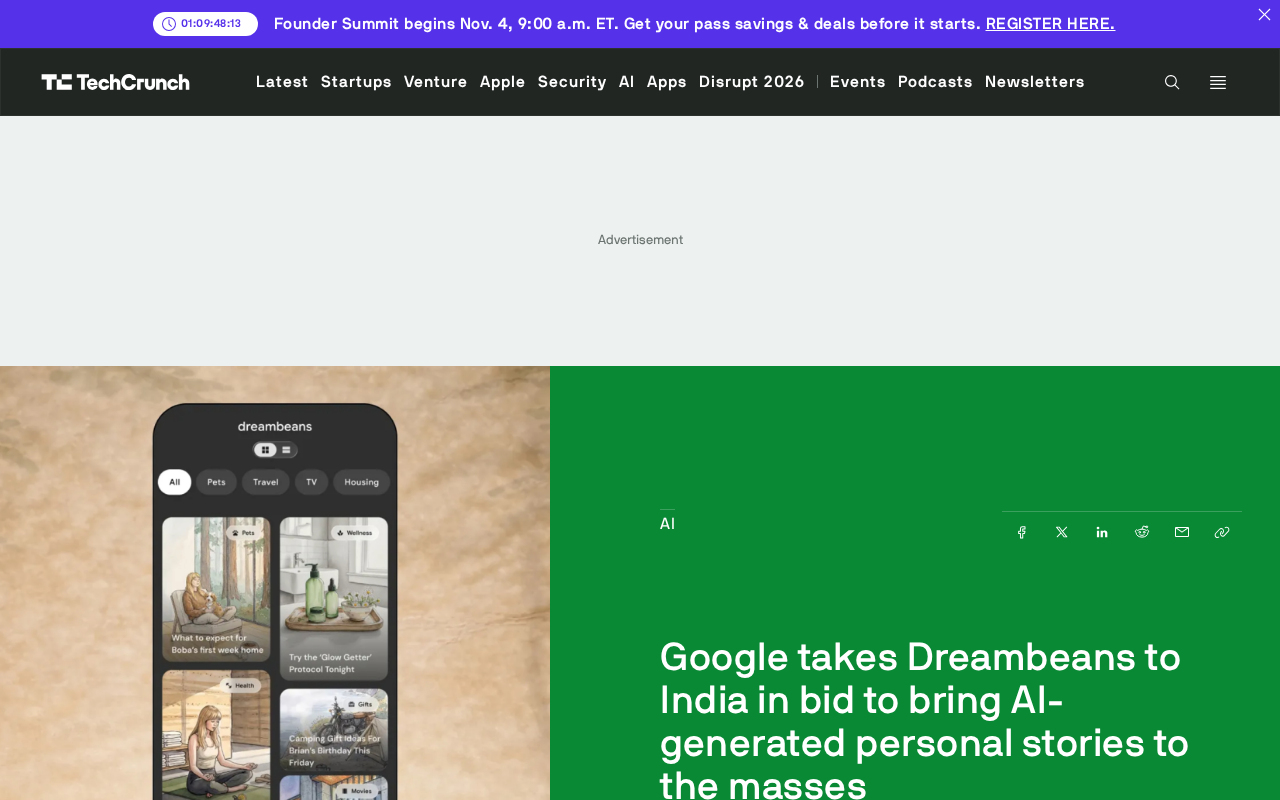
What Is Dreambeans: Letting AI Tell Your Personal Story
Dreambeans is Google's latest AI experiment, with a core capability of generating personalized story content. Unlike general-purpose chatbots, Dreambeans focuses on the specific niche of "personal stories"—users can use AI to transform an experience, memory, or imagination into readable story text.
The value of this kind of product lies in lowering the barrier to narrative creation. Not everyone is good at writing, but almost everyone has experiences worth being told. Dreambeans attempts to use AI to bridge the gap between "having a story" and "being able to write a story," so that ordinary users can also have a personalized narrative experience.
Dreambeans is an experimental product under Google Labs. Google Labs is Google's internal platform for incubating and testing cutting-edge technology products, and has previously launched projects such as NotebookLM, Project IDX, and MusicFX. Being classified under Google Labs means the product has not yet been incorporated into Google's formal commercialization system; its features, interface, and availability may all be adjusted quickly based on experimental feedback, and it is usually only available in a limited set of regions. This is closely related to its positioning as an "experimental project": it is both technical validation and a low-risk form of market testing—if user feedback is positive, the product may gradually be upgraded or merged into a larger product line; if results are poor, it can be shut down at low cost. Understanding this affiliation helps in judging that Dreambeans' current feature stability and long-term direction both carry considerable uncertainty.
The Indian Market: The Localization Logic Behind 13 Languages
The most direct upgrade in Dreambeans' launch in India is the expansion of language support to 13 Indian languages. India is a multilingual society with limited English proficiency, and a large number of potential users use local languages such as Hindi, Tamil, and Telugu in their daily lives. If an AI product supports only English, the actual reachable user base will be greatly reduced.
Supporting 13 languages means that in India, Dreambeans is no longer "a toy for English users" but has the basic conditions to serve a broader population. This also aligns with Google's consistent strategy in the Indian market—seeking incremental users through language localization rather than serving only the existing English-speaking internet population.
According to the original report, Google positions this expansion as an effort to "bring AI-generated personal stories to the masses." The word "masses" is worth noting: it implies that Dreambeans' target is not technology early adopters, but ordinary content consumers and creators.
The official languages recognized by the Constitution of India include Hindi and English, but states have their own designated official languages, and more than a hundred languages are actually used. According to Indian census data, native Hindi speakers account for more than 40%, while the populations using languages such as Tamil, Telugu, Bengali, Marathi, Gujarati, Kannada, and Malayalam each number in the tens of millions to over a hundred million. At the same time, the proportion of English users in India remains limited and is highly concentrated among urban and more educated populations. This means that the language coverage of digital products directly determines the size of their potential user pool. The Indian government's promotion of digital public infrastructure and local-language internet initiatives in recent years also reflects that "non-English internet users" are the main source of growth in the next stage, which explains why Google made multilingual support its first move in entering the Indian market.
Opportunities and Boundaries of AI-Generated Personal Stories
From the perspective of product form, AI-generated personal stories have several natural use cases: recording and passing down family memories, bedtime stories for children, social sharing content, and lightweight self-expression. These scenarios do not impose strict requirements for "literary quality"; they value emotional resonance and ease of use more, which is exactly the area where generative AI can perform reliably.
But this kind of product also faces common challenges. Personal stories involve a large amount of users' private information, and how to ensure data privacy and content safety is an unavoidable issue. In addition, AI-generated stories easily fall into templated patterns, and how to retain a "personalized" texture while generating at scale is key to whether the product experience can hold up.
Dreambeans is still labeled by Google as an experimental project, and this positioning itself shows that the product is still in the validation stage. The effectiveness of multilingual implementation in the Indian market will become an important sample for observing whether this kind of AI narrative product can truly reach the masses.
The tendency toward templated AI-generated personal stories is rooted in the fact that large language models rely on statistical patterns in training data for generation and tend to output narratives that are structurally complete and smoothly plotted but lacking unique details. To mitigate this problem, common approaches include: having users provide more specific material (characters, settings, key details) as constraints, using multi-turn interaction to gradually refine the story, or offering diverse options for style and ending after generation. On the other hand, personal stories naturally contain sensitive information such as names, family relationships, health, and addresses, and requirements for handling personal data differ markedly across jurisdictions—India has in recent years passed a digital personal data protection law that imposes requirements on data processors regarding notice, consent, and purpose limitation. When processing user story material across borders, how a product designs data minimization, storage duration, and user controllability will directly affect its compliance costs and user trust.
Conclusion
Google Dreambeans' entry into India with support for 13 local languages is a typical attempt at AI localization in an emerging market. It pushes "AI-generated personal stories" from an experiment in the English-speaking world into a market with highly diverse languages and a huge user base. Whether the product can ultimately deliver on the goal of "mass adoption" depends on the balance among localization quality, privacy protection, and content personalization.
One-line Summary
Google's experimental project Dreambeans has launched in India, supporting personal story generation in 13 local languages.
Paragraph Summary
Google's AI experiment Dreambeans is expanding to the Indian market and adding support for 13 Indian languages, seen as a key step in bringing AI-generated personal stories to mainstream users. Dreambeans focuses on the "personal stories" scenario, helping users turn experiences, memories, or imagination into readable story text and lowering the barrier to narrative creation. India is highly multilingual with limited English proficiency, and multilingual support enables the product to reach a broader non-English user base, consistent with Google's long-standing strategy of seeking incremental users through localization in emerging markets. The article also points out that such products face the dual challenges of user privacy protection and content templating, and that Dreambeans remains an experimental project; the effectiveness of its multilingual implementation in India will become an important sample for observing whether AI narrative products can reach the masses.
Related articles

Deleted Reddit Post Sparks Debate Over AI Content Moderation
A Reddit post removed with only a 'Removed by Reddit' notice highlights AI content moderation's transparency gaps, misjudgment risks, and appeal challenges for platforms and creators.

DSH + Ollama Local LLM Deployment in Practice: Free Chat with Da Fei Yu
Bilibili creator tests DSH + Ollama local LLM deployment end to end: Ollama install, Xunlei-accelerated downloads, ModelScope GGUF model import, DSH custom API address setup, and a comparison of Qwen 3.5 4B, 8B, Gemma, and other models on 8GB VRAM, with advice on choosing local deployment vs. API calls.

Tested: A $899 Mac Mini vs. a $200/Month AI Subscription
Real-world test of whether an M4 Mac mini can replace a $200 AI subscription: 16GB can't fit large models, and both speed and quality fall short—but privacy, no caps, and near-zero running costs make it an ideal host for an always-on agent. Includes buying advice per configuration and money-saving strategies.