Google Expands AI & Economy Team: Top Academics Join to Study Economic Impact
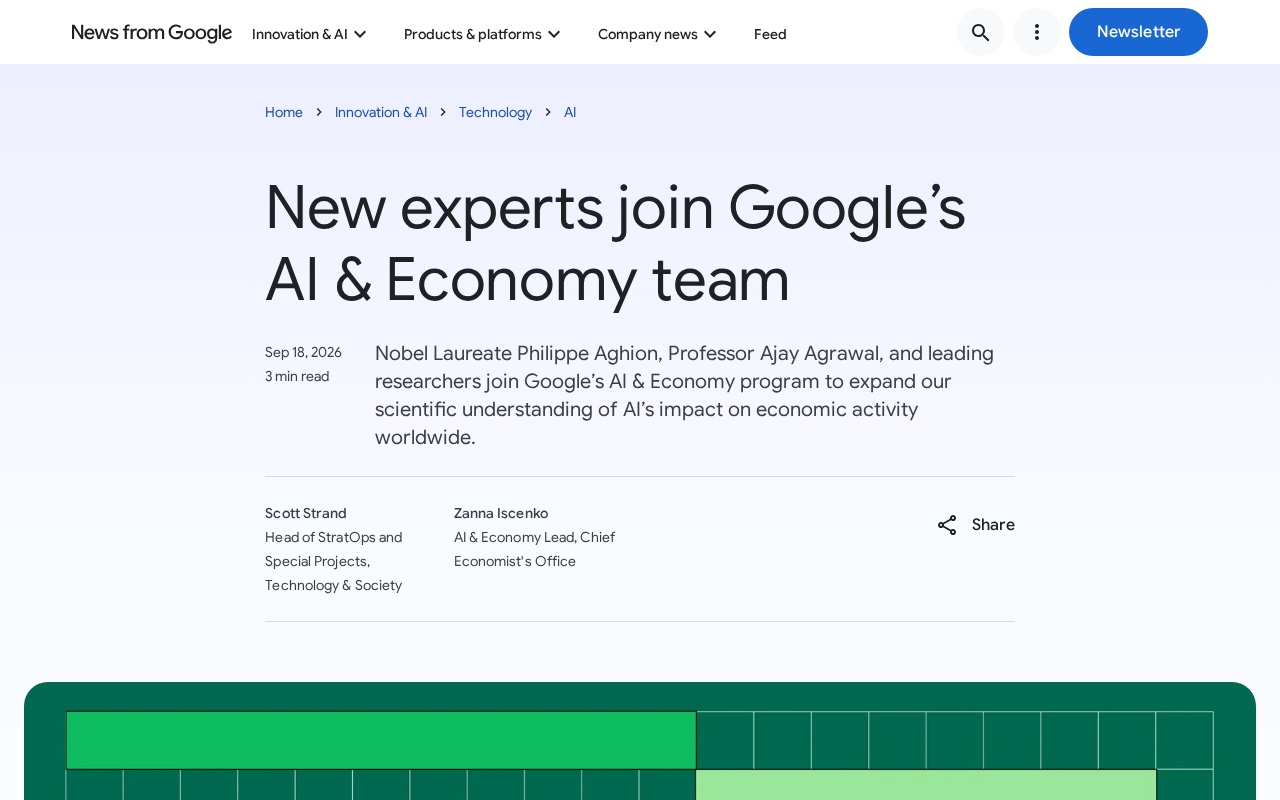
Google expands its AI & Economy team with top academics to empirically study AI's macroeconomic impact.
Google has announced an expansion of its AI & Economy team, adding three categories of talent — world-class academic advisors, fellows, and core internal researchers — forming a structure that balances academic rigor with practical applicability. Rather than focusing on technical R&D, the team takes an economics lens to analyze AI's effects on employment, productivity, and industrial structure. The move signals that tech giants are pushing the study of AI's economic impact from theoretical debate into quantitative, empirical research. While Google's vast platform data gives it a unique research advantage, the independence and transparency of company-led research will remain a key area of external scrutiny. Specific team members and research topics have not yet been disclosed.
Google recently announced the expansion of its AI & Economy team, bringing in a cohort of world-class academic advisors, fellows, and core internal researchers. This move reflects how tech giants are placing growing importance on systematic research into AI's economic impact, as generative AI continues to accelerate its penetration across industries.
Why Google Is Building an AI & Economy Team
The disruption that artificial intelligence poses to employment, productivity, and industrial structure has become a shared concern for both policymakers and businesses. By expanding its AI & Economy team, Google aims to draw on the combined expertise of academia and industry to better understand how AI technology is reshaping the macroeconomic landscape.
The team is not focused on technical R&D, but rather on analysis through an economics lens. Bringing in external academic advisors signals that Google wants to leverage independent scholars' research methods and perspectives — helping ensure that findings are not overly shaped by commercial interests, and thereby strengthening the credibility of the research output.
Since generative AI exploded into public consciousness in late 2022 — led by products like ChatGPT — economists have rapidly ramped up research into its macroeconomic implications. As with previous technological revolutions, the core debate centers on the relative strength of "substitution effects" versus "complementary effects": will AI displace jobs at scale, or will it more often act as an augmentation tool for human labor and give rise to new professions? McKinsey, the Brookings Institution, OpenAI, and others have all published related reports, but their conclusions diverge significantly depending on research methodology and data sources. In this context, Google — with business lines spanning Search, advertising, and cloud computing — holds platform data covering hundreds of millions of businesses and consumers, giving it empirical research conditions that few academic institutions can match.
A Three-Tier Research Structure
According to Google's description, this expansion covers three types of roles: world-class academic advisors, fellows, and core internal researchers. This combination reflects a clear division of responsibilities.
Academic advisors typically come from top universities and research institutions, providing strategic direction and methodological guidance. Fellows are often mid-career researchers who take on specific research projects. Core internal researchers ensure that the work remains tightly integrated with Google's own products, data, and technical capabilities.
This tiered structure ensures both academic rigor and the ability to translate findings into practical product and policy recommendations.
The practice of tech companies establishing "fellows" programs or academic partnerships is not unique to Google. Microsoft Research, founded in 1991, has long brought in external scholars for fundamental research, and Meta's economics research team has collaborated with prominent economists on papers covering employment and platform economics. The core tension in this type of industry-academia collaboration is this: companies have the data and compute, while academics bring independence and methodological expertise. Whether such partnerships can produce research genuinely free from commercial objectives depends on the specifics of collaboration agreements — including data access rights, publication autonomy, and ownership of outputs. When external parties evaluate the quality of such research, they typically look closely at whether papers undergo peer review and whether researchers retain the right to publish independently.
What This Means for the Industry
Tech companies proactively investing resources in studying AI's economic impact is itself a noteworthy signal. On one hand, it suggests that AI's economic effects have moved beyond theoretical discussion into a phase that demands quantification and empirical research. On the other hand, platforms like Google hold vast troves of real-world data, and their research conclusions could have a meaningful influence on future policy discussions.
That said, information available from official materials remains limited — no specific team member roster, research agenda, or expected outputs have been disclosed. The independence and transparency of this kind of company-led economic research will also be a focal point of ongoing external scrutiny.
As more details emerge, the intersection of AI and economics is poised to attract more empirical research from the industry, providing new evidence for understanding economic transformation in an era of technological change.
Related articles
Robinhood Executive to Speak at TechCrunch Disrupt 2026 on Winning the Modern Financial Consumer
Robinhood VP of Product Marketing Abhishek Fatehpuria will speak at TechCrunch Disrupt 2026 on winning the modern financial consumer. Early-bird saves up to $200 before Sept 25.

Using ChatGPT to Batch-Generate Editable Academic Slides: A Practical Efficiency Tool for Researchers
A complete workflow for batch-generating editable academic PPTs with ChatGPT: upload a PDF and template, use a structured prompt to render slides as images, then convert to editable format — all in under 30 minutes.
GPT-6 Full Power Guide: Unlocking Ultra Thinking Intensity via GPT-work
Step-by-step guide to using GPT-6 at full power: Apple ID registration, Plus/Pro subscription, and unlocking GPT-6 Ultra max thinking intensity via GPT-work client.