Google Fi Launches Super Network: Dual 5G Auto-Switching Improves Coverage

Google Fi launches Super Network to automatically switch between two 5G networks and optimize connectivity.
Google Fi has launched a new feature called "Super Network" that lets users automatically switch between two different 5G networks for better connection quality. Rolling out now to select devices, it requires a Pixel 9 or newer, Fi eSIM activated, and other physical SIMs disabled. Super Network continuously monitors both 5G networks and switches when the current one weakens or becomes congested, with no manual intervention. It marks a return to Google Fi's early multi-network concept, though the technical path has shifted from multi-carrier roaming to eSIM-based dual-5G intelligent switching. The article analyzes the feature's practical value and device limitations, and notes that network aggregation is becoming a new direction for MVNOs and phone makers.
Google Fi is rolling out a new feature called "Super Network," which allows users to automatically switch between two different 5G networks to get better connection quality. The service begins rolling out to select devices today, marking another attempt by Google Fi in the direction of mobile network aggregation.
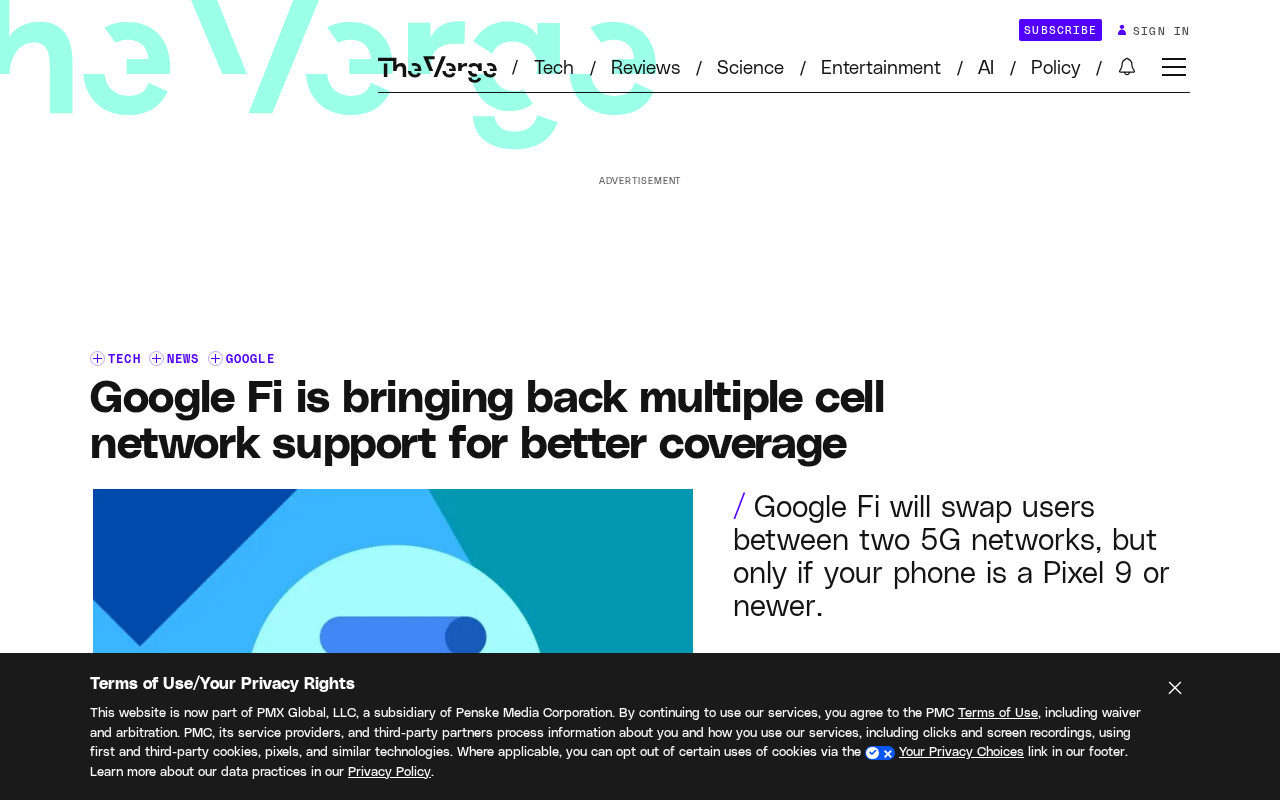
How Super Network Works
According to Google Fi's official description, Super Network continuously monitors the quality of two 5G networks and automatically switches the user's connection to the other, better-performing network when the current network's signal weakens or becomes congested. The entire process requires no manual intervention from the user; the switching logic is handled in the background by Fi's network management system.
This feature relies on eSIM technology. Users need to activate Google Fi's eSIM on a Pixel 9 or newer phone and disable other non-Fi physical SIM cards to trigger the Super Network capability. Google Fi says this is to ensure the stability and consistency of network switching and to avoid conflicts in multi-SIM environments.
From a technical perspective, Super Network is essentially an upgrade of multi-link aggregation or network selection strategy. It does not require both networks to transmit data simultaneously; instead, it dynamically selects the best connection at the connectivity layer, similar to how a phone automatically switches between Wi-Fi and cellular networks—but this time the choice is between two cellular 5G networks.
eSIM (embedded SIM) is a programmable SIM chip soldered directly onto a phone's motherboard. Users don't need to insert a physical card; they can activate service by downloading a carrier profile. Compared with physical SIM cards, eSIM supports remote provisioning and multi-number management, allowing users to store multiple carrier profiles on the same device and switch as needed. In the context of Google Fi's Super Network, the advantage of eSIM is that it allows the phone to retain access to two 5G networks simultaneously and dynamically activate one in the background without the user having to manually swap physical cards. Because physical SIM slots and eSIM may conflict over radio resources, disabling other non-Fi physical SIM cards ensures the purity and stability of the network-switching logic.
Multi-link aggregation generally refers to bundling multiple physical or logical links at the data link or network layer to increase bandwidth, reduce latency, or enhance reliability. Common forms include transmitting packets simultaneously over Wi-Fi and cellular (such as MPTCP or link aggregation), or dynamically selecting the optimal path based on link quality. Google Fi's Super Network does not require both 5G networks to transmit data simultaneously; instead, it employs a "network selection strategy"—continuously monitoring metrics such as signal strength and congestion on both links and dynamically selecting the better one at the connectivity layer. This approach is similar to how a phone automatically switches between Wi-Fi and cellular, but the switching domain is limited to two cellular 5G networks, which places higher demands on radio management and protocol stack coordination—one reason it is limited to newer models like the Pixel 9.
Why Multi-Network Support Returns Now
In its early days, Google Fi touted "multi-network" as a core selling point, capable of switching among the three major US carrier networks to provide broader coverage. But later, with architectural adjustments and changes in carrier partnerships, this feature gradually faded. The launch of Super Network can be seen as a return to that early concept, though the technical path is different—moving from reliance on multi-carrier roaming to intelligent switching between dual 5G networks based on eSIM.
This change also reflects a new normal in the mobile network landscape: although 5G coverage has expanded significantly, experience differences across frequency bands and base stations remain pronounced. Indoors, on subways, and in crowded areas, a single network may experience reduced speeds or higher latency, giving dual-network redundancy real value.
Mobile Virtual Network Operator (MVNO) refers to an operator that does not own physical network assets such as wireless spectrum and base stations, but instead leases capacity from traditional carriers through wholesale agreements and offers services under its own brand. Google Fi is a typical MVNO: it has no self-built 5G network, and its service depends on cooperation agreements with multiple US carriers. MVNOs' competitive advantage usually comes from pricing, plan flexibility, and software experience rather than network coverage itself. The significance of Google Fi's Super Network is that it uses software-level intelligent scheduling to compensate for an MVNO's lack of physical network resources—using eSIM to connect to two 5G networks simultaneously is equivalent to gaining dual-network redundancy without owning a network, thereby narrowing the experience gap with carriers that own their own networks.
Practical Significance and Limitations for Users
For eligible users, the direct benefits of Super Network are fewer coverage dead zones and improved connection stability. Especially while on the move—such as driving or taking public transit—the smoothness of network switching affects calls and streaming experiences. Google Fi claims the feature can complete switches automatically without the user noticing.
However, the feature currently has clear device requirements: it is limited to Pixel 9 and newer models and requires Fi service to run on eSIM with other SIM cards disabled. This means most existing Fi users cannot experience it for now, especially those using physical SIM cards or older Pixel devices. Google Fi has not disclosed when it will expand to other Android devices or iPhone.
In addition, Super Network currently involves only two 5G networks, and the specific carriers are not identified in the source material. Users' actual experience will also depend on network deployment in their area.
Industry Perspective: Network Aggregation Becomes a New Trend
Google Fi's Super Network is not an isolated event. In recent years, several mobile virtual network operators (MVNOs) and phone manufacturers have been exploring multi-network intelligent switching solutions, using the flexibility of eSIM to aggregate resources from different carriers. The benefit to users is potentially better coverage and redundancy, while for carriers it increases the need for dynamic scheduling of network resources.
From a competitive standpoint, Google Fi differentiates its service through software-level network management rather than relying on a single carrier's network quality. This aligns with its positioning as an MVNO: it has no wireless network of its own but can optimize user experience through intelligent scheduling. Whether Super Network can become a long-term selling point for Fi depends on the pace of subsequent coverage expansion and device support.
Network aggregation has multiple meanings in mobile communications: on the radio access network side, carrier aggregation (CA) bundles different frequency bands of the same carrier to boost single-user speeds; on the device side, dual-SIM dual-standby and dual connectivity (such as EN-DC) allow a phone to connect to two network nodes simultaneously; at the service layer, MVNOs and phone manufacturers use eSIM to enable cross-carrier multi-network intelligent switching. Google Fi's Super Network belongs to the third category—cross-carrier network selection aggregation. In recent years, with the proliferation of eSIM on iPhone and Android flagship devices, devices have gained the ability to store multiple carrier profiles, providing the hardware foundation for cross-network aggregation. Meanwhile, 5G spectrum fragmentation (low bands offer broad coverage but low speeds; mid bands offer high speeds but poor penetration) makes it difficult for a single network to maintain optimal experience in all scenarios, so cross-network redundancy has shifted from a "nice-to-have" to a differentiation tool with real value.
Conclusion
Google Fi's Super Network is a meaningful attempt that brings multi-network switching back to the core of the product, using eSIM and 5G as technical pillars. For Fi users on Pixel 9 and newer models, the feature is already available; for the broader user base, further expansion by Google Fi is needed. The network aggregation approach is worth watching, but its actual effectiveness still needs to be tested by the market.
Related articles
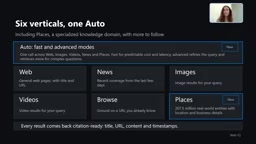
Microsoft WebIQ: Verifiable Real-Time Web Grounding for AI Agents
Microsoft WebIQ gives AI Agents real-time, citable web grounding across web, news, images, videos, and Places—164ms P95 latency, 50% fewer tokens, Scopes source control, and MCP integration.
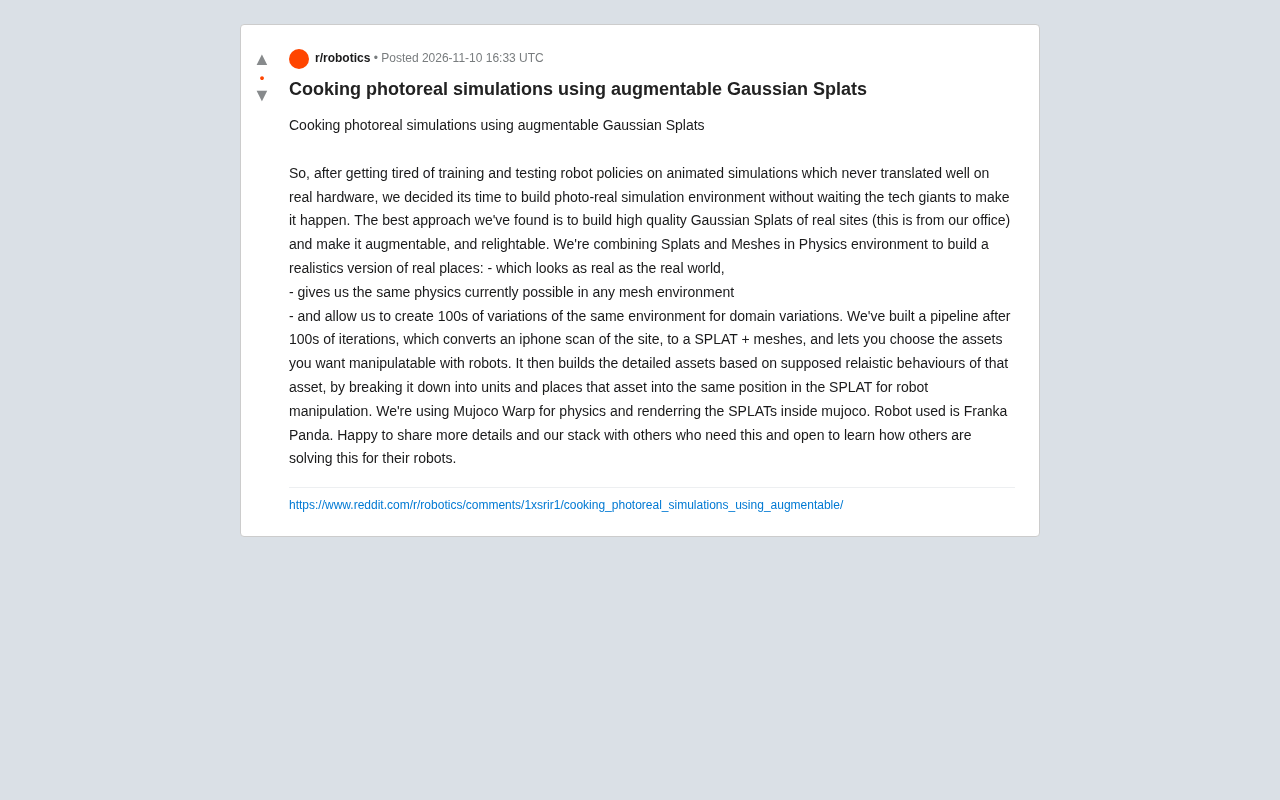
Augmentable Gaussian Splatting: Building Photorealistic Simulation Environments for Robot Training
Team combines Gaussian Splatting with meshes to build photorealistic robot simulation environments, integrating MuJoCo Warp physics and Franka Panda for augmentable, relightable real-site simulation.

Gemini 4 Carbon Released: The Leap from Gemini 3 to Gemini 4 in Under a Year
Google releases Gemini 4 Carbon, less than a year after Gemini 3. In the official demo, Carbon reverse-engineered the Theme Park binary, added a new DeepMind-themed ride, and ported it to the web in one shot.